


 Francais
 Deutsch
 Italiano
Refine Your Search
Baltimore Maryland USA 1958 stock footage and images
- Showing 15451 to 15456 of 25435 results more
more Hide
Hide
Parts and systems of electronic computers for bookkeeping, in an early 1960s computer room in the United States.
A film on bookkeeping services and use of early model computer technology to improve efficiency of banking services in the United States. A man seated at a desk while at work. Early model computer central processor in operation. A bank check being placed in the loading mechanism of a "reader-sorter" machine. The machine reads symbols printed in magnetic ink. The bank identification number of the check is checked. After checking the identification number, documents are read. Information contained in the magnetic symbols is checked. The documents are sorted. The information is placed on a magnetic tape. Close-up views and wider views of of computer magnetic tape and magnetic tape drive machines. Next, the information is processed and sent to a high speed printer for immediate examination. Man wearing glasses examines pages from the printer as it runs a continuous feed paper roll. Sorting of the documents. The documents are arranged in numerical order by the machine. A woman works loading magnetic tape reels on the tape drive machine. The master file containing complete data of each account is worked upon. Views of lights on the early model computer. The computer reads an identification number. Several information and transactions of the customers are added to previous transactions. Another master file is created using the information. It records the information of the customer account. Other information like that of overdrafts and closed accounts is also recorded. The customer statement is prepared. Customer information and opening balance is recorded from a tape. Information about the current balance is also recorded. A woman works on a reader sorter machine in operation. It sorts the checks. Close-up view of printer running continuous feed paper and printing transaction information. Tape unit containing complete information of all accounts is printed. View of an analog clock and a hour glass with sand in it. Narrator states that the computer will take 3 or 4 hours to complete the accounting for up to 30,000 daily deposit transactions, which would formerly take 60 man hours for the same operation. Views of the computer central processor unit (CPU) and views of the computer operator's console. A man seated at the console desk works. Three men wearing business suits, who are employees or officers of the Merchandise National Bank of Chicago, are seeing viewing blueprints and discussing.

African American Pastor refers to Hitler's "Mein Kampf" as he tells his church congregation about the critical stakes in World War II."
Camera pans down from the top of St. Thomas Church (1 W 53rd St, New York, NY 10019, United States) on W 53rd Street and 5th Avenue in New York City. Cars and double-decker bus are seen on the street. Views of other churches in the South. African American children entering a Sunday School. An African American Army Lieutenant in uniform and a woman sit in the balcony of a church with a predominately African American congregation. Camera focuses on the choir singing in a loft on the first floor. An African American soldier in uniform sings a solo with the choir. The African American pastor of the church steps to the pulpit and looks up at the Church's Service flag where numerous stars represent members of the congregation serving in the Armed Services. The Pastor notes that some are present that morning, pointing out Private Roberts, Sergeant Jackson, and Lieutenant Carter, all of them in Army uniforms. He also acknowledges a Woman's Army Corps member, who identifies herself as Private Parks, First Class. As the Pastor speaks, scene shifts American Joe Louis beating German Max Schmeling in their second boxing match in 1938 at Yankee Stadium. Scene shifts to Max Schmeling training with German paratroopers and Joe Louis running an obstacle course during U.S. Army basic training in World War 2. The American flag and constitution are seen in contrast to the German Nazi flag and Adolf Hitler's book, Mein Kampf, now seen being held by the Pastor of the church, as he reads excerpts from it to the congregation. Several views of church attendees listening to the Pastor, as he reads despicable remarks about African Americans from Hitler's book.
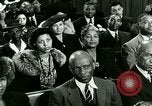
Film illustrating participation of African Americans in U.S. history from Colonial times to after the Civil War
Opening scene shows African American congregation in church, during World War 2, listening to their preacher speak about liberty. Closeup of the Minister speaking. As he refers to the seed of Liberty taking root in Boston, a plaque on the gate of the Granary Burial Ground of 1660 is shown reading: "Within this ground are buried the victims of the Boston Massacre, March 5, 1770." The gate swings open revealing the cemetery. Next, an illustration of British Redcoats shooting into a crowd on that occasion is shown. Closeup of the illustration shows an African American, named Crispus Attucks, falling as the first victim of the gunfire. A monument to him on Boston Common, is then shown. Closeup of the monument. Excerpt from a film about the Revolutionary War shows reenactment of the battle off Concord. The 221-foot granite obelisk at Bunker Hill, Boston, is seen, marking the site of the first major battle of the American Revolutionary War. A musket is seen with a sign attached reading: "Gun belonged to Peter Salem, a colored man who carried it at Lexington, Concord, and Bunker Hill, and with it shot Maj. Pitcairn." (Refers to Major John Pitcairn, a Scottish Marine officer, killed at the battle of Bunker Hill.) Illustration and painting of Peter Salem with his musket in the company of other patriots, is shown, as well as a glimpse of a mass reenactment of the battle of Bunker Hill. Next is seen the famous 1851 oil-on-canvas painting of Washington Crossing the Delaware, by the German American artist Emanuel Gottlieb Leutze. Closeup of one oarsman, identified as African American, Prince Whipple. Film Reenactment of the ragtag American army at Valley Forge in the snow, shows their suffering. Among them is an actor in the role of African American, Salem Poor, who had purchased his freedom from slavery and fought with Washington's army. A bell ringing and the American flag of 13 stars signifying the 1776 Victory. Film reenactments of pioneers including whites and African Americans working together, felling trees and building forts and barns, and the like. Scene shifts to a man of war ship under sail firing a salvo from its cannons. This is followed by illustrations of Commodore Perry in the battle of Lake Erie, during the War of 1812. In a dory with Perry is a black man named Tyler Thompson. War ships exchange gunfire. Narrator cites Perry's famous words of victory: "We have met the enemy and they are ours." Scene shifts to a painting of American general Andrew Jackson and his troops, at the Battle of New Orleans, in 1815. A battle reenactment shows a black American soldier participating. Postwar view of American ship building activity. View of a large sailing vessel. Cannon fire ushers in the Civil War in 1861 as Confederates fire on Fort Sumter. Images of combat are overlaid by the statue of Abraham Lincoln in his memorial at Washington, DC. Next, settlers are seen heading West in a wagon train. Camera focuses on a black couple who are part of the wagon train. White and African American men work side-by-side building a railroad. An early steam locomotive races along the tracks. .
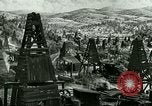
African American soldiers serving in wars, especially World War I; Memorials to African American United States soldiers.
A film on contributions of African American soldiers in various wars, but mostly focusing on World War I era. African American workers at an oil field with oil derricks talk to each other. Depiction of African Americans serving in the Spanish-American War and advancing towards a battlefield. African American man speaks about his experience of the war. Scenes of excavation and construction of the Panama Canal. Huge earth moving equipment at work and a man triggers an explosive detonation during the dig. A U.S. Navy ship underway in the newly completed Panama Canal. World War I scene of a U.S. Army unit including African American soldiers marching through a town in France, in formation, with a military band leading the march. African American soldiers of the 813th Pioneer Regiment near Marseilles France work to build a railroad. Also scenes with soldiers from the 332nd Labor Battalion, and the 808th Pioneer Regiment clearing an area near Verdun. African American soldiers of the 8th Illinois infantry (later the 370th infantry) running with the rifles as they mobilize for battle in France. African American soldiers of 371st Regiment and 372nd regiment crossing battlefield during World War I. Members of the 369th regiment in battle. Railroad guns and heavy artillery firing during World War I. American soldiers leaping from a trench and running across no mans land during battle. African American soldiers of the 369th infantry ("Harlem Hellfighters") receiving awards, medals, and citations at an awards ceremony in France during World War 1. Henry Johnson and other African Americna soldiers marching in New York City victory parade soon after the armistice ending World War I. Graves of soldiers at Arlington Cemetery as seen from a moving vehicle. Images of grave markers for several African American soldiers and officers. Two African American soldiers approaching the All Wars Memorial to Colored Soldiers and Sailors, in Philadelphia, Pennsylvania. Close-up view of the memorial and plaque on the memorial. Several other memorials in the U.S. showing African American soldiers. View of a facsimile of the 371st Infantry Regiment, 93rd Division (colored) memorial in France, near the towns of Ardeuil and Séchault. Dramatized depiction of the memorial being destroyed by the invading German Army on June 15, 1941. African American preacher speaks in a church.
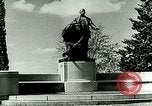
Contributions of African Americans in various fields in the United States.
(See also clip 65675078146 from different film transfer). Famous African American men and women citizens in the United States. Clip opens with of Booker T. Washington at Tuskegee University. Scene in a laboratory with African American scientist and inventor George Washington Carver, as an elderly man, working with another scientist in the laboratory. African American judge of New York city court. African American explorer Matthew Henson is seen looking at a globe (he was with Admiral Peary planting the American flag at the North Pole in 1909), and an unnamed African American surgeon at work in an operating room in New York. Next scene shows famous "father of the blues" musician and composer W.C. Handy (William Christoper Handy) smiling. Next is seen the financier and publisher of the Amsterdam News, Dr. C.B. Powell (Clilan Powell) greeting three uniformed African American women during a World War 2 war bond drive, and handing them a check (close up is shown) for 25,000 dollars, dated January 4, 1942, for the war bond drive. It is from the account of the Victory Mutual Life Insurance Company which Dr. Powell also owned. The check is signed by C.B Powell and Philip M.H. Savory (Dr. Savory was co-owner of the New York Amsterdam News). The next scene shows Elise Johnson McDougald, better known as Gertrude Elise Ayer, who was the first black full-time public school principal after the consolidation of New York City schools in 1898. She was also a noted woman writer during the Harlem Renaissance. She is seated in her office at her desk, likely in P.S. 119 in Harlem, since this is approximately year 1945 and she was at P.S 119 at that time. Her name plaque is visible on the front center of the desk. Principal Ayer smiles as a woman delivers a document to her. Next is seen the African American historian, author, and professor, Lawrence D. Reddick, serving in his role as the curator of the Schomburg Collection of African American Literature. In an art studio is seen the famous African American sculptor and painter Charles Alston, at work on a sculpture. Next scene shows the famous African American contralto singer, Marian Anderson, receiving a bouquet of flowers and smiling after a performance. This transitions to a view of African American orchestra conductor Dean Dixon leading an orchestra in a performance of Beethoven's 9th Symphony. Several views of different sections of the orchestra performing under Dixon's direction. Clip closes with brief shots of campuses of several historically black colleges and universities in the United States like Howard University, Hampton, Tuskegee, Fisk, Prairie View. An American college football game underway at the stadium of one of the colleges.
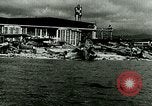
New recruits, including African Americans, commence training in the U.S. Army during World War II
Views of damage in the aftermath of the Japanese attack on Pearl Harbor, December 7, 1941. Scene shifts to African American pastor in pulpit of a church speaking about U.S. armed forces. A woman in the congregation whose son is serving in the Infantry, points to a flag filled with blue stars for service members from the church. She reads letter from her son telling her he has been selected for Officer Candidates School. View of new recruits in a railroad depot. African American recruit pauses to say goodbye to his mother, but is moved along by a uniformed Army officer. Closeup of locomotive wheels turning. Glimpse of barracks in an Army base. Recruits leaving railroad train and entering a snow-covered building. Army sergeants organizing the new recruits inside the building. An army spokesman welcomes them to the training camp. Recruits being interviewed about their past training and experiences. Closeup of a Sergeant inquiring about the kind of machine tools a recruit had worked with. Recruits assembled in a base auditorium where they hear from a Chaplain and an officer who demonstrates how to salute. (World War II; WW II; World War 2; World War Two)
CRITICALPAST.COM: About Us | Contact Us | FAQs - How to Order | License Agreement | My Account | My Lightboxes | Shopping Cart | Advanced Search | Featured Collections | Website Terms & Conditions | Privacy Policy ©2026 CriticalPast LLC.
License Agreement |
Terms & Conditions |
Privacy Policy
©2026 CriticalPast LLC.