


 Francais
 Deutsch
 Italiano
Refine Your Search
Baltimore Maryland USA 1958 stock footage and images
- Showing 4699 to 4704 of 25435 results more
more Hide
Hide
Modern housing facility with fully equipped kitchens and landscaped gardens in U.S. are compared to housing in other countries
Housing facilities and living conditions in the United States compared to various other countries. China: Men and women in boats, where they eat, sleep, work and live. North Pole: Eskimos stand with a sledge outside an igloo. Arabia: The Arabian desert. Arab tribal women and children outside a house in the desert. Homes along the canal in Holland, Netherlands. A man rows a boat in the canal. Houses along the canal in Venice, Italy. Men row gondolas. Crowded living conditions in the U.S. Pedestrians and houses in a crowded community market place. A modern community housing facility. Spacious houses with landscaped surroundings. Entrance to a home in an apartment building. A woman in a fully equipped kitchen with modern equipment and facilities. African American women work in the apartment laundry. Children play in the spacious gardens.

Construction of Liberty Ships vital to War Effort in World War 2
World War II Liberty Ships that carry war materiel like guns,tanks and planes, in the Marine Shipyard in Sausalito, California, across bay from Richmond California shipyards. View of Vice Admiral Emory Scott Land (retired), speaking about the need for ships, and more ships, for the war effort. Among Liberty ships shown are Billy Mitchell, George Chamberlain, Waslater, Cermak and Charles Summer. Ships with bow numbers 434, 432, and others lined up under construction. View of Senate bill 3500, Merchant Marine Act of 1936 authorizing merchant ship building to support commerce and National Defense. Marine architects and engineers work with blueprints and models to optimize design for fleet of merchantmen that would eventually be called "Liberty Ships." National Posters seen. One shows burly shipyard worker with sledge hammer and reads: "Swing it Brother." Another shows convoy of ships at sea and reads: "You Build ''em. We'll sail 'em." Construction begins. Timbers, plates, anchors , engines, steel blades, and other of the hundred thousand items needed build a ship. Crowds of Shipyard workers leaving after a work shift. A sign on building reads,'It can and will be done', and another, under which workers walk advertises war bonds . Shaping metal with gas torches. Fabricating ribs of steel. Spray painting. A woman welder named Mary Smith, welding with torch. Cutting steel using patterns and torches. Fabricating bulkheads. Riveting. Derricks lift heavy assemblies.
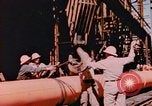
Role of Iron and steel in construction of Liberty Ships. Use of cranes for heavy construction during World War 2.
Building a Liberty Ship in California shipyards (Sausalito or Richmond) during World War II. Raising an 8-ton steel mast from which a ship's boom will extend for loading operations. The gantry crane operator seen in control cabin. A house of steel is built to sit on the deck of an attack transport ship. It is lifted with the help of crane and put into the ship. Several cranes are used to move a 100 ton, 4000 horsepower diesel engine into place in the ship's hold.
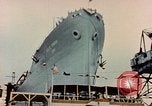
Launching, naming, and outfitting newly built Liberty Ships in Sausalito, California
A new ship, named "Bold Creek" is ready for a launch out of Sausalito California shipyards (or Richmond California). A ceremony takes place. A formation of crew members welcome guests by saluting them. The guests climb a platform and Christen the ship which slides down the ways into the water. Work commences immediately on another ship in the same place. Another ship is launched (number 22 on its bow). The yard launches 5 ships per day for two years. A ship is moved by a boat called a "sea mule." into a line of ships being outfitted. After being outfitted with everything for operation and living, a Liberty ship departs on its maiden voyage.
Preliminary steps in manufacturing steel during World War 2 for the war effort
"Making Steel for War" shows powered shovel digging iron ore out of an open pit mine. After obtaining the Iron Ore ,it is crushed and shipped to steel mills. Countless open railroad cars filled with iron ore in a marshalling yard. Iron ore being loaded into an ore carrier ship. The ship carrying the Iron Ore reaches its destination, where huge cranes with claw buckets reach in and remove the iron ore from the ship. View of steel mill complex including rail yard, furnaces, and numerous structures. Powered shovel digging limestone out of open pit mine and loading it on to conveyer. Coal being discharged from coking ovens and bursting into flames when it contacts the open air. .
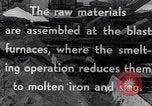
Charging and tapping a blast furnace for making steel during World War II (WWII)
The raw materials used in manufacturing of steel are carried by ore cranes and transfer cars, into a blast furnace, to be smelted. Steel workers drill out the clay tap plug, tapping the blast furnace, and molten iron runs out into runners in floor, amidst flame, smoke and fumes. A technician reads the temperature of the pour using an optical pyrometer.The molten iron creates flames, smoke and fumes as it progresses to empty into a large specially designed rail car, pulled by a locomotive.
CRITICALPAST.COM: About Us | Contact Us | FAQs - How to Order | License Agreement | My Account | My Lightboxes | Shopping Cart | Advanced Search | Featured Collections | Website Terms & Conditions | Privacy Policy ©2026 CriticalPast LLC.
License Agreement |
Terms & Conditions |
Privacy Policy
©2026 CriticalPast LLC.