


 Francais
 Deutsch
 Italiano
Refine Your Search
Berlin Germany 1935 stock footage and images
- Showing 4519 to 4524 of 6795 results more
more Hide
Hide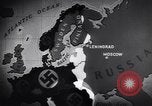
German Operation Barbarossa on the Eastern front in World War II
Animated map shows extent of German controlled areas in Europe following their conquest of the Balkans in World War 2. Norway is under their control and German forces threaten Leningrad and Moscow. A soviet defense line is shown on the map. The German attack is shown to come from 5 directions on June 22, 1941, with the launch of German Operation Barbarossa. A sky filled with German Heinkel He 111 bombers is shown. German Panzer III tanks with 75 mm guns. Army trucks carry German troops into battle. German soldiers on motor cycles and infantry advance under fire. Animated map shows principal German targets as Leningrad, Moscow, and Kiev. It then shows beginning a drive from the North to encircle Leningrad. Arrows show where German Marshal Fedor von Bock's forces drove 480 miles into Soviet territory. Slates identify cities being overrun by German invaders, including: Pskov, Novgorod, Brest-litovsk, Minsk,Mogilev, and Vitebsk. On July 17, 1941, a German tank is seen entering Smolensk, past the Dnieper River threatening Moscow, itself. To the south, German forces, under Marshal Gerd von Rundstedt, cut deep into the Ukraine. Newspapers world-wide consider the Soviet forces close to defeat. Slate shows communique from the German High Command stating: "The issue in the East is already settled. Smolensk is the last halt on the road to Moscow." German infantry marching. Scene shifts to heavy artillery being fired by Soviet forces in a snowy scene clearly later in the year. Animated map shows German forces very close to Moscow on October 15, 1941, forcing the Soviet Government and all foreign missions to move to Kuibyshev, 700 miles to the east. Adolf Hitler, in a speech on October 3, 1941, states that the enemy is broken and will never rise again. Animated map shows 500 thousand square miles of Soviet territory occupied by German forces. Views of fires burning in Russia. Damaged and abandoned Soviet industrial plants. A German guard atop a hill looks down on thousands of Soviet people in the occupied areas of Russia. Damaged and abandoned Soviet T-26 tanks. Glimpse of damaged Soviet aircraft and field artillery. Headline in New York World Telegram newspaper reads: "Berlin Admits Russ War May Last Winter." Another headline reads: "Red Army Holds Push On Moscow." Weary German soldiers traveling in horse-drawn wagons, pulling field artillery. Soviet and German war planners are seen at work. Slate quotes Adolf Hitler saying: "A single blow must destroy the enemy, without regard for losses... A gigantic all-destroying blow." German armor moving along a road. Animated map shows this technique in the German invasions of Poland, France, the Balkans, and Yugoslavia. In contrast, the Soviet planners are seen, as map illustrates how they intend to take advantage of the vast area of their land by holding lines of defense an falling back as necessary to keep engaging the invaders across interior of the Soviet Union. Soviet infantry are seen marching along a road. German troops riding atop their tanks. Soviet troops forcing German invaders into close combat in her cities. Soviet soldiers running in a city and firing heavy machine guns. Bomb damage and rubble inhibit German armor mobility in cities. Cities where this kind of Soviet resistance prevailed were: Rostov, Kharkov, Kiev, Kursk, Smolensk. German troops leaving a city with heavy black smoke rising in the background. More views of cities where Soviet troops are engaged German forces in House-to-house battles, including: Odessa, where the Old Opera Theater building is shown sandbagged and relatively undamaged. The Odessa NI tank, created from an STZ-3 agricultural tractor.
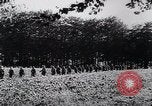
German troops fight house to house against Allied (mostly British) forces in Arnhem Netherlands during World War 2
During Operation Market Garden, German soldiers move forward on foot and on bicycles in Arnhem and other areas of Netherlands during World War II. German infantry find abandoned American and British equipment. They open a cigarette tin from their findings, share cigarettes all around, smoking and smiling. German infantry, including some very young German soldiers march along a roadway. House to house fighting between British and German forces in Dutch towns and villages of Arnhem region. Germans take British and American soldiers as prisoners and search them thoroughly. Allied POWs are marched between locations and guarded at roadsides, including near a building with sign that says "Maarland" on it (likely hamlet of Maarland, or present day Oost-Maarland). Near end of clip German narrator references Operation Berlin withdrawal and rescue effort being conducted by Allies to try to remove remaining Allied forces from the region.

President Truman and State Secretary George Marshall meet to confer on China crisis.
Secretary of State George Marshall emerges from plane in heavy rain. President Truman greets Marshall at airport. They stand together for photos and shake hands. Truman and Marshall walking and talking together beside the White House in Washington, D.C. They are meeting to discuss American policy regarding Berlin and the China crisis.
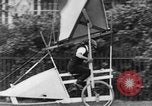
Early and historic flight: Attempts to fly ornithopters, including Gustav Lilienthal's large ornithopter.
Scenes of vintage, historic, early aviation flight attempts: Men at controls of several unsuccessful ornithopter aircraft, intended to fly by flapping wings. One man rides a bicycle equipped with wings that he flaps using sticks by his handle bars. Another sits in a tub-like machine with tricycle wheels, as it "flaps" its wings. In a third scene, men assist as operator moves very large wings on a machine. Although the wings move, the machine doesn't. This large machine might be Gustav Lilienthal's ornithopter. It had a 3 horse-power motor. Location might be Berlin's Tempelhof Airport, around 1927
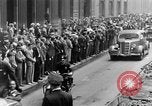
A motorcade passes a crowded street at a parade to honor Jesse Owens and other Olympic athletes
A parade honoring Jesse Owens who won four gold medals in Berlin Olympics.Other athletes are in the parade. A motorcade moves past a large crowd as ticker tape falls from buildings. Men seated on top of the car in the parade. Large crowd cheers the heroes. The street is torn up, restricting traffic to a narrow pathway. Police officer walks on construction rubble. Along most of parade route, spectators stand in the construction areas of the roadway to get closer view.
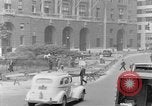
New York City parade to welcome American olympic team home and honor Jesse Owens who won 4 Gold Medals in one day.
A parade in New York City welcomes returning American olympic team and honors Jesse Owens for his outstanding performance during the 1936 Berlin Olympics. The New York City Police band plays at the parade. A motorcade follows the band. Men in cars. Two men sit on top of a car. Elevated train crosses the street above the parade which ran from The Battery to Randalls Island.
CRITICALPAST.COM: About Us | Contact Us | FAQs - How to Order | License Agreement | My Account | My Lightboxes | Shopping Cart | Advanced Search | Featured Collections | Website Terms & Conditions | Privacy Policy ©2026 CriticalPast LLC.
License Agreement |
Terms & Conditions |
Privacy Policy
©2026 CriticalPast LLC.