


 Francais
 Deutsch
 Italiano
Refine Your Search
Berlin Germany 1935 stock footage and images
- Showing 4531 to 4536 of 6795 results more
more Hide
Hide
U.S. Brigadier General Ira Eaker leads B-17 raid on Rouen, France, during World War 2
U.S. Army Air Force armorers ride atop bombs on trolleys, being pulled by a tug on an airfield in England during World War 2. Airmen gather around a bomb as one writes in chalk, "To Schicky (referring to Hitler family, Schickelgruber) this is only the start, Love, L.E.Z." Views of Airmen rolling bombs on carts under a B-17E aircraft. View from inside a B-17 as ground crews look up through open bomb bay doors. B-17 combat crewmen walking and riding bicycles, to attend a mission briefing. Inside the assembled aircrews are briefed by a British RAF officer, who says, "We're going to work. The target is XZ 462." He goes on providing details to be followed by aircrews. The crews leave the briefing room. Next, B-17s are seen taxiing out for takeoff. The lead aircraft is "Yankee Doodle" piloted by Brigadier General Ira Eaker. Another is "Stinky." Next is "Little Skunk Face."And the last one "Berlin Sleeper." Ground crews watch as the B-17 bombers take off and assemble into formation overhead. Views from inside a B-17 as bombs fall and its gunners fight off German fighter planes. Bombs seen falling and exploding on the ground and raising clouds of smoke. Glimpse of gunners firing at attacking German aircraft. Narrator states there is anti-aircraft fire all around them, that jolts the aircraft. The B-17s assemble in formation for the flight home. Back at the base, some wait atop the tower for the returning aircraft. General Ira Eaker, Chief of the U.S. VIII Bomber Command, steps from a returning aircraft, and greets Major General Carl Spaatz, Commander of the 8th Air Force. Final scene shows Brigadier General Eaker, smoking a cigar and surrounded by civilian and military reporters. ( Note: Reportedly, the B-17 "Stinky" crash landed in Athenry Co Galway Ireland on the 15th January 1943 with General Jacob Devers and a party of other Generals onboard, but none were injured and and all arrived safely at 2AM the same day, in Belleek, Northern Ireland.)
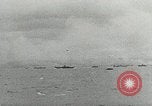
D-Day in World War II. British and American forces landing on Normandy beaches, and fighting their way inland.
D-Day invasion of France by Allied Force during World War 2. American troops wade ashore from landing crafts at Omaha Beach, Normandy. Wounded huddle together on Omaha Beach. Allied troops care for wounded on litters at the beach. Fallen American soldiers covered and lying on beach next to a dozen captured German prisoners of war. Allied ship burning offshore. Reinforcements coming from other beaches and from more landing craft. Troops wading ashore from landing craft. German soldiers firing rifles and mortars. A crashed Allied glider. "Screaming Eagle" insignia of 101st airborne Division on sleeve of paratrooper. German reinforcements of armor and infantry arriving from Berlin. British infantry leaving landing craft on another Normandy beach. They move rapidly off the beach and then fight their way inland, crawling at times. British artillery support firing. Views of British soldiers and American soldiers advancing in coastal towns of Normandy region. The steeple of a church falling to shellfire. British General Bernard Montgomery jumping down from an amphibious vehicle at a beach in Normandy. Allied troops riding armored vehicles into a French town. U.S. Air Forces P-38 fighters in flight overhead. Formation of British aircraft. Closeup of British De Havilland Mosquito bomber. Gun camera footage of Allied aircraft in close support, flying low and strafing German ships, flak towers, and fortifications. British Hawker Typhoon aircraft in action.
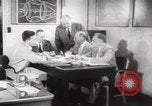
General Electric producing the first American jet airplane engine. Bell Aircraft building first U.S. jet powered airplane.
General Electric Company engineers work on designs for America's first jet aircraft engine during World War 2. In the company's plant, at Lynn, Massachusetts, machinists make parts for the engine and others assemble it. Company executives conversing about the enterprise. On April 18, 1942, the first engine produced is rolled into a test cell for operational testing. Engineers pull down the door to the test cell displaying the words: "Fort Knox." Engineers at control panel of the test cell. View into the test cell. GE Project manager, Donald F. Warner, actuates toggle switch to "on" position, and the engine ignites. Flame seen in rear of the engine. Complete change of location. View of Bell Aircraft company buildings. Bell engineers working on design of an airplane designated, XP-59A (Airacomet) to be powered by the new General Electric jet engine (later designated J-31 by the military). Views of the Bell engineering and production activities at secret facilities in Buffalo, New York. Two Bell workers expressing reservations about airplanes without propellers. A main intersection street scene in Schenectady, New York. Pedestrians walking and shopping. An F.W. Woolworth store on the corner. Copy of the Schenectady Gazette Newspaper, with headline about 500 planes raiding Berlin. A man buying a copy of the paper.
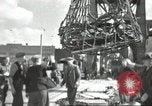
Soldiers of the British Expeditionary Force board a train in England during Battle of France of World War II.
The BEF (British Expeditionary Force) transporting to France during Battle of France of World War II. Artillery and vehicles being transported on ship at British harbor with the help of cranes. 'Jump on Berlin First Stop' written at the back of the vehicles. British Army troops march with their baggage. The British troops board a railroad train that departs from a railroad station in England. British soldiers wait on train station platform for the train to arrive.
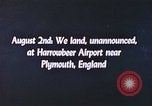
President Truman and his party at RAF Station Harrowbeer near Plymouth, England during World War II.
United States President Harry S. Truman, and his party, make unplanned stop at RAF Station Harrowbeer during return from the last 4-Power meeting of World War 2, held at Berlin in July, 1945. (Their planned destination, RAF Station St Mawgan, was fogged in. So the President instructed his pilot, Lieutenant Colonel Henry T. Myers, to land at Harrowbeer, when they saw it was clear.) Truman descends steps from the Presidential Airplane (Douglas VC-54C named the "Sacred Cow," used by Presidents Roosevelt, and Truman). Two other C-54 aircraft have also arrived (unseen). One carried Secretary of State, James F. Byrnes, who poses with the President and three members of the British WAAF (Women's Auxiliary Air Force) identified as: Section Officer Eira Buckland Jones, Corporal Clarice Turner, and Leading Aircraft Woman Audley Bartlett. Views from inside car taking members of Presidential party to Plymouth Harbor. Groups of local people wave as the car passes through the English countryside. Larger numbers of spectators line the streets of the city of Plymouth. View of Plymouth Harbor from launch taking members of President's party out to the USS Augusta, anchored in Plymouth Sound (not seen).
Atrocity victims and war crimes in the European Theater in World War II.
A film titled 'That Justice Be Done' on preparations that are made for prosecution of war criminals shortly after the end of World War 2 in Europe. The statue of the third U.S. President Thomas Jefferson at the Jefferson Memorial in Washington DC, United States. Flashback of German Chancellor Adolf Hitler addresses people at a Nazi Nuremberg Rally. Many German officers and soldiers seated in a hall and cheering with Nazi salutes. Views of civilian atrocity victims, killed by Nazi German soldiers during the war. Corpses of men, women, and children victims of mass shootings and killings. Mutilated bodies of several people on a field. Women crying. Bodies of U.S. soldiers in uniform shot in the back, in violation of established rules of warfare. Victims of Nazi prosecution. Dead bodies of emaciated concentration camp victims piled up on carts drawn by mules for burial, led by a man wearing a gas mask. View of a Nazi night rally with soldiers carrying torches. A Nazi book burning event, with brownshirt SA Nazi soldiers and civilians throwing books into a burning outdoor fire at Bebelplatz in Berlin in 1933.
CRITICALPAST.COM: About Us | Contact Us | FAQs - How to Order | License Agreement | My Account | My Lightboxes | Shopping Cart | Advanced Search | Featured Collections | Website Terms & Conditions | Privacy Policy ©2026 CriticalPast LLC.
License Agreement |
Terms & Conditions |
Privacy Policy
©2026 CriticalPast LLC.