


 Francais
 Deutsch
 Italiano
Refine Your Search
Berlin Germany 1935 stock footage and images
- Showing 5491 to 5496 of 6795 results more
more Hide
Hide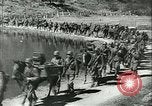
German forces invade Poland September 1, 1939, in onset of World war II.
Invading German infantry are seen advancing at a slow pace into Polish regions bordering Germany. They carry weapons and supplies on pack horses. Austrian troops and Mountaineers ascend hills and mountains on the Southern flank. Views of residents happily welcoming the invading troops in former German areas (West Prussia, Poznan, and Upper Silesia). Women and children throw flowers to German troops riding in a Sd.Kfz. 11 special motorized vehicle (Sonderkraftfahrzeug) towing an artillery piece. They throw flowers at German soldiers in a Sd.Kfz. 231 8-Rad armored personnel carrier. A group of mostly women and children wave enthusiastically from the front of what looks like a school building. Another group of welcoming residents includes several men in military uniforms. They wave as mounted German troops and horses pass. A local man tears down a Polish street sign. Crowds watch and cheer a passing German Panzer IV Ausf E with a short-barreled 75-millimeter gun. German officers riding in open staff cars are surrounded by cheering crowds as they make their way with difficulty through the throng. Crowds give Nazi salute and call out "Sieg Heil." German troops march with difficulty through the center of the crowds.
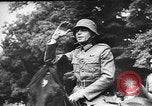
Japanese newsreel about fall of Paris, France to German forces following Battle of France, and armistice at Compiegne
Japanese newsreel covers armistice signed between the French and the Germans in Compiegne, France during World War II, after the fall of Paris during the Battle of France. A German soldier on horse back salutes. The German Army on horse back enters Paris. German troops pass through the Arc de Triomphe on parade. They march on the streets of Paris. A landscape view of Paris. German Chancellor Adolf Hitler at the Eiffel Tower near the Seine River with some officials. Hitler looks at a Nazi flag fluttering. Nazi posters and boards displayed in the streets of Paris. German troops with guns stand along a street. Ferdinand Foch's railway carriage. French and German officials enter the railway car in the Compiegne Forest (Same railroad car where Germany signed surrender in World War I). Hitler reads the armistice. The railway car in the Compiegne Forest. The railway car reads 'Voiture Restaurant' which means a dining car. German and French officials get down the dining car after the armistice is signed. Adolf Hitler and German Field Marshal Wilhelm Keitel get down the car.
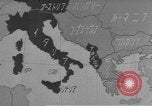
German paratroopers' airborne invasion and German Army's attack during the invasion of Crete, Greece.
Nazi Germany launches an airborne invasion of Crete, Greece during World War II. A map shows the advance of the German forces towards Crete. Airborne forces commanded by General Kurt Student advance forward. German pilots fly towards Crete. German Luftwaffe Junkers Ju 52 fly towards Crete. The aircraft drop bombs and attack. German paratroopers descend and land below. Machine gunners fire guns. Wrecked Allied aircraft. The German forces advance. German troops climb hills. German soldiers carry guns and attack Allied soldiers. Airplanes drop bombs on land. Soldiers fire artillery. Soldiers hide behind a rocky hill. Soldiers on foot march Allied prisoners (many of the POW appear to be British). The city after the invasion.
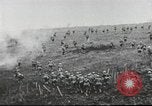
Scenes of Britain through the 20th Century World Wars and beyond; many blitz scenes from World War II
British troops on the battlefields and in the trenches of World War I. The Royal Family (King George VI, Queen Elizabeth, Princess Elizabeth and Princess Margaret) in formal appearance on a balcony. Scenes of World War II. London ablaze in the Blitz air attack by Luftwaffe of Nazi Germany. Firefighters direct water hoses on burning buildings. Funerals for dead at Coventry who were killed in the blitz. Destroyed homes in London and destroyed industry throughout Britain from blitzkrieg. A British bus upended and leaning against a building destroyed by the blitz. Many graves in British Military Cemetery. British contributions to science and technology. An early revolving radar antenna. Early jet propulsion work yielding jet powered British V-Bomber aircraft in flight. A doctor administers penicillin shot to a child patient in a doctor's office. An atomic bomb test with mushroom cloud rising.
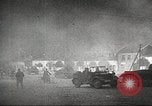
German Operation Barbarossa invasion of the Soviet Union is successful at first but then fails to defeat the Soviets
German forces overrunning Soviet cities and towns during Operation Barbarossa of World War II. View of the city, Pskov, on the Veilakaya river. A steel bridge is seen and city across it with smoke rising. German troops marching in loose formation over a bridge in Novogorod. Views of German armor and troops entering Soviet cities of Brest-litovsk, Minsk, Mogilev, and Vitebsk. View of German Panzer III tank heading toward the camera as it enters a narrow street in Smolensk. Animated map shows progress of these German advances and highlights German forces under German Field Marshal Gerd Von Runstedt attacking deep into the Ukraine. Headline on Chicago Daily News reads: "Nazis Claim Knock-out Victory" with subtitle line reading,"Moscow line cracks." Other newspapers reflect conviction that Soviet forces face imminent defeat by Germany. Slate shows communique issued by the German High Command, stating: "The issue in the East has already been settled. Smolensk is the last halt on the road to Moscow." More views of marching German troops. A battery of Soviet artillery firing from a snow-covered field. Animated map shows German forces movement close to Moscow and Foreign diplomatic representatives being moved from Moscow to city of Kuibyshev. Hitler speaking on October 3, 1941, saying "This enemy is broken and will never rise again." Animated map depicts 500 thousand square miles of Soviet territory occupied by December, 1941, and compares it to the entire west central United States encompassing the states of : South Dakota, Iowa, Nebraska, Kansas, Missouri, and Oklahoma. Glimpse of fires raising much smoke in agricultural area of the Soviet Union, destroyed industrial plants, and huge numbers of Soviet citizens under German occupation. Destroyed Soviet armor, aircraft and artillery pieces. With winter coming on, views of German forces in rain gear moving slowly through cold rainy weather. Some walk beside horses and other ride on horse-drawn caissons along with artillery pieces. Segments of film show contrast between the German military strategies. The German forces would plunge deep into enemy territory and create an area of conquest. This is illustrated by a slate bearing Adolf Hitler's statement that, "A single blow must destroy the enemy, without regard for losses, a gigantic destroying blow." An animated map reminds the viewer of the success of this approach by the Germans in Poland, France, and the Balkans. German Generals seen planning the same "Blitz" approach against the Soviets. Film shifts to the Soviet strategy, showing their military planners idea of defense in depth, with multiple lines of successively stronger defense, taking advantage of the great size of their territory. Views of Soviet troops on the move. View of Shells knocking out a German tanks. Panzer III tanks advancing. Panzer VI tanks completely covered by German troops catching rides. Soviet field artillery and machine guns firing in cities, forcing German soldiers to leave their vehicles and seek them out. Soviet cities bombed out and burning, limiting the ability of armor to navigate in them. Montage of battle scenes cities of Rostov, Kharkov, Kiev, Kursk, Smolensk, standing in the way of the Nazi blitz into the Soviet Union. Battles being waged in cities. (World War II; WW II; World War 2; World War Two)
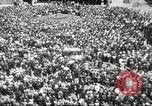
The Soviet Union is placed on a total war footing in June 1941, as the Fascist axis powers invade in Operation Barbarossa.
Soviet Union mobilizes in wake of the Operation Barbarossa, invasion by Germany and its allies in World War 2. At beginning, the film shows a large crowd of Soviet citizens gathered as they learn about the invasion on June 22, 1941, Camera pans over the crowd and shows many closeups of individuals and groups. Brief view of Joseph Stalin broadcasting to the Soviet people on June 22nd, saying, "This war is not an ordinary war. It is a war of the entire Russian people, not only to eliminate the danger hanging over our head, but to aid all people groaning under the yoke of Fascism." High speed printers produce news reports for distribution across the land. Views of men on horseback leaving a rural village to answer the call for recruits to defend the nation. Views of conscripts being marched in formation on a city street, under direction of a Soviet officer. Film emphasizes the roll of women in the war effort, showing women pasting patriotic posters on a wall. A cadre of uniformed women soldiers is seen marching along a city street past spectators. A large group of many kinds of Soviet citizens walking together, including men, women, and youths. A boy works, checking a newly manufactured rifle, in an arms factory. Boys digging with pickaxes alongside older miners in a coal mine. Women in an army unit wearing full uniforms including bed rolls. A Soviet army unit containing both men and women. A woman operating a lathe in a war plant machine shop. An old man seen along with women harvesting grain by hand, on a farm. A steam locomotive moving on a rail road. A woman at the helm of a ship. Women operating farm equipment. Soviet soldiers removing usable metal objects from a dwelling to use in the war effort. Women and children gleaning remains in a farm field. Cattle being driven to prevent their capture by the enemy. An old man with an old fashioned rifle, tanding watch over rural fields, on the lookout for German airplanes.
CRITICALPAST.COM: About Us | Contact Us | FAQs - How to Order | License Agreement | My Account | My Lightboxes | Shopping Cart | Advanced Search | Featured Collections | Website Terms & Conditions | Privacy Policy ©2026 CriticalPast LLC.
License Agreement |
Terms & Conditions |
Privacy Policy
©2026 CriticalPast LLC.