


 Francais
 Deutsch
 Italiano
Refine Your Search
Berlin Germany 1935 stock footage and images
- Showing 5497 to 5502 of 6795 results more
more Hide
Hide
U.S. Army Air Force aircraft drop supplies for Italian partisans on snow-covered fields of Italy (WW2)
United States OSS (Office of Strategic Services) Operational Group's assistance in helping to organize and coordinate partisan activities in Italy during Cayuga Mission of World War II. In support of Italian anti-fascists and anti-Nazi Germany, U.S. Army Air Force aircraft drop parachute supplies for Italian partisans on snow-covered fields.
A U.S. SI (Secret Intelligence) agent forges a document with a German Neo-Nazi symbol in the European Theater (WW2)
U.S. OSS (Office of Strategic Services) SI (Secret Intelligence) operations against Axis Powers in the European Theater during World War II. An SI agent washes a paper with 'Eagle atop Swastika' Nazi symbol of Hitler's Third Reich in Germany. The officer pours a solution and places the paper in a surgical tray. He fixes the paper on a cardboard and further examines it.
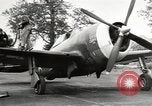
Ground crews work on U.S. Army Air Force P-47 Thunderbolt fighter aircraft in England during World War II.
U.S. ground crews work on United States Army Air Forces P-47 Thunderbolt fighter aircraft in England prior to a bombing raid on Emden, Germany by U.S. 56th Fighter Group during World War II. P-47 Thunderbolt fighter aircraft parked. The ground crew mounting an auxiliary fuel tank and loading wing guns.
With the arrival of spring life returns back to normal after siege of Leningrad in Soviet Union during World War II.
Ice melting and water flowing as Spring comes to Leningrad following winter siege by Germany in World War 2. Crosses from Nazi graves wash away into streams. Convoy trucks continue to drive on the melting ice of Lake Ladoga. Group of children in Leningrad enjoy a walk outside. A child rides a tricycle. A woman washes windows of a trolley. Point of view (POV) shot of driving trolley in Leningrad, showing controls. People board trolley. Soviet women soldiers from Army and women sailors from women's Navy corps walking. Wide shot of Leningrad with trolley running. Dancers from the famous ballet theater board a Soviet battleship. Dancers perform traditional dances while sailors play violin and other instruments. Sailors watch as dancers leave ship in small boat. Woman spits on German prisoners of war POWs as they are marched through the streets of Leningrad. Soviet citizen soldiers or militia march in procession holding rifles with fixed bayonet.
Images of signed affidavits by U.S. military personnel verifying authenticity of images of German Concentration camp scenes
Camera shows close up of two certificates of affidavit signed by Lieutenant Colonel George Stevens and Lieutenant Kellogg. The first affidavit by U.S. Army Signal Corps Colonel Stevens cites Stevens' work from 1 March 1945 to 8 May 1945 photographing concentration camps and prison camps liberated by Allied forces. It is read aloud by George Stevens (or by a narrator reading the text of the affadavit). The second affidavit, signed by U.S. Navy Lieutenant E.R. Kellogg, and witnessed by Captain John Ford, is also read aloud. It cites Kellogg's expertise in motion picture and photographic techniques through his employment with Twentieth Century Fox Studios in California from 1929 to 1941. He attests that he has thoroughly examined the concentration camp liberation films of the Army Signal Corps and found them to be unaltered, genuine, and true copies of the originals in the U.S. Army Signal Corps vaults. A map shows the location of concentration camps in Germany and other parts of occupied Europe under Nazi control. (World War II period).
German invasion of Denmark on April 9, 1940, in World War II
In spite of Non Aggression treaty with Denmark, signed by Germany, May 31, 1939, German ships carrying army troops dock in Copenhagen and offload troops, tanks and equipment in the midst of local citizens, as part of surprise invasion of Denmark, on April 9, 1940, in World War 2. Some local citizens running away from the dock area. View of German troops marching along a street in Copenhagen, as local people line the sidewalks, watching.
CRITICALPAST.COM: About Us | Contact Us | FAQs - How to Order | License Agreement | My Account | My Lightboxes | Shopping Cart | Advanced Search | Featured Collections | Website Terms & Conditions | Privacy Policy ©2026 CriticalPast LLC.
License Agreement |
Terms & Conditions |
Privacy Policy
©2026 CriticalPast LLC.