


 Francais
 Deutsch
 Italiano
Refine Your Search
Berlin Germany 1937 stock footage and images
- Showing 817 to 822 of 6871 results more
more Hide
Hide
Trial of Wolf-Heinrich von Helldorf before the Nazi People's Court for conspiracy in July 20th plot to kill Hitler
Opening scene shows Wolf-Heinrich von Helldorf, Chief of the Berlin Germany police, reviewing a contingent of police as they march past him. Scene shifts to courtroom, where he is being tried for conspiracy in the July 20th plot to kill Adolf Hitler. The venue is the People's Court (Volksgerichtshof) presided over by the Court's President, Roland Freisler, who does all the talking during the proceeding. Von Helldorf stands quietly before the court, while Freisler berates him. The court is filled with military and civilian officials.
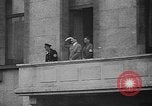
Brief views of Hitler at Nazi rallies and parades during late 1930s.
Film opens showing Adolf Hitler, in uniform, on the balcony of his new Reichs Chancellery on Wilhelmplatz (completed in 1939). He is accompanied by Deputy Fuhrer, Rudolf Hess and Schutzstaffel Leader, Julius Schrek. Supporters crowd the square and cheer them. Scene shifts to a nighttime rally, and then to Closeup of Hermann Goering on a balcony with others (unidentified). Glimpse of a Schutzstaffel brass band marching in torchlight parade and Hitler saluting from a balcony. Schutzstaffel assembled in Wilhelmplatz (77 Wilhelmstraße, 10117 Berlin, Germany). Some spectators climb a tree to get better view of events. Crowd returning Nazi salute to Hitler standing alone on Reichs Chancellery balcony. Inserted slate reads: "Memorial Day, 1936."
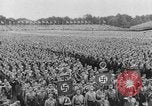
Adolf Hitler is appointed Chancellor. German President Hindenburg is honored with a military parade
Opening scene shows many thousands gathered in a Nazi rally at Zeppelin Field in Nuremberg. Adolf Hitler shakes hands with some Nazi Storm Troopers (Sturmabteilung). Next, Hitler is seen on stage with German President, Paul von Hindenburg, when he was appointed Chancellor of Germany on 30 January 1933. German troops and some sailors parade, in honor of Hindenburg, along Unter den Linden in Berlin. A contingent does goosestep march past Neue Wache. Camera records various views of the parade. A military band plays for the marchers, while standing in formation in the center of the avenue.
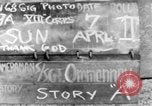
Near the end of World War II in Europe, American artillerymen fire several rounds from a 105mm howitzer
A month before the end of World War 2, in Europe, an American gun crew is seen with 105 mm howitzer set up under a camouflage net at the edge of a field next to a road near Lubbecke (Lübbecke), Germany. The gun crew is from the U.S. 326th Field Artillery Battalion,84th Infantry Division. The crew loads and fires several rounds. After the first round is fired, one crewman rubs the barrel where the name of their gun, "Berlin Bound," is painted. Local homes can be seen around the field. At end, a brief glimpse of the gun from the road, shows that it is set up close to several large German homes.
Mix of moving images and still photos showing events in life of German rocket pioneer, Reinhold Tilling
Film opens showing large cloud of white smoke rising from a rocket propelled rail car. That is followed by a series of still pictures showing various designs of German rocket pioneer, Reinhold Tilling. Next, the airplane used to test fire Tilling's rockets at altitude, in 1933, is seen, with rockets slung beneath its wings. Pilot is seen climbing into the airplane cockpit. This is followed by series of photographs taken from the ground as rockets are fired from the plane. The airplane is seen small, at altitude, in some. Scene shifts to fire raging at one of Reinhold Tilling workshops, at Osnabruck, Germany, where he and two assistants were fatally injured when gunpowder charges they were compressing for rocket engines, exploded on October 10, 1933. Slate (in German) reads German rocket pioneer engineer Reinhard Tilling shot one of his rockets, on Tempelhof Feld near Berlin, 800 meters into the air. The rocket landed 500 meters away from the launch site, on November 13, 1932. Change of scene shows men standing in a boat on Lake Dümmersee as they retrieve a Tilling postal rocket from the water. Its wings are extended in the glide position. Views of other boats on the lake and of men holding several folded postal rockets.
Montage of German rocketry scenes from 1930s through World War II. Nazi surrender. Atomic bomb. Japanese surrender
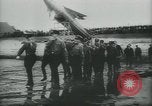
German rocket pioneer, Gerhard Zucker, attempting to develop postal rockets in the 1930s. Location is Wadden Sea off Cuxhaven, on April 9, 1933, where Zucker follows Nazi Sturmabteilung (also called SA or Stormtroopers) carrying the mail rocket across wet sands. The rocket is set up on a launch stand. Zucker and an assistant ignite the 8 side rockets and the mail rocket takes off. It noses up and loops over backwards, falling to the sand. German Stormtroopers lift up the damaged device. Next, is seen a later, more modern, rocket trial ending in failure. Two German engineers display a model similar to the pulse-jet-powered "buzz bomb" (V-1) employed by the Nazis in World War 2. A brief glimpse of similar American machine on sand flat, as narrator states German acknowledgement of knowledge gleaned from Dr. Robert Goddard's work. A German V-1 flying bomb (aka Doodle Bug) being launched in 1944, during World War 2. View of British houses of Parliament, London, England; an air raid shelter sign in City of Westminster. Londoners waiting out a raid in the shelter. Scenes of fire and destruction during German bombing of London, as narrator speaks about the more advanced German V-2 ballistic missiles employed later in the war. Londoners trudging through debris amongst bombed out buildings. Change of scene to U.S. infantry and armor advancing deep into Germany. Narrator refers to them overrunning rocket bases and other vital war-making facilities, near the end of the war. Glimpse of large number of German prisoners of war. Documents of military surrender being signed by Field Marshal Wilhelm Keitel, in Berlin, May 8, 1945. Closeup of Keitel. Scenes of American forces operating in Pacific theater. Aerial view of atomic bomb explosion. Japanese surrender ceremony on September 2, 1945, aboard the battleship USS Missouri. U.S. soldiers and other service personnel return home and greeting loved ones at end of war. Aerial view of Pentagon building and surrounding area in Arlington Virginia near Washington DC. U.S. troops boarding a ship in San Francisco, bound for war again, this time in Korea (1950).
CRITICALPAST.COM: About Us | Contact Us | FAQs - How to Order | License Agreement | My Account | My Lightboxes | Shopping Cart | Advanced Search | Featured Collections | Website Terms & Conditions | Privacy Policy ©2026 CriticalPast LLC.
License Agreement |
Terms & Conditions |
Privacy Policy
©2026 CriticalPast LLC.