


 Francais
 Deutsch
 Italiano
Refine Your Search
Berlin Germany 1937 stock footage and images
- Showing 949 to 954 of 6871 results more
more Hide
Hide
Chinese and Japanese soldiers fighting during the Marco Polo Bridge Incident.
Japanese propaganda during the Sino-Japanese War. The Marco Polo Bridge Incident battle between the Chinese Nationalist (Kuomintang) and the Imperial Japanese Army. “1937” flashes on the screen with explosion in the background. Graphics over newspaper reads, “Trouble started at Lukoukiao near Peking. When Chines troops fired on Japanese soldiers” A map depicting Beijing and neighboring cities and regions. “Lukowkiao (Marco Polo Bridge) is shown on the map. Sign reads “Lu Know Kiao”. Marco Polo Bridge (Fengtai District, China) near Beijing. The Lugou Xiaoyue monument (Wanping Bridge, Fengtai District, Beijing, China) with Chinese writings. A truck drives across Marco Polo Bridge. Aerial view of Marco Polo Bridge. Soldiers marching on a wooden bridge. Chinese women running on the street in Shanghai. Refugees loaded on a truck. A woman carrying a baby. Nationalist planes in flight, bombing Shanghai to drive out Japanese soldiers. “Chinese Warplanes rain bombs in Shanghai” reads one newspaper headline. “590 Killed..War At Shanghai’s Front Door” reads another headline. The Palace Hotel (Swatch Art Peace Hotel 23 East Nanjing Road (Bund 19), Shanghai 200002, China) in Shanghai. Debris and destroyed buildings from damage by Chinese Nationalist plane bombings. Large group of refugees leaving Shanghai. Chinese Nationalist plane in sky. Buildings on fire. “Nanyang Bros. Tob. Co. Ltd Godown No.3” building on fire. Japanese soldiers running in two straight lines. Japanese troops sit on moving truck. Japanese troops with fire hoses to put out flames. Another plane in the sky. A column of Japanese soldiers fire rifles in the air with Japanese flag behind them. Soldiers shooting anti-aircraft gun into the air.
A Japanese naval cadet meets his parents and relatives during vacation
Japanese WW2 movie with opening credits indicating it is dedicated to those who died in the World War 2 Hawaii to Malaysia naval battles. Film depicts events from 1930-1937. In 1930: an Imperial Japanese Navy cadet walking down a village road. The cadet passes in front of farm. A young Japanese farm girl rushes from house and waves to the cadet. The girl talks to the cadet. Japanese cadet walking down country road. He calls for his aunt. Cattle grazing in field. A woman, girl, and boy working in a rice paddy farm saw the cadet. The three farmers rise and warmly greet “welcome home” to the cadet. Young cadet returning salute to the farmers, who turned out to be his aunt and cousins. The woman asks her son to accompany the cadet. The farm boy joins his cousin. Cadet and the farm boy walking down country road; boy is carrying suitcase for cadet. View of a Japanese farmhouse belonging to a wealthy family. A farm field is seen in the foreground. Young cadet takes off his shoes before entering the house. Shoji doors traditional interior of a Japanese house. Japanese man and woman at home wearing kimono. The young cadet goes inside and greets his mother. The young cadet bows to his father, and they talk.
Rocket motor designs by International scientists and inventors, reflecting early work by German rocket researchers
Designs by various international scientists and inventors who have contributed to solving the problems of rocket motor development, based on the German preparatory work. Their combustion chamber designs owe much to the German pioneers in the field. Shown are design sketches by Russian scientist, Konstantin Tsiolkovsky (Ziolkowsky) in 1914; French inventor Henri Melot, in 1920; German Friedrich Zander, in 1931; Bull, 1932; The American Rocket Society, with several designs from 1932; and The Cleveland Rocket Society. Views of rocket combustion research activity by Ernst Loebell of the Cleveland Rocket Society in 1933. He is seen outdoors in the snow with his apparatus. View of Loebell's test firing stand, and a picture of an actual test firing, outdoors. Ernst Loebell with model and rocket motor from his spaceship projects of 1934 and at the International Exposition dedicated to Art and Technology in Modern Life held in Paris, 1937. Cutaway views of the spaceship. The rocket motor wrapped in cooling coils. Rocket motor design by John Shesta of the American Rocket Society, from 1934. Design by Rene Armengaud of France, in 1934 and Deich in 1935.
Implementation of the Mao Zedong led economic and social plan titled the 'Great Leap Forward' in Red China.
Postwar living conditions in the People’s Republic of China under the Communist regime of Mao Zedong (Mao Tse-Tung) photographed by Indians visiting the country. The film highlights China's problems of industry, agriculture, and excess population. Advertisements and posters for the Mao Zedong led economic and social plan titled the 'Great Leap Forward' in 1958. Objectives of the plan. Agriculture, industry, and education in China, including brief shot of men, women, and children in classroom, possibly for re-education. Men and women work in factories and plants. A Russian sign reads 'Made in the Soviet Union'. Workers inside a huge automatic automotive plant set up and supplies by the Soviet Union (SU). A steel and iron company rebuilt and enlarged with the aid of Soviet Union. A seamless steel tube mill supplied and erected by the SU. A plant designed, equipped, and built by SU technicians. A bridge over a river. Women work in a high voltage testing laboratory equipped by the East German government. A fully automatic petroleum refinery built by the Japanese. A heavy gilding machine plant started by the Japanese in 1937. Various factories, plants, and industries in China. Rural farmland and irrigation. People work in backyard furnaces, factories, presses, rolling mills and automotive factories. Deserted city streets with few cars. Workers inside an automotive plant. Communist Party of China Chairman Mao Zedong signs a pact with the Premier of the Soviet Union Nikita Khrushchev. Newspaper headlines regarding the disagreements leading to rifts in the China-Soviet relations in 1960. The Soviet Union withdraws technicians and support from China resulting in closure of industries. Statistics highlight China's dropping industrial production in steel, coal, electricity, and petroleum compared to that of USA, Soviet Union, and United Kingdom.
Film 'Why We Fight' episode "Prelude to War" depicts battle scenes in various countries during World War II.
Series 'Why We Fight' episode "Prelude to War" depicts the battles during World War II. United States soldiers parade on street lead by a band. Japanese bombing attack on Pearl Harbor, Hawaii, on December 7, 1941. The London Blitz with buildings destroyed and burning. The Eiffel Tower in Paris with Nazi flag flying atop it. German troops marching into Paris, through the Arc de Triomphe. Japanese warplanes bombing shanghai, China, in 1937. Chinese residents running for shelter. Glimpse of German "Schwerer Gustav" 80 cmrailway gun firing during German offensive against Soviet Union in 1941. German forces entering Czechoslovakia in 1938. German mounted troops entering France in 1940. Heavy guns firing. German ships en route to Norway 1940. German Ju-52 aircraft flying low over trees. Montage showing rapid succession of war scenes, including heavy guns firing, smoke rising, explosions, an aircraft shot down and crashing straight down, German armor on the move, German Ju-52 aircraft dropping paratroopers into Holland and one flying over Athens, Greece, with Mount Lykabettus in the background. More of the same with Narrator mentioning Belgium, Albania, Yugoslavia, and Russia (where citizens are seen digging anti-tank trenches and fortifications). Cavalry charging across a field. A German tank rolling forward. A German Dornier Do-17 bomber taking off, and bombs falling.
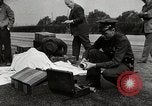
Japanese American travelers being stopped on a highway, and having their belongings searched during World War II.
Several trucks and automobiles carrying Japanese-Americans citizens are stopped and directed to the side of a highway, where policemen search their personal baggage (during time in World War 2 when the U.S. government was sending many Japanese-American citizens to internment camps or relocation centers). Police officers being directed by officials in civilian clothes, search open suitcases and other containers of clothing and personal items, laid out on the pavement. The Japanese American owners repack their suitcases after they are searched. One truck open stake truck is carrying many items of luggage and clothing rolled up and tied. These are all off-loaded and spread out on the pavement for search. A Japanese American woman stands near a 1937 Chevrolet 4-door sedan, in which children are seen looking out from the back seat. The woman helps a man roll up a bundle of clothes, as a uniformed policeman, nearby, searches another one. The woman and and two men repackage and tie the bundle with cord, as a policemen looks in the car trunk. More views of Japanese Americans with their luggage laid out on the pavement being searched. One woman has belongings tied up in a cardboard box labeled: "Sunland Biscuit Company, Los Angeles & San Francisco." Under direction of a civilian official holding a walkie talkie telephone, a policeman helps people load their belongings into an open truck after they have been searched.
CRITICALPAST.COM: About Us | Contact Us | FAQs - How to Order | License Agreement | My Account | My Lightboxes | Shopping Cart | Advanced Search | Featured Collections | Website Terms & Conditions | Privacy Policy ©2026 CriticalPast LLC.
License Agreement |
Terms & Conditions |
Privacy Policy
©2026 CriticalPast LLC.