


 Francais
 Deutsch
 Italiano
Refine Your Search
Berlin Germany 1937 stock footage and images
- Showing 1585 to 1590 of 6871 results more
more Hide
Hide
Dr. Konrad Adenauer, Chancellor of Germany, arrives in Paris for conference to determine future of West Germany
Air France DC-3 aircraft taxis to parking space after landing in Paris. Ground crewman guides it using paddles in his hands to signal the pilot. Dr. Konrad Adenauer, Chancellor of Germany, who arrived to participate in the London-Paris conferences determining the future of West Germany, is greeted by diplomats and officials as he descends from the aircraft.
Former Ambassador to the United States for Germany, Johann Heinrich von Bernstorff, leaves New York for Germany aboard the Frederik VIII Danmark.
Rear view of railroad train from Washington carrying former Ambassador to the United States for Germany, Johann Heinrich von Bernstorff. Count von Bernstorff waving from the train. Unidentified man talking to an officer, possibly Captain Thomsen of the Frederik VIII . View of the Frederik VIII as it pulls away from pier. Ship Frederik VIII in harbor. Unidentified man in bowler hat. Count von Bernstorff was allowed to depart for Germany amidst diplomatic tensions as the United States USA was preparing to enter WWI.

Caskets carrying victims of Hindenburg disaster being loaded aboard a German ship Hamburg for shipment to Germany in New York.
Dead bodies of victims of Hindenburg disaster in New York, United States. People lined up on the pier to attend the funeral ceremonies of victims who lost their lives in the explosion of German airship Hindenburg in New York, United States. Nazi flags fly at half mast after the Hindenburg disaster. A Nazi General salutes as caskets wrapped in Nazi flags lined up on the pier. United States military officers at the ceremony. A casket wrapped in Nazi flag being hoisted aboard the German ship Hamburg for shipment to Germany.
The Black Forest wooded mountain range in Germany and snow capped mountains in Austria.
Famous tourist destinations and architecture in the Black Forest, Germany and Innsbruck, Austria, before World War 2. Views of the Black Forest, a wooded mountain range. Trees on either side of the Rhine valley. The Rhine River. Farm buildings seen. Skyline of Innsbruck, Austria. The Hofkirche is seen. Snow-capped mountains in the background. View of the Clock Tower building or Stadtturm (Herzog-Friedrich-Straße 21, Innsbruck, Österreich). Buildings on either side of a street. People and vehicles on the street.
A British Royal Artillery officer, in charge of Belsen concentration camp at Lower Saxony, Germany speaks after liberation.
An officer of the British Royal Artillery, in charge of the Bergen-Belsen concentration camp operated by Nazi Germany at Lower Saxony, Germany. The officer speaks after liberation about the conditions at the camp when Allied forces reached there. Seventeen thousand prisoners buried by them. The prisoners had no food for six days and they ate turnips. The officer informs about the cook house since organized at the camp. Clip is part of Nuremberg Trials prosecution exhibit 230. (World War II period).
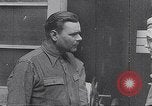
Camp guards arrested and piles of tortured dead bodies moved for burial at Bergen Belsen concentration camp in Germany
The Bergen-Belsen concentration camp operated by Nazi Germany in Lower Saxony, Germany after liberation by British Army during World War II. Narrator identifies Nazi officer by the name Kramer, as the camp commander, who is taken into custody by British troops. Guards of camp arrested by British Army. Prisoners inside the camp starved and sick, including some in a bunk house. Liberated woman weeps and kisses hand of a British soldier. Dead bodies of atrocity victims lie on grounds. Dead bodies of young women. Tortured and severely beaten dead bodies. Prisoner numbers tattooed on the arms of dead bodies. SS guards ordered to toss corpses in trucks. Immense number of dead bodies kept on open ground. SS guards toss dead bodies in a large open mass grave. German women guards at the camp walk out of a barracks, ordered to bury the dead. They drag dead bodies and throw them in a mass grave. A bulldozer sweeps piles of dead bodies in mass grave. Its operator covers his face. Pile of dead bodies swept into a mass grave. A U.S. Navy signed affidavit of authenticity of the footage concludes the clip. Clip is part of Nuremberg Trials prosecution exhibit 230
CRITICALPAST.COM: About Us | Contact Us | FAQs - How to Order | License Agreement | My Account | My Lightboxes | Shopping Cart | Advanced Search | Featured Collections | Website Terms & Conditions | Privacy Policy ©2026 CriticalPast LLC.
License Agreement |
Terms & Conditions |
Privacy Policy
©2026 CriticalPast LLC.