


 Francais
 Deutsch
 Italiano
Refine Your Search
Berlin Germany 1937 stock footage and images
- Showing 4585 to 4590 of 6879 results more
more Hide
Hide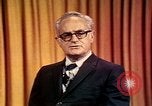
Moderator Peter Lasigor concludes and restates issues raised by Stennis and Fulbright in United States during a debate.
Moderator concludes debate on 'Role of Congress in Foreign Policies' between John C Stennis, Chairman, Armed Service Committee and William J Fulbright Chairman, Foreign Relations Committee in United States organized by American Enterprise Institute. The Moderator Peter Lasigor says that Stennis and Fulbright disagree on the issue of Congress's role in foreign policy. Stennis has said that the Congress has contributed in making 40 mutual treaties and plays a crucial role in making Foreign Policies. Stennis states the resolutions passed on the issues of Cuba, Berlin and others. Lasigor says that both of them agree on the point of reassessment. The points Fulbright raised were about the war making functions and deprivation of senate from the agreement on war issues.
Manufacture of Lancaster Bomber aircraft (KB-700) in Canada by Victory Aircraft Limited
Opens with "back the attack" 5th War Loan fundraising message of World War 2. Film title "Target Berlin" seen along with sound and images of impact of bombardment. Scenes from an aircraft manufacturing plant in Canada. A man seen in office over a telephone conversation getting news to build the bombers. Canadian men and women war production workers working in the plant talk about the manufacturing of the Lancaster Bomber. Designers,engineers and officers engage in discussion about the blueprints and drawings of the aircraft for production. Workers, engineers, and technicians manufacturing and assembling various parts of the aircraft in Victory Aircraft Limited, an aircraft production company. "KB-700" painted on the fuselage of the nearly completed aircraft.
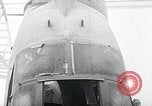
Canadian Lancaster bomber KB-700 under construction and ready for its first flight to England from Canada.
Completion of first Canadian Lancaster bomber KB-700. Workers and engineers in manufacturing plant finalize the work of Lancaster production. Overhead view of entire length of aircraft in factory while under construction. Air Force Officers inspect the built aircraft. Celebration and inaugural ceremony of the Lancaster aircraft with musical bands, cheering people visible in the background. Aircraft moves out from the aircraft factory hangar, "VICTORY" written on the top of the hangar at the plant, Victory Aircraft Limited. Flight crew members along with a dog, climb up in the aircraft. Views of interior of Lancaster bomber, main corridor, and cockpit and controls. Aircraft named the "Ruhr Express", takes off from Canada for its first flight to England. View of it flying over waters with ice. Aircraft lands on the concrete runway in London. Senior Air force officers and other dignitaries receive the flight crew members. Address from Sir Stafford Cripps, British minister of aircraft production with emphasis on the capability of the Canadian Lancaster. Air Force Officers in briefing preparing for attack on Berlin. (World War II period).
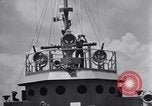
Allied Invasion of North Africa during World War II
Allied warships move towards North Africa during World War 2. A U.S. Navy sailor on a destroyer monitors sonar indicating presence of a submarine. A sailor looks through a pair of binoculars and another U.S. Navy sailor nearby has a pair of headphones. Loudspeaker signals call to general quarters. Sailors rush up the stairs. Numerous depth charges are launched and explode in the water. Next, a wide oil slick on the surface indicates the submarine has been struck by the depth charges. An officer looks through a pair of binoculars. A man speaks into a radio. Soldiers amuse themselves on a troop ship. One plays the piano and others playing play cards, read novel while eating an apple. Flags of Major General Patton and Rear Admiral H. Kent Hewitt aboard the USS Augusta (CA-31) off the coast of North Africa. Semaphore flags and signal lights communicate between ships. Soldier with 'map of West Africa' in his back pocket. Two soldiers read a language guide. An animated map detailing Plan Acrobat to invade North Africa. Map includes Casablanca, Algiers, Tripoli, and Libya. Soldiers exercise, peel potatoes and relax on a troop ship. Clothes hung on a line. British soldiers write letters home. A soldier pastes news on a bulletin board. The bulletin announces that the 'German Afrika Corps' are in full retreat. Night time aerial views of bombing of cities in Italy. Narrator states the bombing included Naples, Genoa, and Turin. Explosions and smoke on the ground below from the bombing. Aerial view of daylight bombing at lower altitude of a Renault tank factory. Submarine on surface at twilight. Eighth Army plane. General Eisenhower, General Mark Clark and French General Giraud. Night scene. Soldiers on the deck. German WWII headquarters at night with guards in Rome and at the The Reich Chancellery in Berlin. Hitler at Berghof . German switchboard, terminal, and radio communications. Messages passed between Allied ships via signal light and ship-to-ship cargo transfer. ( Note The Operation Acrobat discussed in this film is misleading. That plan was scrapped, and the Allied North African campaign was conducted as part of Operation Torch.)
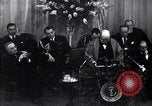
Churchill addresses people at the Westminster College in Fulton, Missouri and talks about the situation in Europe.
Prime Minister of United Kingdom Winston Churchill delivers a speech at the Westminster College in Fulton, Missouri (501 Westminster Ave, Fulton, MO 65251, United States). US President Harry S. Truman and other officials sit behind him on the stage. Churchill talks about the need to develop understanding with Russia and the situation in Europe. This is an excerpt from his speech entitled “The Sinews of Peace” (popularly known as the ‘Iron Curtain Speech’) and contains that reference. Churchill said “From Stettin in the Baltic to Trieste in the Adriatic, an iron curtain has descended across the Continent. Behind that line lie all the capitals of the ancient states of Central and Eastern Europe. Warsaw, Berlin, Prague, Vienna, Budapest, Belgrade, Bucharest and Sofia, all these famous cities and the populations around them lie in what I must call the Soviet sphere, and all are subject in one form or another, not only to Soviet influence but to a very high and, in many cases, increasing measure of control from Moscow.”
President John F Kennedy address the nation and announce increase in defense budget.
President John F Kennedy address the nation and announce increase in defense budget by 3.5 billion in Washington DC. Cameramen get ready to shoot the address. Press people hear the President Kennedy. President Kennedy says "and if war begins, it will have begun in Moscow not Berlin."
CRITICALPAST.COM: About Us | Contact Us | FAQs - How to Order | License Agreement | My Account | My Lightboxes | Shopping Cart | Advanced Search | Featured Collections | Website Terms & Conditions | Privacy Policy ©2026 CriticalPast LLC.
License Agreement |
Terms & Conditions |
Privacy Policy
©2026 CriticalPast LLC.