


 Francais
 Deutsch
 Italiano
Refine Your Search
Berlin Germany 1952 stock footage and images
- Showing 799 to 804 of 6462 results more
more Hide
Hide
United States interests in South America and Latin America just before World War 2, and German presence in the Americas
Opening scene shows U.S. State Department officials of the Division of the American Republics in a meeting. They examine a map titled "Inter-American Highway" showing a proposed highway running from the border of the U.S. and Mexico at Laredo Texas, all the way through Mexico, Latin America, and into South America. View of South American farmers loading hay into a horse cart, then of cattle in a stockyard being herded by a cowboy on a horse. Aerial view of city of Rio de Janeiro Brazil circa 1938. Narrator discusses threat of dictatorships in countries of South America. Views of German ships and German contracted ships loading and unloading at Buenos Aires harbor. Narrator describes system of barter where Argentina sends goods to Germany in exchange for German-made goods. Swastika flag on one of the cargo ships. Dock crane with German sign "Deutsche Maschinenfabrik A.G. Duisburg". Letters on side of a ship reads 'Buenos Aires Maru'. Supplies unloaded from ship. Cargo stacked including wooden boxes with German writing labeled "Vorsicht - San Paulo Brasilien". In a Latin American or South American city, view of the storefront for luxury goods by Herm Stoltz & Co. A Nazi German flag hangs above the store entrance. Fine leather goods, cameras, figurines, steins, etc from Germany are shown in store window displays. View of Nazi German books on display in storefronts, including closeup of translated book "Mein Kampf" ("Mi Lucha") by Adolf Hitler, bearing an image of Hitler on front cover. A German passenger aircraft parked at an airfield, which narrator describes as being part of a German airline offering service to South America within two days of Berlin, Germany. More German airplanes are shown at an airport in South America. View of government offices in Rio de Janeiro Brazil. Large crest with a bird atop an entrance. Interior office view of President Getúlio Vargas of Brazil seated in discussion with American diplomats. Narrator indicates that Vargas learned of German colonists in Brazil planning his overthrow by assassination, and therefore outlawed all Nazi activity. Poster of Vargas communicating his policies. Scene switches to exterior view of the State, War, and Navy Building (later the Executive Office Building) in Washington DC, with the First Division Monument in the foreground. Interior view of office door bearing sign for Under Secretary of State. Inside, Sumner Welles is seen in discussion with officials. He is asked about the American attitude toward Latin America. Welles describes the importance of strengthening ties between the countries of the Americas. Under Secretary Welles states that the welfare of all of the countries in the region may depend on their continued solidarity.
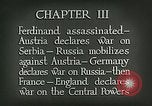
Assassination of Archduke Ferdinand becomes the prelude to World War I. Portion of funeral procession of Archduke Ferdinand.
Newspaper headline declares Archduke Franz Ferdinand of Austria and his wife Countess Sophie's assassination by a Bosnian youth in Sarajevo. The Archduke's bullet ridden uniform. The caskets carrying the bodies of the Archduke and his wife are taken to Vienna. The caskets wrapped in the Austrian flag at the port. Officers and soldiers salute in their honor. Priests lead the funeral procession followed by the caskets brought in horse carriages. Various New York newspaper headlines depicting beginning of World War I: Austria declares war on Serbia, Russia mobilizes against Austria, Germany declares war on Russia, France and England declare war on the Central Powers. Berlin: A large crowd gathered on the streets of Berlin. Mobilized German troops and band march on the streets. Crowd greets the German soldiers.
German Naval and Airborne attacks during the Norwegian Campaign of World War II.
The first phase of German assault on France and the Low Countries during World War II. Animated maps illustrate the East Prussian Corridor. Nazi swastika flags on a building in Germany. German railroads transport war material. Newspaper headlines proclaim war. Animated maps of Norway depict German aggression during the Norwegian Campaign in 1940. German naval units cruise off Norway. German sailors and troops aboard the ships and submarines German paratroopers land in Norway. German aircraft fly over Norwegian mountains. German troops in the fields during invasion. Soldiers look through binoculars. German guards outside the Reichstag in Berlin. German Fuhrer Adolf Hitler emerges onto a balcony and salutes the Berlin crowds.
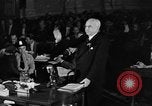
Under Secretary of State George Messersmith gives testimony about the Hans Eisler case and Dorothy Thompson to HUAC commission
Excerpts of testimony by United States Under Secretary of State, George S. Messersmith, to the HUAC (House Un-American Activities Committee) in Washington DC. Ambassador Messersmith raises his hand and is sworn in, and then seated beside his legal counsel, Norman M. Littell. Ambassador Messersmith gives testimony about Hans Eisler and Dorothy Thompson related to his own time in Berlin Germany in the 1930s on behalf of the U.S. State Department. He references his work with U.S. diplomat Sumner Welles. He says that he read the Eisler file to refresh his memory. He says that although they were not involved in the war at the time the responsibility on the State Department had increased. He talks about a case related to columnist Miss Thompson. He looks into his papers He talks about the time when he was posted in Berlin and Austria and she made a number of visits. He laughs. He tells about officers who showed prejudice in examining visa papers.

Nixon-Agnew election campaign states that Nixon will speak for United States and its citizens in the world.
Richard Nixon-Spiro Agnew election campaign for the Presidency in United States. United States citizens. A huge crowd gathered on the streets. Westminster skyline of London. Several boats in the Thames River. Champ Elysees, with Arc de Triomphe (Pl. Charles de Gaulle, 75008 Paris, France), at night. The Brandenburg Gate (Pariser Platz, 10117 Berlin, Germany) in Berlin, behind barbed wire. Lines of Russians on Red Square, in the snow. St. Basil's Cathedral in background. Leonid Ilyich Brezhnev and Soviet leaders. Chinese leader Mao Zedong and North Vietnamese leader Ho Chi Minh. Egyptian leader, Gamal Abdel Nasser. British Prime Minister Harold Wilson. Cuban President Fidel Castro. French leader, Charles de Gaulle. Hotline telephones on a table. Men seated with notepads in a press conference. Several microphones in view. Presidential Seal. Buildings and monuments in view. Washington Monument (2 15th St NW, Washington, DC 20024, United States) behind the White House. Nixon-Agnew Presidential election campaign states that Nixon will speak for United States and its citizens in the world.
Tanks and troops transported by the Military Aircraft Command during Army Reforger 76 exercise in Europe.
A civilian narrator is speaking from the Military Airlift Command (MAC) Headquarters Command Post, at Scott Air Force Base,Illinois. He mentions MAC missions supplying war materiel to Israel, in 1973, and the famous Berlin Airlift of 1948. Scene shifts to troops in military exercises, riding across fields in U.S. M113 armored personnel carriers (APCs) and walking with their weapons and gear. An M60 Patton tank moves along a muddy road, past the camera. Troops of the U.S. Army 101st Airborne division stand in formation on a ramp next to a MAC C-141 transport aircraft. They are about to be airlifted to Europe, to participate in War games, in Germany. Some of their armor and trucks seen offloading at a destination airfield. Major John Gray, Jr. of the 1st Brigade, 101st Airborne Division is interviewed, standing in front of a C-141 aircraft from the MAC 62d Airlift Wing, stationed at Joint Base Lewis-McChord, Washington. UH-1 (Huey) helicopters deploying infantry in a field and moving away as the troops advance during an exercise. M113 APCs moving past the camera. MAC C-141s landing in Germany as they airlift the U.S. troops who participate in these exercises.Several C-141s taxiing on the airfield. A MAC C-5 Galaxy aircraft with its nose hatch open and armored vehicles that it carried, parked in front of it. Closeup of turret on an M60 medium main battle tank. View of the tank being loaded into a C-5 and view inside the aircraft as the tank is maneuvered in its cargo hold.
CRITICALPAST.COM: About Us | Contact Us | FAQs - How to Order | License Agreement | My Account | My Lightboxes | Shopping Cart | Advanced Search | Featured Collections | Website Terms & Conditions | Privacy Policy ©2026 CriticalPast LLC.
License Agreement |
Terms & Conditions |
Privacy Policy
©2026 CriticalPast LLC.