


 Francais
 Deutsch
 Italiano
Refine Your Search
Berlin Germany 1952 stock footage and images
- Showing 871 to 876 of 6462 results more
more Hide
Hide
Marshall plan construction, export, and industry growth and recovery of Europe after the devastation of World War 2
British workers crowd into a dining hall and have lunch. A radio broadcast credits improvements in the British standard of living to the Marshall Plan. Examples of increase attention to developing European self-sufficiency, with advent of Marshall Plan ending in 1952. A train runs on the railway track. Men ascend on the wires above the railway track and work on them. Construction workers seek improved methods and efficiencies. They pack Camel Cigarettes in a box for the purpose of export. Cars in a showroom on which a slip indicates, 'Austin Motor Company Ltd'. The work of expansion of industries going on, with emphasis on increasing exports to the United States. Modern machines and equipment used in the work. Discussion of post Marshall Plan times in Europe.
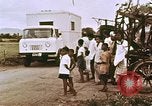
Planned Parenthood brings animated film to villages in India, creating awareness about family planning and birth control
Efforts of Planned Parenthood Federation highlight the problem of increasing population and food scarcity in India. A van arrives in a village. Children and a man stand along the side of a street. "Van donated by International Planned Parenthood Federation" IS written on the van. (IPPF was founded in India in 1952.) The van arrives in the village to create awareness among the people about the family planning and birth control. Planned Parenthood members gather to teach people in the village about the importance of family planning. View of a film projector being turned on and a film running in the projector. An animated film is shown to people regarding the family planning program. People watch the film. Some are women holding small children. The film related family size to overcrowding of the land. It shows the family of a farmer. It shows that a farmer works hard on his farm to get a good crop. When he has a big family, he will have to divide the land among many children. The animated film attempts to breakdown the belief that large families bring security and prosperity.
The Castro-led revolution in Cuba.
Film opens with bongo drummer playing and other Cuban musicians playing instruments while dancers in fetching costumes dance and enjoy themselves. Scene shifts to view from water of Havana skyline and then to automobile traffic on a busy street in a commercial district of the city. A Busy street crowded with pedestrians on sidewalks. Cuban workers leaving an industrial plant at shift end. Smoke pouring from three tall smoke stacks in background. Large machines employed in a factory. A construction worker in the cab of earth moving equipment. A field worker rotating a long wooden boom by hand. Men cutting sugar cane with machetes. A farmer opening gate to allow water into an irrigation network. View of water rushing into the irrigation ditches and entering the area of crops. A farmer using cattle to pull his plow. Cattle entering a stockyard. Shoppers at an open-air market filled with all kinds of fruits, vegetables and other agricultural products. Families of poorer people in rural areas outside of Havana. They live in shacks ahd are photographed with their small children. Next, two uniformed members of the Cuban National Police (Policia Nacional de Cuba) are seen. (The narrator mentions that Cuban people lived for 60 years under a succession of corrupt and often dictatorial leaders.) View of men in a line being monitored by a National policeman. Fulgencio Batista y Zaldívar is seen next to his wife, Marta Fernández Miranda, as they cast ballots in the 1952 Presidential election. Glimpse of several Cuban National Police lined up looking over a wall. Next, members of Fidel Castro's resistance movement are seen silhouetted against the sky, as they walk, carrying arms, in the mountain regions of Cuba. Fidel, himself is silhouetted as his men walk past him. Views of Castro's men moving through the rugged mountain terrain as shots are being fired. The combat becomes more intense. The views are from the Castro forces as they engage in fire fights with Batista forces (unseen). Machine guns are heard, and an explosion occurs. More views of the Castro forces using a machine gun and small arms. Scene shifts to a public square in Havana as it fills with people celebrating the downfall of Batista on 1s of January, 1959. Crowds surround Fidel Castro as he arrives in Havana. The crowds cheer him wildly. as the hero, and liberator of the Cuban people. Castro addresses the crowds from a balcony, promising them elections, land reform,freedom and the rights guaranteed under the Cuban Constitution of 1940. Glimpse of a copy of that document. View of Manuel Urrutia raising his hands to acknowledge the crowd, when he was named President on January 3rd, 1959. Fidel Castro arriving in New York City and greeted as a Cuban Nationalist hero. Castro waving to crowds of admirers. In Washington,DC, he is seen placing a memorial wreath at the Statue of Abraham Lincoln in the Lincoln memorial. Castro speaking at a press conference in Washington,DC. Speaking from a podium, in English, he states emphatically that he is not a communist. Castro is seen later, back in Havana at a large political gathering, where he and Che Guevara along with other revolutionaries, engage others in publicly broadcast discussions and debates. A barefoot boy is brought into the center of the proceedings, where he points an accusing finger toward someone (not clear who that person is). View inside a newspaper printing plant, as Narrator states Castro began attacks on the Press resulting in the demise of the Free Press, and its takeover by government run newspaper "HOY." View of Hoy sign in front of a newspaper building. Communist propaganda seen dominating papers and magazines at a news stand. Small bust of Lenin seen for sale.
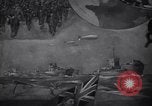
Eisenhower as the Supreme Commander of the North Atlantic Treaty Organization (NATO) and as the President of the Columbia University
Highlights the military career of U.S. General Dwight D Eisenhower from 1945 to 1952. Depicts notable World War II scenes and events starting on D-Day as Allied Forces invade France. Allied planes drop bombs on the enemy positions. Allied troops in Higgins boats land on the beaches of Normandy France. U.S. tanks move forward. Allied soldiers advance towards Saint Lo. Battle in St Lo area. General Patton Forces move forward. French troops and the soldiers of the U.S. 5th Corps march through Paris. The civilians cheer. Allied soldiers move towards the German border fighting on their way. Battle of the Bulge - when the Germans turned counter offensive. The bridge at Remagen on the river Rhine. Allied troops cross the bridge. Allied troops on the offensive, west of the Rhine. The enemy surrenders. Rubble on the streets. General Eisenhower with the troops. Military officers sign documents of German surrender on May 7 1945 in Reims at SHAEF headquarters. Eisenhower makes a speech at the end of the war. Eisenhower, in Paris, waves at the people from an open carriage. People welcome him in his homeland with a ticker tape parade in New York City. Eisenhower waves at the people gathered at the side of the streets from an open car of a motorcade. Eisenhower swears in as the 1st post war Chief of Staff of the U.S. Army. He visited troops in various parts of the world. He salutes and moves towards a car with his wife as he leaves active military life. Pictures of Eisenhower as he becomes the president of the Columbia University. He reviews the troops as he becomes the Supreme Commander of the North Atlantic Treaty Organization (NATO). Eisenhower on European soil. He enters a car. He assumes supreme command of the land, the sea and the air force. Against the threat from the USSR he prepares the European Armies. Soldiers enter into a train. He reviews troops. General Eisenhower and General Matthew Ridgway salute. He enters into a plane with his wife. Painting of Eisenhower being sworn in as President of the United States. Eisenhower Library in Abilene, Kansas, two boys leaving the Library.
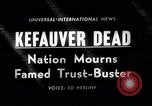
Long and honorable career of Senator Estes Kefauver comes to an end with his death.
Senator Estes Kefauver at a hearing as a Chairman of special Senate Committee to investigate organized crime in 1951. Kefauver campaigning for the Democratic presidential nomination in 1952 and 1956. Kefauver emerging from his plane and waving to crowd. Sign on plane: 'Kefauver for President' Kefauver showing his coon skin cap to the press and throwing it to them as he 'throws his hat into the ring' at start of a campaign. Estes Kefauver with Adlai Stevenson at the speaker's stand at the Democratic convention.

Timeline summary of the events and achievements of President Eisenhower's administration.
"The Eisenhower Story": A pre-election pro-Eisenhower propaganda film designed to highlight Eisenhower's qualifications for reelection as President in the 1956 election. Factory whistle blows and men entering a factory. Car chassis factory assembly line. Locomotive engineer blows train whistle and railroad locomotive with cultivators on a flat bed car. Cultivators harvesting grain. Woman carries groceries from shop to a 1950's sedan car parked on street. View of 1950's automobile highway traffic and aerial view of highways being built under his plans for highway construction and road expansion. View of Eisenhower at swearing in ceremony during his inauguration as President in 1952. In his speech, Eisenhower emphasizes that, "we stand ready to engage with any and all others in joint efforts to remove the causes of mutual fear and distrust among nations..." Newspaper headline 'Korean Truce Signed' at time of armistice during Korean War. American troops disembark ship and greet family. Secretary of State Dulles talking with German chancellor Konrad Adenauer. Secretary John Dulles seen also with British Prime Minister Winston Churchill. Eisenhower and Churchill at Geneva conference, along with Soviet leader Khrushchev and Marshal Nikolai Bulganin. Eisenhower speaks before United Nations about efforts to form an "atom pool." He notes United States "determination to help solve the fearful atomic dilemma...." Newspaper headlines 'Eisenhower Signs Sea Way Bill'. Construction of Saint Lawrence Seaway. 'Budget' and 'tax cuts' news in newspapers, including headline, "White House ends all wage controls...." Farmer plows field with tractor. Construction of new buildings and highway construction through Eisenhower programs. Views of the newly established Department of Health, Education, and Welfare. Workers filing cards in giant room of file drawers and cabinets. Nurse draws vaccine into syringe. Children are vaccinated (likely polio vaccine). President Eisenhower meets leaders from different countries at White House, including England's Queen Mother and King Paul, Queen Frederica of Greece, and Prime Minister St-Laurent of Canada. Eisenhower at press conference discussing disarmament notes importance of the "elimination of opportunity of surprise attack." View of shore towers and listening platforms and missiles rising on platforms to protect America from attacks. First nuclear submarine, the USS Nautilus (SSN-571 ) launched on January 21, 1954 by Mrs. Mamie Eisenhower in Connecticut. Plane taking off from aircraft carrier USS Forrestal (CV-59) while underway at sea. Formation of Northrop F-89 Scorpion aircraft in flight.