


 Francais
 Deutsch
 Italiano
Refine Your Search
Berlin Germany 1952 stock footage and images
- Showing 1045 to 1050 of 6470 results more
more Hide
Hide
Activities on deck of USS Augusta, during visit of President Harry S. Truman of United States to Berlin, after World War II.
USS Augusta during visit of President Harry S. Truman of United States, to Berlin, after World War II. Sailors and crew members of the ship assembled during an event. Navy band musicians play. African American man dressed as woman dances with sailors. Sailors and officials enjoy. A boxing match on a ring built on the deck of the ship.
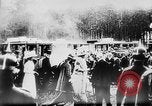
Social activities engaging German notables and wealthy, in Berlin, just before World War I
German notables and wealthy people gather upon arrival before the start of horse races at the Berlin-Grunewald race track. All fashionably dressed, men and women socialize. Several women converse with Kaiser Wilhelm II, who is in military uniform and Pickelhaube (pointed helmet). View of the racetrack, with spectators watching as horses race past. Closeup of photographers taking pictures as horses jump a barrier on the course. Change of scene shows a Zeppelin aloft and a large inflated airship being moved by a number of men, holding it down. Next, several racing cars are seen as they pass the camera, singly. Finally, carriages are seen with elegantly dressed occupants moving slowly past one another in a promenade at a park. Some of their horse-drawn carriages are bedecked in flowers. Other than ladies, the participants appear to be young military officers, including many lining the pathway on both sides.
Germany institutes measures to increase war efforts on the home front during World War II
Captured German propaganda film designed to encourage the German population near the end of World War 2. The closed Theater des Volkes (Theater of the people) in Berlin is seen at it's start. Steel gates are being pulled across the entrance of the Deutsches Opernhaus (German Opera House). Steel gates are drawn across the entrance to the Schiller Theater on Bismarckstrasse in Berlin. A sign announcing the open hours at a play house, is covered by a cardboard. Likewise a sign at an opera theater is covered. (Narrator states that Joseph Goebbels, Nazi Reich Minister of Propaganda, has been given the title: "Reich Plenipotentiary for Total War.") City trams are diverted to carry war supplies. View of men loading boxes into one. A tram pulling rail cars loaded with freight. An automobile being towed by a tram. Morale boosting slogans posted in various places. (one reads "Relentlessly determined to win victory." Another reads "With the Leader (Fuhrer) to Victory." Joseph Goebbels, addressing a rally of armaments workers in the Rhineland District, tells them (according to the Narrator) "Before we admit the enemy to German soil, and submit ourselves to his will, we will first work our hands bloody and work to our last breath." The assembled workers applaud enthusiastically. Men and women over 65 years of age are mobilized to help with the war effort and seen engaged in light manufacturing. German miners coming off shift volunteer to dig trenches and prepare earthworks. The receive tools and march to a work site. Views of men digging defenses in East Prussia where it became urgent as the Soviet army drew near in October, 1944. In another similar scene, many women are seen working alongside men building defenses. A group of Nazi officers pose for pictures ostensibly working to also dig fortifications. A huge civilian work force is seen digging deep and wide ditches to stop or delay invaders.

Germans raise the Nazi flag and put flags on the buildings to celebrate Hitler's 55th Birthday in Germany.
55th Birthday of Hitler on 20 April 1944. The Nazi flag being raised. A monument topped by German Eagle with motto engraved on its side reading (in German): Our walls are broken but not our hearts. A small celebratory parade along Unter den Linden in Berlin passes under the Brandenburg Gate. A band plays music. A woman puts the Nazi flag on a wall. Berliners place small swastika flags all about in the city, including some in the rubble of Allied bombing. A flag on a damaged building. A woman holds a banner with the slogan: Our walls are broken but not our hearts. People read newspaper. German Chancellor Adolf Hitler in a motorcade stops on a road and he is greeted by Hermann Goering. They chat in the road in front of his car. Hitler walks with Goering to Greet members of the German military high command, including: General Wilhelm Keitel; Grand Admiral Karl Doenitz; and other flag officers. Hitler then walks with the officers to review an honor guard. (World War II period).
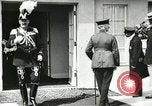
Kaiser Wilhelm II dedicates Germany's new Olympic Stadium on the 25th Anniversary of his Coronation
On June 8, 1913, the 25th anniversary of his coronation, Kaiser Wilhelm II presided over the inauguration of the new stadium (Deutsches Stadion) built near Berlin, to host the 1916 Olympics. These scenes were recorded immediately after the ceremonies. A German Admiral exits from a stadium building in Deutsches Stadion (Deutsches Stadion, Olympischer Platz 3, 14053 Berlin). Soon after, Kaiser Wilhelm II, exits, conversing with German Chancellor, Theobald von Bethmann-Hollweg. The Kaiser is attired in Hussar full dress uniform with fur busby. A German officer salutes and directs the Kaiser to athletes (German Olympic hopefuls) standing to the side, whom he introduces to the Kaiser. The Chancellor turns back into the building, and Empress Augusta Viktoria emerges and stands nearby, as the Kaiser speaks with the athletes and shakes hands with several of them. He chats amicably with the introducing officer, who smiles and salutes. The Kaiser then climbs into a waiting carriage in which the Empress is already seated. She holds a booklet or program in her hand. Attendants place a carriage robe over the Royal Couple and the carriage departs. Spectators watching the Royals are seen behind a railing at the Grunewald Racecourse track (part of the complex). The broad expanse of athletic grounds is behind them. Final scenes show many youths, walking along at the end of the ceremonies. in various uniforms (representing schools or clubs). some carry programs. some wear sashes on their outfits. Family groups are also seen. Stadium seats are seen briefly in the background to the left. A group of girls wearing dark skirts and white blouses with dark ties, are among the various small groups of youth walking together. (Note: The Deutsches Stadion was located in an area reserved as a Peoples' Park, by the Kaiser, in 1904. The property was leased for 30 years, in 1907, by the Union-Klub for the Grunewald Racecourse. But it also continued to serve general sports activities. The stadium was built on the racecourse grounds.)
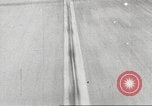
Views of the Autobahn in Germany and of various cities connected by it
Film opens showing German Autobahn highway as viewed from a moving car. Automobile wheel wells and tires seen as cars move along the highway. Cars seen range from the most modest to the grandest. Overlay identifies Leipzig and shows Der Hauptbahnhof (central train station) in Leipzig, which was the largest in Europe at the time. Roadway passing it contains all kinds of vehicles, including a tram line. Next, the city of Dresden is identified with an overlay. Der Dresdner Zwinger – Palace Of The Elbe is seen with numerous fountains. People are relaxing on stone benches. The city of Breslau is featured next. Film shows churches near the Oder River. The city of Stettin is then seen. Focus is on Waly Chrobrego (Ramparts of the Brave), named after Polish King Boleslaw I Chrobry (11th c.). Shown is a beautiful promenade located on the bank of western branch of the Odra River. It is also known as Hakenterrasse "Terrace of Haken" named after mayor of Szczecin in years 1878-1907. A motor yacht is parked at the river front. Scene shifts back to the Autobahn, again, as a mercedes benz car is photographed heading toward the camera. A stone wall with "Berlin" and it's "coat of arms," engraved on it, introduces views of that city. Aerial View of Unter den Linden showing the Palace Bridge crossing the Spee River and wooded area of the Lustgarten to the right. Across the bridge to the left is the Zeughaus ( Arsenal) the oldest building on Unter den Linden. The airborne camera pans over the central area of Berlin. Then, suddenly, a closeup of the Autobahn is seen from a car riding on it. Views from a high speed automobile, racing along an essentially empty highway. Isolated image of a Nazi monument containing an Eagle atop a wreath containing a swastika. View from low flying airplane of vehicles traveling on the autobahn
CRITICALPAST.COM: About Us | Contact Us | FAQs - How to Order | License Agreement | My Account | My Lightboxes | Shopping Cart | Advanced Search | Featured Collections | Website Terms & Conditions | Privacy Policy ©2026 CriticalPast LLC.
License Agreement |
Terms & Conditions |
Privacy Policy
©2026 CriticalPast LLC.