


 Francais
 Deutsch
 Italiano
Refine Your Search
Berlin Germany 1952 stock footage and images
- Showing 1051 to 1056 of 6470 results more
more Hide
Hide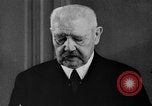
President Hindenburg re-elected in 1932. Freikorps (Free corps) active during unrest in Germany
President Paul von Hindenburg speaking briefly on occasion of his re-election in 1932. Armed elements of a Freikorps (Free Corps) controlling people exiting a building in Berlin. A large contingent of Freikorps marching on a street. Freikorps forming themselves and moving to control people demonstrating in Berlin. A parade on a city street being led by Freikorps, carrying batons. Many spectators line the sidewalk.

Flight testing of a bi-wing Berliner Helicopter in Washington DC.
Test flight of a Berliner helicopter by Henry Berliner. A hybrid airplane helicopter built by Emile Berliner and his son Henry Berliner is shown during a Washington DC test flight. It rises and move forward in short hops. The lighter weight design and high incidence large camber lower wing indicates it was likely built in 1924 or 1925 as one of the last Berliner models, following after a triplane version that was test flown in February 1924.

During a presidential election debate in the US, John F Kennedy and Richard Nixon comment on the necessity to defend Berlin.
The third Kennedy-Nixon Presidential Debate in the United States. Moderator Bill Shadel introduces the candidates and tells that candidates will not share the same platform. Republican candidate U.S. Vice President Richard M Nixon is in a Los Angeles studio and Democratic candidate Senator John F Kennedy is in New York. He also introduces the panel of correspondents who will question the candidates. The panel includes Frank McGee from NBC News, Charles Van Fremd from CBS News, Douglass Cater from Reporter magazine and Roscoe Drummond from New York Herald Tribune. Frank McGee asks Kennedy whether he would take military action to defend Berlin. Kennedy answers and says that the U.S. has contractual right to be in Berlin coming out of the conversations at Potsdam and of World War II. He states that the United States must meet its commitment on Berlin in order protect the security of Western Europe. He concludes by saying that the U.S. will meet its commitments to maintain the freedom and independence of West Berlin. Nixon disagrees with Kennedy's statement that the Republicans are trigger-happy and lead the nation into wars. He talks about the Democratic presidents who led the U.S. into wars. He concludes and states that he thinks there isn't any question about the necessity of defending Berlin.
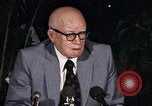
General Omar N. Bradley talks about the occupation of Berlin during World War 2 at a press conference in Hawaii.
General Omar N. Bradley visits Hawaii. The General at a press conference. He answers reporters' questions during the conference. He talks about the occupation of Berlin and dealings with Russians during World War II. Mrs Bradley is seated next to him. He speaks of fact that while U.S. forces were capable of taking Berlin, they did not because it had been pre-arranged for the Soviets to take Berlin and for the allied forces to occupy a divided city. Bradley notes that he was not going to take on 100,000 casualties by taking Berlin, only to give it back to the Soviets. With regard to the Soviets, he says, "they're not easy people to deal with."
A student group enters the Museum of the Palatinate at the Heidelberg American High School in Germany.
Activities of students at the Heidelberg American High School in Germany. A student group enters the Museum of the Palatinate (Hauptstrasse 97, 69117 Heidelberg, Baden-Wurttemberg, Germany). The student group exits. Two students pause to examine a large display of meat in a butcher shop window. A student enters "German-American Teenagers Club".

People support the French faction in an election in Saarland, Germany.
Elections to choose between the leaders of Germany and the French faction in Saarland, Germany. People enter a building to vote. People cast their votes. Placing of the votes in the ballot box. Men count the votes. People give a large support to the French faction.
CRITICALPAST.COM: About Us | Contact Us | FAQs - How to Order | License Agreement | My Account | My Lightboxes | Shopping Cart | Advanced Search | Featured Collections | Website Terms & Conditions | Privacy Policy ©2026 CriticalPast LLC.
License Agreement |
Terms & Conditions |
Privacy Policy
©2026 CriticalPast LLC.