


 Francais
 Deutsch
 Italiano
Refine Your Search
Binh Thuy Vietnam 1969 stock footage and images
- Showing 3265 to 3270 of 4373 results more
more Hide
Hide
Crowd of ethnic Vietnamese refugees near ships at pier, fleeing Cambodia
Ethnic Vietnamese refugees fleeing violence in Cambodia are evacuated to Vung Tau, South Vietnam during the Vietnam War. A crowd of refugees at a pier. A ship in the background. Many refugees gathering belongings during evacuation. View of name on stern of one ship which reads "Da-Nang". Refugees with their children waiting.
A U.S. Special Forces ordnance demolition expert conducts a class on M-26 grenade launchers for Montagnard trainees in Bu Gia.
A U.S. Special Forces ordnance demolition expert conducts a class on M-26 grenade launchers for Montagnard trainees in Bu Gia, Vietnam during Operation Switchback of the Vietnam War. SP/4 (Specialist 4th Class) Thomas Coppinger conducts a class for Montagnard trainees through two Vietnamese interpreters. Rifle grenades exploding on an impact area. The two interpreters fire M-26 rifle grenades. Explosions on the impact area.
Montagnard trainees throw M26 grenades during a class conducted by U.S. SP/4 (Specialist 4th Class) Thomas Coppinger in Bu Gia.
U.S. Special Forces ordnance demolition expert SP/4 (Specialist 4th Class) Thomas Coppinger conducts a class on M26 grenade launchers for Montagnard trainees in Bu Gia, Vietnam during Operation Switchback of the Vietnam War. Montagnard trainees throwing M26 grenades. Explosions on an impact area.
Realistic example: U.S. Army 1st Battalion 87th Infantry prepares for a night operation.
Night vision techniques and the use of metascope and starlight scope by the United States Army. Relaistic example of a night operation. Command post of the Alpha Company, 1st Battalion, 87th Infantry. Captain Wald briefs Sergeant King about a night mission to be conducted the same night. Soldier on the radio nearby. The two officers draw and mark the route on a map. Captain Wald salutes the Sergeant and gets on the radio. Animation shows the functioning of a starlight scope, a portable battery operated telescope. Includes the functions of illumination and magnification. A soldier prepares for the night mission. He walks up to a log and sits behind it. He mounts the starlight scope onto the rifle, selects a target, takes a comfortable position with support and then turns the power switch on. After that he takes aim, adjusts the eye piece focus and the range focal ring, and fires.
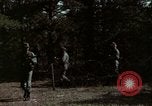
Realistic example: U.S. Army patrol reaches the Listening Post and scans the area for danger during a night operation.
Night vision techniques and the use of metascope and starlight scope by the United States Army. Relaistic example of a night operation. 2100 hours: 1st Battalion, 87th Infantry patrol clears the parameter. Sergeant King checks if the soldiers' eyes are adapted to darkness. Animation depicts parts and operation of camera, parts and functioning of human eye, comparison between the two, and functioning of rods and cones. Listening Post (LP): Sergeant King confirms the patrol's coordinates, the LP in turn alerts the headquarters that the patrol has passed his position. An illuminated object falls from the sky to the ground. The soldiers cover one eye to retain night vision in the same. They advance through the jungle. A soldier sights danger area and signals the patrol to halt. Soldiers sit on the ground and scan the area. Scanning includes short, abrupt, irregular movement of the eyes over and around the area every 4 to 20 seconds. A stream in the area.
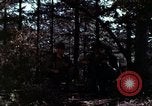
U.S. Army soldiers employ night vision principles and night vision devices for a successful night operation.
Night vision techniques and the use of metascope and starlight scope by the United States Army. Relaistic example of a night operation. Sergeant King obtains a starlight scope to scan the opposite bank.. Point man receives instructions for crossing the danger area. Soldiers advance. Soldiers in prone position takes aim with both eyes open above the barrel, and fire. One soldier signals to the rest. Two soldiers by the road. They take out a starlight scope and look through it. Sergeant King decides to continue and the patrol moves across. A soldier signals with a torch. They move through the jungle. Sergeant King radios the Company Commander about their approach into the parameter. Point man scans the area with a starlight scope to locate the friendly patrol. Recognizing the patrol leader's signal, the guard signals him to move forward. The patrol moves ahead while the guard continues to scan. The patrol returns, mission accomplished. Soldiers employ the night vision principles of scanning and off center vision, as well as night vision devices for successful night operations.