


 Francais
 Deutsch
 Italiano
Refine Your Search
Bizerte Tunisia 1943 stock footage and images
- Showing 157 to 162 of 3126 results more
more Hide
Hide
German occupation, martial law, and Danish resistance in Denmark during World War II
Film about Denmark after the Nazi German occupying force declared martial law and state of war with Denmark, in 1943-44 during World War 2. It was made by Danes and smuggled out of Denmark during that period. Opens with view of a church building and flocks of birds. Views of German army troops marching into Copenhagen, Denmark on April 9, 1940. SS troops dressed in black, marching. German soldiers carrying rifles with fixed bayonets, goosestepping. A fire burning at site sabotaged by Danish resistance elements in 1943. Derailed trains carrying goods to Germany. Fire at a German factory. Danish workers with bicycles staging a strike in protest German measures in response to resistance actions. Danes gathered in outdoor observance memorializing those killed by the Germans. A shop owned by German sympathizers (Quislings) destroyed by other Danes. People gathered on street on 29 August 1943, when the occupying German forces attacked the remaining Danish garrison and declared martial law. Announcement posted in Danish on a wall. View of Danish Naval vessels ordered scuttled by the Danish Admiralty, including the coastal defense ship,Peder-Skram, seen in front of a large building, the submarine, Havfruen (not seen) and others seen sunk at docks in Copenhagen harbor. Bullet hole through a glass window. A week later, on Sunday, 5 September, 1943, a German Panzer light tank is seen moving on a street, as pedestrians go about their business in Copenhagen. German soldiers patrolling on a motorcycle with sidecar. A man holding his hands up as he is hustled through a crowd under arrest by a German in black uniform (possibly Gestapo or SS). Motorcycle driving through pedestrians on the sidewalk. Spectators line a fence by an open field near a building labeled "Badstue Badminton." One, a woman, speaks through the fence to a Danish soldier interned there. View of the quarters of the Royal Guard at Rosenborg, occupied by German soldiers and with Nazi flag flying above it. Civilian relatives of interned men wait outside army headquarters for news about them. A courtyard, during a mass funeral, is filled with memorial flower wreaths covering the coffins of Danish soldiers and civilians killed by the Germans. Camera focuses on a wreath from King Christian of Denmark, among the many others. Two German soldiers march up a path at the Royal Residence Amalienborg, where King Christian is arrested. Views from moving camera as Danish flags are seen flying all over the city of Copenhagen, on 26 September, 1943, to celebrate the King's 73rd Birthday. The major exception is the Nazi Gestapo headquarters in the "Shellhus" (the prewar Shell Oil offices) shown in isolation. Views of people moving their belongings on hand carts after their homes were taken over by Germans. The slogan in English, "Do it well and do it now,"is seen left by Danish resistance fighters where they sabotaged a German military installation.
Condensed highlights of U.S. forces engaging Japanese in Pacific island-hopping campaign (WW2)
Aerial view from high altitude, shows convoy of American warships underway in the Pacific War in 1943 (World War II). Nearest ship seen is an aircraft carrier. Illustrated globe and animated map show a Naval Task Force headed through the Gilbert and Marshall Islands. Three U.S. Navy Douglas Dauntless dive bombers seen flying in formation with an aircraft carrier steaming in the background. Glimpse of more aircraft carriers. Sailors in the powder handling room of the Cruiser USS Chicago (CA-29) carrying cylinders of powder for her 8-inch guns. Sailors, stripped to the waist, in one of her gun turrets, load an 8-inch shell and powder charges into the breech of one of Chicago's guns. Interesting view from below, as they close the breech and step back as the gun fires. Glimpse of Naval guns firing from a U.S. warship. Another view of sailors loading an 8-inch gun on the USS Chicago. (Note: The USS Chicago was lost between Rennel Island and Guadalcanal in the Solomon Islands on 30 January 1943.) A Baltimore Class Cruiser firing its guns. Flashes from naval guns firing from several American warships in close succession. Fire directed at the shore of a Japanese held island. Gun camera footage from a U.S. warplane strafing Japanese aircraft on the ground at an enemy air base. More gun camera footage of strafing and bombing. Closeup of a U.S. Army Air Forces B-26 Liberator bomber in flight, with others in the background. Views from U.S. Aircraft as their bombs strike Japanese targets on the ground below. A U.S. Navy TBF Avenger aircraft flying overhead as viewed from a landing craft. View from inside a landing craft full of U.S. troops heading toward an amphibious landing. Closeup glimpse of Coxswain in landing craft and troops aboard behind him. Amphibious landings being made under fierce friendly and enemy fire. U.S. troops leaving their landing craft under enemy fire. Marines firing small arms, machine guns, and using hand grenades, in Tarawa, Kiribati. Views of fallen Japanese defenders on Tarawa. Closeup of Marine smoking a cigarette. Another is binding shoulder wound of a buddy. American flag raised on one of the few still standing palm trees. American Marines saluting the flag. Bodies of fallen American marines floating at the shore and on the sands of Tarawa. Marines departing Tarawa. Scene shifts to Chinese Kuomintang (KMT) leader Generalissimo Chiang Kai-Shek, seated with President Franklin D. Roosevelt and British Prime Minister Winston Churchill at Cairo, Egypt on 25 November 1943. Leading Allied military leaders sit at a table to hammer out details of postwar plans. American officers present include U.S. Army Chief of Staff George Marshall and Chief of the Army Air Forces, General Henry H. ("Hap") Arnold.

"Operation Husky" - the invasion of Sicily in World War II.
July 10, 1943, U.S. invades Sicily in Italy. Fleet of warships underway. Navy bombardment of Sicily. Coast Guardsman observes through binoculars. Coast Guardsmen carry troops and supplies in LCVPs (Higgins Boats). LST-356 approaching Blue Beach 2, in the "Cent" area on July 10, 1943, loaded with tanks and other vehicles. A beach master signals with semaphore flags. Troops landing from assault boats. Concentrated enemy air attacks destroy U.S. boats and ships. Enemy aircraft in flight. U.S. troops firing. A map shows Italy. September 9, 1943, amphibious assault on Anzio, Italy. Naval bombardment, followed by troop assault on the beaches.

American workers and OSS in World War 2 work to estimate the loss of German military manpower in battle.
Film outlines process of U.S. military and War Department to estimate the German military manpower losses from 1939-1943 during World War II. Scenes of German military forces in battle. German tank on the battlefront smashes down a tree and German soldiers follow, running behind it. Dead bodies of soldiers lay on the battlefield. Airplane falling from sky to ground after being hit. German Soldiers fire rifles during battle. German soldiers carry wounded on litters and German medical staff treat the wounded soldiers. A wounded soldier on a hospital bed. Nurse leans over hospital bed and talks to a wounded soldier. A study made to find out the number of soldiers returning to their jobs after being injured. A man reads a magazine which reads: 'Estimate of non battle causalities'. German soldiers march through Arc de Triomphe in Paris during occupation of Paris by Nazi Germany. Headline of a newspaper reads: 'Germans silent on Russian gain'. Brief scene of Soviet leader Stalin speaking at a microphone. Cavalry soldiers, likely Soviet, crossing a battlefield. Scenes of World War I German troops being reviewed by officers. Civilian or OSS men lean over a German map and discuss among themselves. They study the map. Scene of men and women at a German news stand buying German newspapers in order to obtain obituary information. OSS personnel translate casualty reports from German newspapers to help estimate deaths of German soldiers and determine force strength. An operations room with American staff analyzing German newspapers. View of a Boeing 314 Clipper Flying Boat aicraft taking off from water. The reports from World War I and II, allied forces, chart, graphs and NARS computers used to estimate German Army's manpower loss. African American women workers operate keypunch machines recording battle casualty statistics which yield punch cards for further data analysis. Punch cards being created and being loaded in sorting and reading machines bearing brand "International" (for International Business Machines or IBM). A document entitled "analysis of obituaries." Man in an office studying a map and a document. A woman helps him as she enters numbers into a Remington Rand adding machine. They estimate the officers killed in war and the number of the killed enlisted men, in order to estimate the total battle loss. They compare the data of soldiers missing, killed, wounded, and unfit for duty from 1939 to 1943.
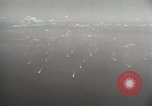
American campaign against Japanese-held islands in the Pacific during World War II
U.S. sea power in the Pacific Theater during World War II. Aerial view of landing craft speeding through the water below. Animated map of Pacific Islands including the Solomons, New Britain, and New Guinea. Shows arrows depicting American amphibious assaults on Russell Islands in February, 1943; on New Guinea, and Rendova in June, on New Georgia in July, on Eastern New Georgia in August, on Choiseul, in October, and Bouganvillle in November, 1943. Aerial view of a Pacific Island airfield. Grumman F4F aircraft with engine running on an aircraft carrier. Bow view of an American Essex class Aircraft Carrier making way in heavy seas. A Douglas Dauntless airplane heading away from a carrier (in background). Map showing locations of American North and South Pacific naval forces and arrows pointing to Tarawa Atoll in the Gilbert Islands, and then to the Marshall Islands (Kwajalein Atoll and Enewetak Atoll). American infantry marching with full field packs, at a port, where they board transport ships. An artillery field piece being loaded on the ship, along with landing vehicles tracked, and army trucks. A convoy of troop ships and supply ships at sea.
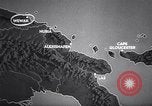
USAAF B-24 Liberator bombers drop 1000 lb demolition bombs over Nubia in World War II.
1943: An animated map depicts the strategic Japanese air and shipping base at Nubia in Papua New Guinea, during World War Two. 25 August 1943, Nubia: USAAF 5th Air Force B-24 Liberator bombers drop 1000 lb demolition bombs, from 16,000 feet, over Nubia. They target bivouac and supply areas. That afternoon, U.S. B-25s, flying low to the ground, make strafing attacks against the Japanese airfield at Nubia. United States soldiers unload jeeps, bulldozers, scrapers and other construction equipment in an abandoned Japanese airfield at Nadzab. U.S. 5th AAF constructing their air base. USAAF C-47s bring Australian infantrymen to the new base.