


 Francais
 Deutsch
 Italiano
Refine Your Search
Bizerte Tunisia 1943 stock footage and images
- Showing 163 to 168 of 3126 results more
more Hide
Hide
Various war scenes showing Soviet counteroffensive against German forces during Battle of Stalingrad (WW2)
Battle scenes outside the snow covered city of Stalingrad, Russia, Soviet Union, as Soviet forces attack German forces that had encircled the city. Aerial view of Soviet Sukhoi Su-2 light bomber aircraft as it releases bombs on Nazi German positions. Soviet soldiers on the ground using flame throwers against German positions. Three Soviet RF-8 (GAZ-98) Aerosled (aircraft engine powered ice sled) are seen racing by camera position over snow covered terrain. Large batteries of Katyusha rocket launchers fire rockets toward German positions. Soviet soldiers advancing across open fields. Map depicting how Axis power was squeezed in early 1943 and defeated by the Soviet forces that had encircled it during Operation Uranus in late November 1942. Scenes of ruined city of Stalingrad from bombing in World War 2. A soviet soldier covers an artillery gun barrel after it fires a last shot in February 1943. Powerful sceneshowing bombed out Stalingrad buildings and one large building on fire, with a lifesize outdoor art sculpture of happy Soviet children playing in a circle in the foreground. Soviet civilians greet and embrace the defending Soviet soldiers and fly a Soviet flag. Group of German soldiers waving a white flag emerge from a blockhouse and surrender as prisoners of war to Soviet soldiers. Contingent of senior German generals and officers under Friedrich Paulus are seen during surrender, including General Walther von Seydlitz-Kurzbach. General Arthur Schmidt, General Maximilian von Daniels, and General Edler von Daniel.
Italian Co-Belligerent Army. Truck loaded with Italian soldiers and barracks bags driven to town in Italy.
Troops of Italian Co-Belligerent Army. The Italian First Motorized Group, the first Italian unit to fight alongside the Allies after the armistice of September, 1943, moves to the front in early December, 1943. Italian soldiers stand on roadway. They look at maps and talk. Two soldiers with dog. Italian officer speaks to the soldiers. Soldiers listen to officer, holding pen and papers. Soldiers unroll telephone wires. Soldiers load barracks bags on truck. Truck loaded with soldiers drives past. Men wave the soldiers. A convoy of trucks moves along road. Civilians with carts move in opposite direction. Trucks parked in Italian town. A soldier waves the flag. Soldiers talk with civilians. Soldiers stand on sidewalk. Trucks cross bridge. (World War II period).
Trucks loaded with Italian soldiers of the Co-Belligerent Army pass signs in Italy.
Soldiers of the Italian Co-Belligerent Army. The Italian First Motorized Group, the first Italian unit to fight alongside the Allies after the armistice of September, 1943, move to the front in early December, 1943. Trucks loaded with soldiers driven. A convoy of trucks and jeeps moves along road. Soldiers seated in trucks with guns. Trucks pass signs of nearby towns: 'Venafro-Mignano' and 'Pietravairano'. (World War II period).
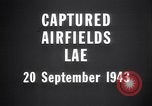
Destruction from Allied bombing at Lae airfield, New Guinea. B-25s fly bombing missions against Japanese targets in Wewak area.
Opening slate gives date as September 20, 1943. Scenes show devastation wrought by Allied bombing of the Japanese airfield at Lae, New Guinea. Most views are from the ground, as Allies occupy the field. Numerous Japanese aircraft are destroyed along with all the buildings and facilities. Next, is shown the view from inside a B-25 bomber, on September 27, 1943, as it flies in a 100 aircraft bombing mission to attack coastal facilities, ships, and airfields in the Wewak area, including the main air base at Wewak and its satellite fields at Boram, Dagua and But. Several B-25s are seen ahead in formation. View of the coastal area below as the camera plane (B-25) comes under fire by Japanese anti-aircraft guns. A pall of smoke hangs over the Wewak area from bombing by B-24s earlier. view from cockpit as the B-25 makes very low strafing and bombing attack against the Japanese satellite airbase at Boram. Another B-25 seen as it flies close to the ground. View to the rear shows small parachutes being released by the B-25, carrying single 100-lb fragmentation bombs and 23-pounders in clusters of three. The fragmentation bombs explode amongst palm trees sheltering Japanese aircraft. view out the back of the camera B-25 shows it continuing to fly, just over the tree tops, at very low altitude. Next, several B-25s are seen rejoined up in formation, ahead. Scene shifts to view from high altitude of bombs striking in the Wewak waterfront area. View from below of three B-25s in formation. Then view from cockpit of a B-25 flying low over the water strafing a ship. (Narrator says they dive low to skip-bomb a ship trying to escape.) Various views of the high hills at the waterfront. View from B-25 strafing Japanese aircraft on the ground at Dagua and Boram airfields. several B-25s in formation headed home. (World War II period).
Echelon of three B-24 aircraft of 98th Bombardment Group "Pyramidiers" in flight following raids on Naples and Messina Italy
Interior of B-24 aircraft. Muzzle of .50 caliber gun. Waist gun window and gun sight. B-24 aircraft flying. View of B24D "Snow White and the Seven Dwarfs" in flight (SN 41-11913 of the 98th Bombardment Group, the B-24 Liberator unit nicknamed the "Pyramidiers". This aircraft went down May 1, 1943 after flying into another aircraft in a cloud). Front part of B-24 over muzzle of .50 cal gun. Aerial views of B-24s flying. B-24 named "The Witch" seen (SN 41-11840 of the 98th BG "Pyramiders". This aircraft was lost August 1, 1943 in Operation Tidal Wave raid of Ploiesti Romania oil refineries). Artwork on both of the above "Snow White and the Seven Dwarfs" and "The Witch" was painted by Amos Nicholson. Clip closes with echelon of three B-24s seen. Footage shot during return to base following bombing mission over Naples and Messina, Italy. (World War II period).
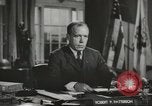
American Undersecretary of War speaks to difficulties facing Allies in confronting Germany and Japan in World War II
Undersecretary of War, Robert Porter Patterson, Sr. speaks about a report from the General staff outlining the needs for combating Germany and Japan in World War 2. He cites Operation Husky, the invasion of Sicily, as an example of what will be needed. He continues to narrate in the background as an animated map appears showing the buildup of supplies and Allied forces in North Africa; Allied air forces flying 60 thousand sorties over Sicily and, the direct amphibious assault using 3,200 vessels. Map also depicts opposing forces of 12 (“unwilling”) Italian Divisions and 3-1/2 German Divisions. View of Allied troops carrying some of their 31 thousand casualties on stretchers from field ambulances. Allied medics attending to the wounded. Some are seen lying on stretchers in a row on the ground near a wall. Interior of a field hospital where surgeons and other medical personnel treat the wounded. Animated map shifts to Europe with Germany at its center, showing , in contrast to Sicily that was only an “outpost,”, the heavily fortified perimeter of Axis controlled areas; the axis industrial might; and the disposition of 300 German Divisions (mostly on the Eastern front) defending the region. Next, the map illustrates Japan’s defended regions in the Pacific Image returns to Undersecretary Patterson i n his office, speaking of the Allied offensives planned for next year (1944), and emphasizing their challenge and difficulty. Scene shifts to General Jonathan Wainwright and his garrison at Corregidor, in the Philippines, surrendering to Japanese forces in 1941. Japanese military camera pans over the Americans being taken prisoner. Other Americans and Filipinos are seen being marched together under guard. Scene shifts to classic views of the Japanese attack on Pearl Harbor, Hawaii, on December 7, 1941. View of Japanese soldiers executing two Chinese civilians in 1937. Dangling bodies of persons hung by Nazis during Operation Barbarossa in Russia, in 1941 A Russian soldier comforts a little girl as he escorts her across a snowy landscape. Time bomb left by German forces retreating from Naples, Italy, in 1943, blows up a Post office building . Views of damage to building and bodies of victims. American Military Police assisting a victim. American soldiers carrying an injured civilian on a litter. Scene shifts to British Foreign Minister, Anthony Eden, Soviet Foreign Minister, Vyacheslav Molotov, and U.S. Secretary of State, Cordell Hull, entering a hall in the Spiridonovka Palace, during the 1943 Moscow Conference in Russia. Close-up of the American, Soviet, and British flags on a table. View of many delegates seated around the table. Close-up of Molotov, Eden, and Hull signing conference document.