


 Francais
 Deutsch
 Italiano
Refine Your Search
Bolinas Beach California USA 1934 stock footage and images
- Showing 10663 to 10668 of 26867 results more
more Hide
Hide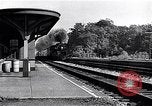
Vignette about importance and value of family members working together
Members of a 1950s American family at their places of work and sharing time at home together. Steam locomotive pulling passenger train at high speed past a railroad station, without stopping. A railroad employee arriving at office relieving another employee finishing his shift. The employee engaged in various tasks at the rail office. He places a package on platform as another high speed passenger train passes. Hills and lake in background. Scene shifts to several boys playing at a swimming hole. One lying on ground, playing a recorder musical instrument, jumps up, waves goodbye to friends, and rides away on his bicycle (past a man using a scythe). Closeup of name: "Gazette Building," on building. The boy arrives there, picks up papers, and rides off again to deliver them in his job as a newspaper delivery boy. Views of town streets and shops. Two women window shop and discuss a sewing machine on display. Change of scene to woman serving at counter in a restaurant. She serves coffee to a customer and carries milk shakes to two boys and two girls at a table. The girls discuss dresses pictured in a magazine. Next, the waitress is seen looking at a fancy dress in a shop window. Next is a classic 1950s image of a family at home in the living room: A mother, father, boy, and grandmother, in their living room at home. Both women do needlework, husband smokes a pipe and reads newspaper, and son reads lying on floor. Father and son start game of checkers, and son blows on his recorder. The housewife suggests getting a sewing machine. Her husband speaks of saving to paint the family house. Mother points out things she could make and save thereby save money. All discuss the matter, and the boy volunteers to contribute some of his earnings to the family, too. Suddenly, the waitress (older daughter in this family) appears showing them her new dress. The father objects to the purchase and the girl leaves. The family is distressed and members try to soothe one another. A phone call causes the mother and father to leave suddenly. They find their daughter distraught sitting alone on bleachers in stadium. They hug her and all leave together. They return to their wood frame home, where grandmother hugs the daughter. The family sits around the kitchen table and reconciles together, with the grandmother dispensing wisdom in the process.

President Dwight Eisenhower answers questions in ninety-fifth Press Conference at White House.
Newsmen and journalists from around the world entering a conference room showing identification cards in the ninety-fifth Press Conference at White House. President Dwight Eisenhower on mike answering questions raised by journalists. A woman journalist asks a question. Reporters writing in notebooks. President speaks about the Constitution of United States of America. Further he says that violence in any form is not acceptable.
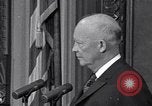
President Dwight Eisenhower speaks about changes in Sugar Act at a Press Conference in White House.
President Dwight Eisenhower on mike answering questions raised by a journalist about changes in Sugar Act, related to Cuba's sugar quota. Reporters writing in notebooks. Close view of President replying. He says United States of America has always been friendly with Cuban people. Journalists applaud and start moving out.
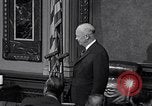
President Dwight Eisenhower replying to questions raised by journalists at the ninety-fifth Press Conference.
President Dwight Eisenhower at mike answering questions raised by journalists at a conference at White House. View of conference where journalists are seated. Journalists writing on notepads.
President Eisenhower at ninety-fifth press conference at White House replying questions related to 'Suez Controversy'
Newsmen entering the conference room. Views of journalists and newsmen seated. President Dwight Eisenhower arrives to answer the questions. Press cameramen at the conference. President replies questions raised about United States approach to 'Suez controversy' and also mentions about the 18-Nation proposal rejected by President Nasser of Egypt. He replies to a woman journalist saying that America will not get into any war unless Congress declares a war.
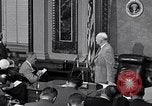
Press Conference at White House where President Dwight Eisenhower answers questions regarding segregation disputes.
During Civil Rights movement in America. Press corp taking notes. A reporter asks President Eisenhower to comment on aspects of State-Federal responsibility in the segregation disputes relating to incident just a day before in Texarkana when the town did not allow two African American students into the school where they had registered. The reporter asks if the President thinks that is a case where the federal government would become involved. President says that Federal District Court can call in Justice Department to bring evidence, review the case, and determine if a party is in contempt of a federal circuit court order regarding integration. The President also decries the violence that occurred in Texarkana in the case. He implores the states to ensure the laws are followed and to follow rulings of the courts. He praises the integration work by school Superintendent Omer Carmichael in Louisville, Kentucky, over two years. Close up view of hand of a reporter writing notes in a notebook during press conference. A reporter from National African American Press asks question to President regarding segregation and regarding the President's statement that changing of traditions and the hearts of men will unfortunately take a long time, is not the solution of the present disorder in many parts of the south over desegregation, that citizens must be restrained from expressing their prejudices in public actions when such public actions are in violation of the law. President Eisenhower says that the local court must determine if someone is in contempt of that court.
CRITICALPAST.COM: About Us | Contact Us | FAQs - How to Order | License Agreement | My Account | My Lightboxes | Shopping Cart | Advanced Search | Featured Collections | Website Terms & Conditions | Privacy Policy ©2026 CriticalPast LLC.
License Agreement |
Terms & Conditions |
Privacy Policy
©2026 CriticalPast LLC.