


 Francais
 Deutsch
 Italiano
Refine Your Search
Bolinas Beach California USA 1934 stock footage and images
- Showing 19333 to 19338 of 26867 results more
more Hide
Hide
Serology unit of the FBI laboratory gathers and analyzes blood samples from a crime scene
Technicians working at the serology unit of the FBI (Federal Bureau of Investigation) laboratory. A technician collects blood sample from a shirt belonging to a suspect. The examiner drops benzidine reagent and dilute hydrogen peroxide into the blood sample in cotton swab. The blood sample turns blue. The examiner writes down notes and cuts a sample from the shirt for microchemical hemoglobin test. He places the sample on the microscope slide. The examiner applies a reagent on the sample in the microscope slide. The slide is warmed before being placed under a microscope. The examiner uses the microscope. Red crystals indicating the presence of hemoglobin found under a microscope. The examiner runs test for origin and blood group of the sample. The examiner also gathers samples from the unstained part of the cloth. The samples are placed on test tubes which are placed on a rack. The examiner marks the locations where the samples were taken in the clothing. The examiner writes notes on his worksheet. Blood serums are added to the samples. The rack containing samples are placed inside a refrigerator overnight. The examiner brings out a vial containing liquid blood sample from the same refrigerator. The liquid blood sample is centrifuged, and samples are gathered for a liquid blood grouping slide. Testing solutions are added to the samples. The slide is agitated to expedite the grouping reaction. The examiner reads the slide through a microscope. The examiner brings out vials of samples from blood-stained fabric gathered the day before. The test tubes are placed on the centrifuged machine. Blood samples on vials are placed in small rack. The examiner determines blood sample to be of human origin. Centrifuged grouping samples are placed in grouping slides to determine blood type. Examiner reads samples microscopically. A technician fills out a worksheet. Law enforcement officers read a laboratory report from the FBI.
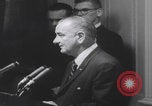
Lyndon B. Johnson speech on Vietnam War; scenes from World War II and Korean War
United States President Lyndon B. Johnson delivers a speech at a news conference in July 28, 1965 during the Vietnam War. President Johnson quotes a letter from a woman in the Midwest, "Dear Mr. President: In my humble way I am writing to you about the crisis in Vietnam. I have a son who is now in Vietnam. My husband served in World War II. Our country was at war, but now, this time, it's just something that I don’t understand. Why?”. United States Army soldiers in a Vietnamese jungle. A crying Vietnamese child. A man sits in front of a fire in the middle of a ruined house. Fascist leaders Adolf Hitler and Benito Mussolini during a parade in Munich, Germany. Flags of Nazi Germany and the United Kingdom. British Prime Minister Neville Chamberlain disembarks from in Munich for the Munich agreement. Nazi German guards turn their heads in unison. Adolf Hitler and Neville Chamberlain walk together. Crowd civilians perform the Nazi salute. Hitler and Mussolini in balcony. Neville Chamberlain reads the “Peace For Our Time” speech. “We regard the agreement signed last night and the Anglo-German Naval Agreement as symbolic of the desire of our two peoples never to go to war with one another again” Chamberlain said before smiling. Ruins of a bombarded city in Europe during World War II. Mussolini gesturing strongly during a speech. Cavalry soldiers on horseback in Ethiopia. Royal Italian Army fighting in Ethiopia during the Second Italo-Ethiopian War. Italian soldiers firing with a Fiat-Revelli M14 machine gun and advancing in field. Emperor Haile Selassie I of Ethiopia protests Italian aggression in the League of Nations. A stylized Nazi eagle statue in Austria. Austrian soldiers during the German Anschluss of 1938. Hitler and Austrian politicians perform the Nazi salute in Vienna. Explosions from night bombardment during the Korean War. Communist Chinese People's Liberation Army troops firing with Chinese Type 24 Maxim Water-Cooled Machine Gun and rifles in Korea. Soldiers’ feet climb and jump up uneven terrain in the battlefield. United States Army M46 Patton tanks pointing upwards and firing at enemy positions. An M46 Patton tank and trucks of the United Nations Forces crossing the 38th parallel line in Korea. Sign denotes the 38th parallel line. President Johnson continues his speech at the White House. “Why must young Americans, born into a land exultant with hope and with golden promise, toil and suffer and sometimes die in such a remote and distant place? The answer, like the war itself, is not an easy one, but it echoes clearly from the painful lessons of half a century. Three times in my lifetime, in two World Wars and in Korea, Americans have gone to far lands to fight for freedom. We have learned at a terrible and a brutal cost that retreat does not bring safety and weakness does not bring peace. It is this lesson that has brought us to Vietnam.” President Johnson said.
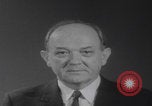
President Johnson addresses the public at a news conference about the Vietnam War
President Lyndon B. Johnson addresses the United States public at a White House news conference about the Vietnam War on July 28, 1965. “We do not seek the destruction of any government, nor do we covet a foot of any territory. But we insist and we will always insist that the people of South Vietnam shall have the right of choice, the right to shape their own destiny in free elections in the South or throughout all Viet-Nam under international supervision, and they shall not have any government imposed upon them by force and terror so long as we can prevent it… We do not want an expanding struggle with consequences that no one can perceive, nor will we bluster or bully or flaunt our power, but we will not surrender and we will not retreat,” says President Johnson,
Crowds gather to watch the arrival of a Sunset Limited train
Early historic moving images show crowds gathered to watch the arrival of a Southern Pacific Railroad Co. Sunset Limited train in Southern United States. They wave as the railroad train moves past them. Another train passes in the opposite direction.
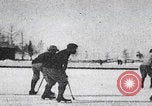
Young men playing ice hockey in winter in late 1800s
Young men playing ice hockey on frozen lake in the United States. The players swing their hockey sticks as they try to hit the puck toward the goal.
New York Journal "Buccaneer" dispatch boat leaves the United States to cover events of the Spanish-American War
The "Buccaneer" dispatch boat of the New York Journal steaming through the water, having aboard war correspondents assigned to cover the Spanish-American war. The dispatch boat sails rapidly in the water.
CRITICALPAST.COM: About Us | Contact Us | FAQs - How to Order | License Agreement | My Account | My Lightboxes | Shopping Cart | Advanced Search | Featured Collections | Website Terms & Conditions | Privacy Policy ©2026 CriticalPast LLC.
License Agreement |
Terms & Conditions |
Privacy Policy
©2026 CriticalPast LLC.