


 Francais
 Deutsch
 Italiano
Refine Your Search
Bolinas Beach California USA 1934 stock footage and images
- Showing 337 to 342 of 26917 results more
more Hide
Hide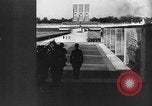
Nazi Party ceremonial grandeur is contrasted to the horrors perpetrated under the 3rd Reich
6th Nazi Party Congress at Nuremberg, in 1934, featuring a "Totenehrung" ceremony, honouring dead. Nazi SA ( Sturmabteilung) and SS (Schutzstaffel) troops in precise formations fill the Zeppelin Field Luitpold Arena, leaving only a wide pathway to the Ehrenhalle war memorial. View from behind honor guard standing at the Ahrenhalle, as Adolf Hitler, flanked by SS leader, Heinrich Himmler (in Black) and Viktor Lutze, head of the Sturmabteilung (SA), approach. Three huge banners with swastikas are seen in the far background. Scene shifts to 1945. American troops are now assembled at the main grandstand (Ehrentribüne) of Zeppelin Field. The American flag covers the wreathed swastika sculpture at the top of the Grandstand. View of German soldiers, who have been mustered out, mingling with civilians in a town. Some speak with an American soldier, who is part of the U.S. occupying force. Scene shifts to the Yalta conference in February, 1945. Winston Churchill, Franklin D. Roosevelt, and Joseph Stalin are seen seated while their most senior military staff members stand in the background. Allied leaders sit around a large conference table. U.S. Secretary of State James F. Byrnes, sits near Prime Minister Winston Churchill. Scene shifts back to Nazi era. Joseph Goebbels, Reichminister of Propaganda is speaking and haranguing a crowd. In contrast, German soldiers are seen conversing with occupying American soldiers. This is contrasted with more scenes of Nazi leaders giving impassioned speeches to a hall filled with Nazi faithful. German soldiers, prisoners of war are seen directed by U.S. military police, behind a barbed wire enclosure. Large numbers of German prisoners of war in an open holding area. Closeups of some. Bucolic scenes of farmers working in fields and herds of sheep and cattle. Hitler speaking in a forceful, animated way and haranguing an audience of rapt listeners. German civilians standing quietly in a group. (Narrator refers them being the people of Beethoven, Goethe, and Martin Luther, as statues of those iconic Germans are shown.) In dramatic contrast, numerous dead bodies of victims are being shown to German citizens by American troops, at Nordhausen, Buchenwald, and Bergen-Belsen concentration camps. This is contrasted against views of German people folk dancing in traditional costumes, German contributions to science (view of Albert Einstein speaking) and industry (view of professional glass blowers at work). Glaring contrast shows German civilians moving the body of a concentration camp victim; several civilians being shot dead by a firing squad (unseen); Rudolf Himmler; and an image Germany being destroyed, as result of the Nazis. American soldiers are loosely assembled in an open field. by the Elbe River at Torgau, Germany on 26 April 1945. American and Russian officers greet each other at the site, where their armies have met in World War 2. American and Russian soldiers mingle and greet one another. Views of Allied forces entering Germany. Another scene of victims' bodies stacked at a concentration camp. French soldiers examine stake where prisoners were tied and executed in the Gestapo headquarters on Paris France. Other views of the Gestapo prison, where victims were buried. Examples of torture devices used to coerce information from prisoners. More views of stacked bodies of victims. Germans carrying bodies from a concentration camp. General Dwight Eisenhower and General George Patton visiting the Ohrdruf Concentration Camp. Burned remains of victims. Closeup of General Patton. German officials and citizens confronting horror as they are compelled to walk through the camp. A huge wagon loaded with bodies of the dead. German women appalled and repelled by the sights. Countless numbers of dead victims covering a large courtyard. German citizens compelled to carry body of a victim from the yard. Others carrying bodies of victims. Large numbers of German citizens, seemingly shamed and remorseful at the revelations. A group of German men carrying shovels and others carrying crosses to commence burying the victims appropriately. Men carrying victims bodies in open wooden caskets along a road lined with spectators. Coffins of victims laid out in a cemetery. (Narrator alludes to them never forgetting.) German men gently place covered coffins in a long mass grave.
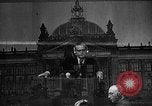
Footage after Reichstag fire, and of rearmament of Germany presented during the Nuremberg Trials in Nuremberg, Germany.
Nazi rise to power, rearmament and remilitarization of Germany leading up to World War 2, and actions related the Nuremberg Trials held at the Palace of Justice in Nuremberg, Germany, following World War II. Exterior view of the Reichstag in Berlin. Joseph Goebbels at desk during the Nuremberg Trials. Hans Bernd Gisevius, former official of the Berlin police administration, testifies concerning his investigation of the Reichstag fire. Hans Gisevius relates how Goebbels recruited reliable Nazis to intentionally burn down the Reichstag as a propaganda stunt to help the Nazi movement. Nuremberg War Trial defendants stand in their dock including Herman Goering, Rudolf Hess, Joachim von Ribbentrop, Wilhelm Keitel, Karl Donitz, Erich Raeder, Baldur von Schirach and Fritz Sauckel. Close up of Herman Goring. Footage showing firefighters spraying water on smoking ruins of Reichstag following Reichstag fire in 1933. A German police officer stands guard at the smoking ruins of the Reichstag. View from a high ridge of League of Nations Palace of Nations in Geneva, and then inside the League of Nations meeting chamber during the disarmament conference of 1933. View of a German Kriegsmarine submarine launching in 1934. Steel mill operations and Industrial war materiel operations in Germany in the early 1930's as Germany rearmed and restarted war production. A Nazi party meeting in Germany where General Werner von Blomberg announces compulsory military service. View of legal document describing new military service law. View of newly recruited (conscripted) civilian German men with suitcases marching forward report for mandatory military training. Nazi forces in training march goosestep at training camp; Junkers 52 aircraft in background. Soldiers goosestep while walking bicycles in a line. Nazi troops trained. Scenes of remilitarization of Rhineland, violating terms of the Treaty of Versailles, as Nazi troops in 1936 march over the Hohenzollern Bridge crossing the River Rhine, with Cologne Cathedral rising in the background.
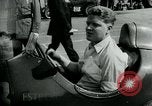
Japanese and French confer in Hanoi; war materiel supplies to China cutoff at Yunnan and Canton; British forces departing Shanhai
Clip opens with unrelated brief two second view of Frank Griswold, winner of 1940 New York World's Fair road race, waving from behind the wheel of his 1934 Alfa Romeo Tipo B after the race. Scene changes to views through the fertile countryside of French Indochina on a trip to Hanoi early in World War II. Narrator notes Hanoi is a principal supply hub for war materiel destined for General Chiang Kai-shek; supplies which the French have now interrupted at the request of Japanese authorities. A train arrives at station in Hanoi. People at the station. Views of downtown buildings of Hanoi and a market place. Street vendors selling foods and goods. A woman carrying a basket on her head. Rickshaw pullers at work behind several people seated at a street-side outdoor cafe. Narrator notes views are proceeding toward the central park where the residence of the head of the new government is located. Views of a couple in formal suit and dress strolling in the park. Major General Nishihara, head of the Japanese mission, is seen exiting a building following talks with the French Governor-General. Scene changes to Lao-Kai (or Lai Cai), a border station between French Indochina and China, where narrator says supply inspectors from Japan have traveled to examine the situation. View of the Yunnan railway with railroad tracks cut off by the French authorities, and guarded by local indigenous soldiers with conical hats (nón lá). Scene changes to the harbor at Canton China. Large ships anchored in harbor. Barrels or drums on the ground near docks, as narrator notes that large quantities of war supplies no lie idle and unusable on the port docks. Scene changes to Shanghai. A procession of forces from Great Britain on parade at a racecourse or stadium, and in the streets of the city, including uniformed bagpipers. Narrator notes it marks the end of British supremacy in China, with the first contingent of British troops departing Shanghai.
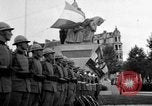
Dedication and unveiling of Memorial to King Alexander I of Yugoslavia. Military parade in Yugoslavia.
Troops lined up near flag draped monument in Yugoslavia. Crowd gathered for the ceremony. The flags are removed as drums roll, revealing the monument statue. French official gives dedication address.(Note: King Alexander was assassinated in Marseille, France, and French Foreign Minister Louis Barthou, was also killed in the same event, in 1934.) Troops stand at attention. Troops march.
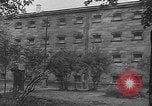
Post World War II trials of German and Japanese Leaders for war crimes
Film opens with exterior view of Nuremberg cell prison, just north of the Palace of Justice, holding war criminals for the Nuremberg Trials. Interior view showing cell bloick area and guards patrol the halls. Cell door with name Karl Doenitz on it. Views of German Admiral Doenitz and Admiral Erich Raeder, looking over war planning charts. Ships burning at sea in nighttime. Glimpse of German U Boat Captain observing through periscope. Back at Nuremberg Prison, an American soldier checks cell of Joachim von Ribbentrop. German Foreign Minister von Ribbentrop seen on steps of an airplane. Scene shifts to Nazi–sponsored so-called American Rally in Madison Square Garden, New York City, on February 20, 1939. A huge picture of George Washington dominates the stage where drummers play while flag-bearing marchers fill the stage. View of audience of 20 thousand persons, rendering Nazi salutes. Someone trying to interfere with the activity is quickly subdued on stage by men in military style uniforms. Scene shifts back to Nuremberg prison, where a soldier guard passes food through cell door to Julius Streicher (unseen). Closeup of Streicher speaking to crowd of people in Germany. Views of German Paramilitary Brown shirts (Storm troopers, or Sturmabteilung) during boycott preventing people from patronizing Jewish merchants. Next, victims liberated from Nazi concentration camp are seen being sprayed in delousing powder by American soldiers. Back at Nuremberg prison, a soldier stands outside the cell of Hermann Goering. Next, Goering is shwon in a scene eating at an outdoor table with other men, at a Nazi-sponsored public feeding event before World War 2. Brief view of German Chancellor, Heinrich Bruening, who fled Germany in 1934 as the Nazis were coming to power. A Graf Zeppelin airship, bearing Nazi Swastika insignia, is seen in flight over New York City. Crew member inside the Zeppelin, looking out a window as he plots a position on a chart. The Zeppelin casts a shadow over an ocean liner at sea, as it passes overhead. Back at Nuremberg cell prison, a guard opens a door with a key. Next seen shows several prisoners walking into a prison yard at an unidentified prison. A firing squad (unseen) is heard marching into position and firing their guns. Scene shifts to Japan, where a Japanese twin engine passenger plane is seen overhead, coming in for a landing. Official buildings are seen in Tokyo and jurists who will participate in war crimes trials. Scene shifts to war crimes trials authorized in Manila, by General Douglas MacArthur. Seen are Japanese General Tomoyuki Yamashita and another Japanese officer on trial at the High Commissioners Residence in Manila, in 1945. Views of ordinary Japanese soldiers. A court convening.
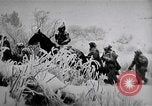
White Russian refugees in Siberia, escorted by White Russian Guards. Bolshevik prisoners. Also a ANT-20 airplane scene.
White Russian refugees making their way through heavy snows in Siberia during Russian Civil War period. They are escorted by several White Russian Guards on horseback. Change of scene shows some Bolshevik prisoners walking through snow, on a snowy day. Wooden sleds and gear towed by horses accompany the prisoners. Anachronistic brief glimpse of the giant Soviet Tupolev ANT-20 airplane in flight overhead, circa 1934. The name Maxim Gorky is written (in Russian) on the wings of the plane. (Russian Civil War and World War I time frame.)
CRITICALPAST.COM: About Us | Contact Us | FAQs - How to Order | License Agreement | My Account | My Lightboxes | Shopping Cart | Advanced Search | Featured Collections | Website Terms & Conditions | Privacy Policy ©2026 CriticalPast LLC.
License Agreement |
Terms & Conditions |
Privacy Policy
©2026 CriticalPast LLC.