


 Francais
 Deutsch
 Italiano
Refine Your Search
Bolinas Beach California USA 1934 stock footage and images
- Showing 331 to 336 of 26917 results more
more Hide
Hide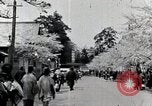
Spring Festival in Japan
Shows Japanese people walking to the spring festival, views of cherry blossom trees, three men dance in park to music played by three other men. Film shot in approximately 1934-35.
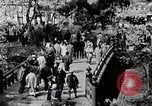
Spring Season in Japan
Shows people walk on streets, people take boat ride in river, rickshaws driven by men and an elephant during the spring season in Japan. Film shot in approximately 1934-35.
Abyssinian Border disputes and the beginning of the Second Italo-Ethiopian War
Start of the 2nd Italo-Ethiopian War (Second Italo-Abyssinian War).Map shows Red Sea, Arabian peninsula, and Africa, and highlighting Ethiopia and its capital, Addis Ababa, along with Djibouti and the regions of Erythree (Eritrea) and Somalie Italienne (Italian Somaliland). Following border controversies, Narrator states the matter came to a head when Italian and Ethiopian elements clashed at Welwel oasis (aka Walwal, or Ual-Ual).on November 26, and again, on December 4, 1934. Views of League of Nations council reviewing the situation. (They later concluded, on October 7, 1935, that Italy violated Article 12 of the League Covenant, by its invasion on October 3rd.) Crowds are seen demonstrating in Ethiopia. Italian forces are seen embarked on a ship as part of Italy's force buildup. Italian forces, including armor and infantry, are seen in their wholesale invasion from Eritrea, into Ethiopia, on October 3, 1935. With war declared, Ethopian troops muster in areas of the Capital, Addis Ababa. Ethopian tribesmen are seen answering the call to arms
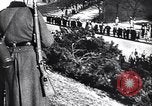
German aggression against Norway in World War II; Comparison of Hitler to gangsters; Gangster shoot-out reeanactment
German soldiers goosestep march into Oslo,Norway, in World War 2. Flasback scene of German refugee children being fed by Norwegians circa 1919, after World War 1, during time of shortages and depression Germany. Animated map showing path of German invasion and area between Hamar and Elverum, Norwegian army resists. Norwegian troops firing artillery. Two Norwegian Army soldiers in snow. One aims a Krag-Jørgensen rifle (film is reversed). German bombers overhead. Norwegian troops taking cover. German He-111 bomber dropping bombs. He-111 diving. Norwegian soldiers run for cover. Bombs exploding on the ground. Me-109 fighter plane strafing. Norwegian soldiers fleeing North. Ju-87 Stuka dive bombers in formation. U.S. Army Captain, Robert M. Losey, in uniform.(He was military attache in Norway and killed during a German bombardment.) German troops occupying various parts of Norway. German paratroopers landing on snow in mountains. He-111s dropping bombs. Bombs bursting on ground. Norwegian civilians in city, flee bombings. Me-109 planes in flight. Two Norwegian women look skyward. German Luftwaffe Stuka dive bombers attacking. A woman running past burning wreckage. Bombs falling from He-111 aircraft. Huge bomb explosion. Junkers Ju-52 trimotor aircraft flying low. Women and children run for shelter. Civilians crowd into open truck to escape. Burning buildings. German troops occupying Norwegian forts. Allied troops landing in Norway, under air attack. Animated map shows limits of allied air forces. British troops carrying wounded. Allied bombardment at Narvik. Allied troops occupy the town. Allies defend against German counter-attacks at Narvik. British troops with German prisoners. Stuka dive bombers attack Allied warships that fight back with antiaircraft guns. Picture of Vidkun Quisling. Hitler on cover of Time magazine. Narrator makes comparisons between Hitler and Gangsters of the 1930s. Gangster John Dillinger being arraigned in the United States. Gangsters and mob firing guns and machine guns shooting from moving cars of gangsters in the 1930s. Dead body of John Dillinger laid out on a autopsy or mortuary table in 1934. Map show Nazi plans for total conquest.

The Philippines gains independence from the United States on July 4, 1946; also scenes from 1941 Japanese invasion WW2
The Philippines are established as an independent nation. Crowds of Filipinos gathered at Rizal Park (Luneta Park) in Manila on the July 4, 1946. View of Independence Grandstand (a temporary structure built in front of the Rizal Monument) with American flag and Philippine flags on tall flag poles.. View looking down on General Douglas MacArthur at a podium, speaking into microphones. Camera pans over various segments of the audience. A map shows the Philippine Islands in context of its neighbors in the Pacific Ocean. Camera pans closeup across faces of many Filipinos gathered at the independence event. View of the Jones Bridge over the Pasig River in downtown Manila. Heacock’s Department Store on the Escolta. The Legislative Building. (later the National Museum of the Philippines). Ocean going ships in a harbor. Cargo being offloaded from a ship onto smaller boat. An industrial complex with eight tall smoke stacks emitting smoke. Steel and petroleum plants. Filipino workers in an assembly plant. The Legislative building with people coming and going. Air raid sirens sounding and people running in streets of Manila at onset of Japanese invasion of the Philippines in December, 1941, at start of World War 2, in the Pacific. People running across the Jones Bridge, seeking shelter. Others boarding a bus. Smoke rising from Japanese bombing. Glimpse of Japanese tanks entering Manila during attack and invasion. Japanese infantry climbing a hill. Bodies of persons killed during the Japanese invasion. Glimpse of Japanese troops occupying Corregidor. U.S. General Wainwright negotiating the surrender of Corregidor with Japanese General Homma. View of an American warship firing during the U.S. campaign to defeat the Japanese on islands in the Pacific. An American landing ship carrying U.S. troops who storm ashore. General Douglas MacArthur striding ashore with a retinue of officers, at Leyte, Philippines, on October 20, 1944. as he keeps his promise to return to the Philippines. Views, back again, to MacArthur speaking at the Independence Day ceremony in Manila on July 4, 1946. Also seen at the ceremony are: U.S. Senator Millard Tydings, (co-sponsor of the 1934 Tydings–McDuffie Act, which provided independence to the Philippines after a 10-year transition under a limited autonomy), and Paul V. McNutt, U.S. High Commissioner of the Philippines, who read President Truman's proclamation of Philippine Independence to the assembly. Camera pans over the gathering which includes many U.S. Service personnel in uniform. The oath of office is administered to the elected President of the Philippines, Manuel Roxas. At the conclusion, the American flag is lowered by Paul McNutt, as President Roxas raises that of the Republic of the Philippines. A celebratory parade in Manila includes a float with signs reading: "Let's Produce and Rebuild," among other things. Other floats represent "Mountain Province," and "The City of Manila," "The University of the Philippines," and "The Division of City Schools." One float, sponsored by the Chamber of Commerce, contains a huge replica machine gear, and models of an aircraft and a ship. It's message is about turning the gear that helps make the nation great. American and Filipino soldiers march, carrying their respective national flags. A white-helmeted military band plays for the marchers. Final scene shows large loose formation of military aircraft in flight very high above the Independence Grandstand, at Rizal Park.
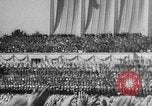
Growth of the German Nazi party and military might (German remilitarization) during the 1930s leading up to World War II
Nazi rally in Nuremberg, Germany ca.1934. Massed Storm troopers and spectators salute Hitler. An artillery piece is fired. Hitler personally recognizing loyal Storm troopers. Animated map of Asia, showing Japanese occupation of Manchuria, and Italian occupation of Ethiopia. Newspaper headlines describe Britain and France hesitating to support League of Nations oil sanctions against Italy; and U.S. increasing its oil exports to Italy by 600% (ca. 1935). Hitler and Hermann Goering looking pleased in Hitler's private railroad car. Adolf Hitler at a planning table covered with maps. German citizens traveling abroad and Joachim von Ribbentrop visiting London, as ambassador to Great Britain, in 1936. View of Léon Degrelle and his Catholic-fascist, Rexist party in Belgium (ca. 1936). View of Colonel Francois de la Rocque speaking at a Cross of Fire (Croix-de-Feu) party night rally in France. Konrad Henlein, leader of the Sudeten German Party in Czechoslovakia. Arthur Seyss-Inquart, Austrian National Socialist official, seen in an automobile during a parade. Sir Oswald Mosley addressing followers and defending Hitler. Street scenes of public disorder attributed to Nazi sympathizers in France and Belgium. Mass meeting of the German American Bund in Madison Square Garden, New York City,1939. U.S. flags and picture of George Washington decorate stage. Fritz Julius Kuhn addresses the gathering and members rough up a protester. Views of heavy industry in Germany, especially steel manufacturing for remilitarization. Persons working at a German concentration camp. Dramatized execution by machine gun. View of Heinrich Himmler. German President Paul von Hindenburg. German national conscription of 1935 during military mobilization efforts. German youth training pilots with gliders. German paratroopers, Junkers 52 aircraft, German soldiers goosestep, views of German tanks. Ju 87 Stuka plane. German invasion of Rhineland, 1936. Construction of Siegfried Line. Antitank barriers, bunkers, dragons teeth. Hitler visiting Westwall. German military parade.
CRITICALPAST.COM: About Us | Contact Us | FAQs - How to Order | License Agreement | My Account | My Lightboxes | Shopping Cart | Advanced Search | Featured Collections | Website Terms & Conditions | Privacy Policy ©2026 CriticalPast LLC.
License Agreement |
Terms & Conditions |
Privacy Policy
©2026 CriticalPast LLC.