


 Francais
 Deutsch
 Italiano

Refine Your Search
Brest France 1920 stock footage and images
- Showing 145 to 150 of 5760 results more
 Hide
Color Sound
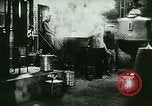
Illegal stills, hijackings, bombings, and other mafia or mob violence depicted in movie enactments
Movie portrayal of gangster activities during prohibition, in 1920s in the United States. Illicit liquor trade and gang warfare. Clandestine liquor manufacture. The illicit liquor is loaded onto a truck for transportation. Truck hijacking after truck carrying liquor smashes into a car blocking the road. Metal milk containers filled with liquor being machine gunned by a passing car. Two business establishments being bombed. Gangsters interrogating two men and threatening them while holding handguns. Faceless gangster in 1920s fashions (actor) fires revolver. A policeman with a gun firing at gangsters during a getaway.
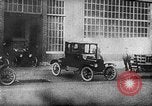
Scenes related to the Ford Motor company and the Ford Model T automobile in the United States.
Ford Model T cars being driven out the exit door of the Highland Park factory, Michigan,circa 1916. Numerous Model T cars driving on both sides of a divided highway. The Ford Highland Park Plant, circa 1920. Panoramic exterior views of the Ford River Rouge plant and factory buildings, circa 1930. A Ford Freighter ship, docked at the River Rouge plant. A view of the home of Henry and Clara Ford, at 66 Edison Road (now 140) Dearborn, Michigan, in 1914. Sketch of children coming home from school, singing song from McGuffey reader school book. View of schoolroom with McGuffey readers on desk. Narrator relates story of Henry Ford trying to buy a McGuffey reader and being unable to obtain one. Narrator states that Ford realizes from this incident "the changes that are reordering his culture. The modes of life which Henry so loved are passing, disappearing into history." Street scene outside Ford Plant, during shift change, and street filled with workers. A car driving on empty road in Sudbury, Massachusetts. The historic Wayside Inn (immortalized in Henry Wadsworth Longfellow's "Tales of the Wayside Inn") which Henry Ford purchased in 1923, to preserve for posterity. View of the original Pennsylvania Railroad Station in New York City, circa 1912. View of crowded sidewalks and street on 5th Avenue, and other street scenes in New York City, circa 1920. Model T Ford cars driving in U.S. National Parks. A visitor feeding a bear from his Ford car, as a U.S. National Park Ranger stands nearby. People in Ford Model T, stopped by side of road to pick wild flowers. Two men remove a seat back from their Model T car to make a camper. Both men lying down in the car. Man carrying picnic basket from Ford Model T, parked beside a beach, where he joins the rest of his party on the sand. Children run along the beach, and stop to play with seaweed.
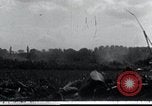
Damaged buildings and ruins in French town of Chaumont-Porcien, during World War II.
Ruins in the French town of Chaumont-Porcien, in the Ardennes region, during World War II. Damaged buildings in the town. View of "Le Poilu victorieux de Chaumont-Porcien": A World War 1 statue of a French soldier in the Place de la Mairie. (The statue is a rendition of the Monument to the dead by Eugène Bénet, designed in 1920 in memory of French soldiers who died in World War I. It depicts a French soldier or "Poilu" with rifle in left hand, holding aloft a laurel wreath or olive branch with his right hand.) A small circular fenced cemetery beside the monument is shown, containing crosses and German helmets of recent German soldiers deaths. German Army vehicles advance into town, passing horse drawn carriages lined up on a street.
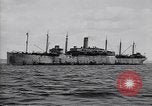
United States troops aboard ship underway at sea.
Ship underway at sea. United States troops aboard ship. Troops on lower and upper deck of ship.
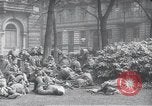
German Monarchists eat and relax in Berlin, Germany during Kapp Putsch.
Footage during the Kapp Putsch, or Kapp-Lüttwitz Putsch of March 1920. German Monarchists relax and eat in the streets of Berlin, Germany. German soldiers raise a Reichskriegsflagge flag of the German empire. People walk on street in front of downtown Berlin government buildings during the unrest. People gather in front of building with sign "Kaiserhof". German soldiers sleep on ground with flag in the background.
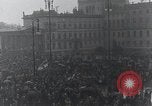
Kapp Putsch attempted coup participants parade on streets of Berlin, Germany
German right wing, conservatives, and monarchists during the Kapp Putsch or Kapp-Lüttwitz Putsch aimed at overthrowing the German Weimar Republic in 1920. Marchers gather and parade outside buildings in Berlin, Germany. They parade and demonstrate holding the Reichskriegsflagge flag with the German coat of arms. Members of the Marinebrigade Ehrhardt, with rudimentary swastika symbols on their helmets are seen handing out flyers to the crowd (The NSDAP Nazi Party was influenced to adopt the swastika in part by the use seen here). German troops relaxing. German coup co-leader Walther von Lüttwitz walks on street, followed by others, one of whom in the front left closest to the buildings appears to be Wolfgang Kapp. Luttwitz inspects German soldiers.
CRITICALPAST.COM: About Us | Contact Us | FAQs - How to Order | License Agreement | My Account | My Lightboxes | Shopping Cart | Advanced Search | Featured Collections | Website Terms & Conditions | Privacy Policy ©2026 CriticalPast LLC.
License Agreement |
Terms & Conditions |
Privacy Policy
©2026 CriticalPast LLC.