


 Francais
 Deutsch
 Italiano

Refine Your Search
Brest France 1920 stock footage and images
- Showing 217 to 222 of 5760 results more
 Hide
Color Sound
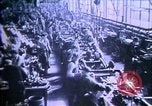
U.S. President Warren Harding dies. Calvin Coolidge becomes President. Good times in America and Hyperinflation in Germany
America and Europe during post World War 1 period of 1920s Sketches: American workers in factories. The U.S. President Warren Gamaliel Harding converses with a friend. President with other officials signs a paper. President Harding dies and the Nation mourns. Pallbearers carry coffin of the President. Sketches depict the various scandals under the Harding administration, including the Tea Pot Dome scandal. Vice President John Calvin Coolidge becomes President. Several sketches of the President . Sketches of rich people in America. People in a car. Automobiles driven out of a Ford factory. Sketch of the workers building a road. Various labor saving electrical devices. Sketches depict a housewife relaxing and people becoming better off economically. Ordinary people gamble on the stock market. Various pictures of American farmers suffering, as demand for food falls in the wake of World War 1. Economic and financial crises affect Germany. Hyperinflation and riots occur in Germany. The unrest gives rise to future leaders like Adolf Hitler in Germany and Benito Mussolini, in Italy.
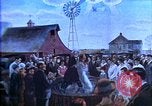
The Scopes trial and the Sacco-Vanzetti trial in the U.S.
Court trials in the United States after World War I. Sketches: The Scopes trial. A science teacher John Thomas Scope. Picture of the evolution of man. Defense attorney, Clarence Seward Darrow supports the theory of evolution. Prosecutor, William Jennings Bryan bases his position on the Bible. A person with a poster. People gathered outside the court room for the trial. Sketches: the court room session. People protesting. In separate matter. Accused anarchists, Ferdinando Nicola Sacco and Bartolomeo Vanzetti, two Italian Americans, on trial in Massachusetts for the 1920 armed robbery and murder of two pay-clerks. People protest against the trial. Policemen bring in the accused, to be tried. A huge crowd gathered to protest against the trial.
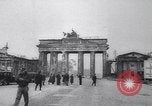
Ruins and damaged buildings in Berlin and Munich Germany at the end of World War II in Europe.
Opening scenes are of ruins in Berlin, Germany at the end of World War II in Europe. Damaged Brandenburg Gate and ruined buildings of Berlin. Damaged building of Adlon Hotel. Allied troops move forward in Germany to complete the Allied occupation of Germany. A truck loaded with Allied troops heads towards Berchtesgaden. Smoke rises from the Berghof, German Chancellor Adolf Hitler's mountain residence (Narrator refers to it as the Eagle's Nest, which is not correct. The Eagle's Nest or Kehlsteinhaus was not bombed and is not shown in this clip). Ruins and damaged buildings in Munich including exterior building facade, and arched stair entrance to festhall, marked with painted lettering by American soldiers, "157th infantry, 45th Division." Interior views of the Hofbräuhaus München beer hall (Hofbräuhaus am Platzl), including interior views of ruins inside its drinking room (trinkstube) with shattered windows and broken furniture. (Narrator refers to this as "the famous beer hall." At least two noteworthy NASDAP formative events occurred there: On February 25, 1920, Hitler presented the Nazi Party Twenty Five Point Program there. On November 4, 1921 the National Socialist party held a large public meeting at the Hofbräuhaus and fighting and protesting broke out after Hitler spoke. The Sturmabteilungen, or "SA", then in its infancy, attacked and ejected protestors.)
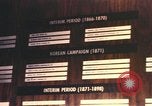
Hall of Heroes at the Pentagon showing hero names from Korean Campaign to the Vietnam War
View of the Hall of Heroes at the Pentagon, in the United States, during the Vietnam War. Names of the war heroes in the hall. Nameplates of the war heroes of each historical conflict on the wall. Names of the soldiers and officers who served the best in the wars. Names under the nameplates reading: 'Interim Period (1866-1870)', 'Korean Campaign (1871)', 'Interim Period (1871-1898)'. Other nameplates read: 'War with Spain (1898)', 'Philippine insurrection (1899-1913)', 'China Relief Expedition-Boxer Rebellion (1900)'. Several other conflicts mentioned in the hall. Other nameplates read: 'World War I (1917-1918)', 'Haitian Campaign (1919-1920), 'Second Nicaraguan Campaign (1925)', 'Word War II (1941-1945) and 'Vietnam (1964-Present).
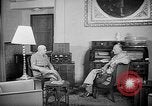
Plenipotentiary French Army General visits Levant States and calls a press conference (WW2)
French Army General Beynet in Beirut, Syria during World War II. General Raymond Humblot and General Beynet talk and listen to radio news. General Humblot dials radio. He is Commander-in-Chief of French troops in Levant States. He leaves Residency and after conference with General Beynet gets into a car. Druze Guard presents arms as the car drives through gardens. They play trumpets. Plate at entrance of building reads 'Here was proclaimed on September 1, 1920, the independence of Great Lebanon'.
Adolf Hitler and Nazi officials meet in Munich, early in World War II, on the anniversary of the Beer Hall Putsch of November 9, 1923.
Narrator announces the "9th of November in Munich." (It is 1941, early in World War 2.) A gathering of Nazi officials in a church. They are celebrating the anniversary of the Nazi Beer Hall Putsch of November 9, 1923. Next, a large group of Nazi officials are seen conversing in a large hall. Adolf Hitler arrives to the cheers and Nazi salutes of the attendees, as he walks through their midst and spends time greeting and shaking hands with his old comrades from the 1920s. He steps to a podium. Closeup of him at the podium responding to the adulation of the assembly by rendering a bent elbow Nazi salute. The audience is applauding. According to the narrator, Hitler speaks disparagingly about U.S. President Roosevelt and Soviet leader Stalin.
CRITICALPAST.COM: About Us | Contact Us | FAQs - How to Order | License Agreement | My Account | My Lightboxes | Shopping Cart | Advanced Search | Featured Collections | Website Terms & Conditions | Privacy Policy ©2026 CriticalPast LLC.
License Agreement |
Terms & Conditions |
Privacy Policy
©2026 CriticalPast LLC.