


 Francais
 Deutsch
 Italiano
Refine Your Search
British-Gliders stock footage and images
- Showing 13 to 18 of 3412 results more
more Hide
Hide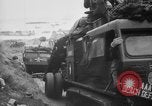
Allied paratroopers in gliders continue airborne assault in daytime, on D-day, after initial airborne troop drop the night before, in World War II
Allied invasion of Normandy, France during World War 2. Allied trucks and equipment move up from beachhead after D-Day. Half-tracks, armed with antiaircraft guns, move up from the beachhead. Back in England, gliders are readied for mission. A long line of Paratrooper medics wearing Red Cross Arm bands, board gliders. View from airplane flying over an airfield filled with C-47 tow planes, and gliders, all painted with invasion stripes. Closeup of Sergeant with British 6th Airborne Division showing Pegasus insignia on his sleeve. British paratroopers boarding a Hamilcar glider. U.S. paratroopers boarding gliders. View from above of Allied gliders being towed across the English Channel View from a ship in the invasion convoy, of tow planes and gliders overhead. View, from aircraft overhead, of invasion flotilla below. Distant view of Allied aircraft shot down by German antiaircraft fire, near the coast of Normandy and exploding in flames upon impact. View from the air of areas flooded by the Germans as a defense measure. Parachutes and gliders on the ground from earlier sorties. Gliders in this wave cut loose from tow planes and maneuver independently. Glimpses of Allied fighter planes moving fast and high above the scene. A glider splashing down in one of the flooded fields. Other fields, studded by the Germans, with poles 12-to 15 feet tall as defense against gliders. Gliders landing. Paratroopers leaving a Horsa glider, after landing.
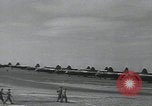
Allied soldiers load weapons and supplies into gliders before D-Day (WW2)
Allied Horsa gliders parked on an airfield in England before D-Day during World War II. Soldiers load a six pounder anti-aircraft gun into a glider. A British soldier drives a Jeep on a ramp into a transport plane. Soldiers roll a large cylindrical container containing guns and ammunition. They place it into a pile. The troops load the container into a glider. A British Horsa glider being towed. British path finder paratroopers put on black face paint and helmets.
Red Devil paratroopers of British 1st Airborne Division, drop into Holland to outflank the German Siegfried Line in World War II
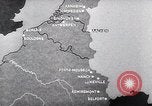
At start, the film shows a formation of American C-47 transport aircraft with paratroopers starting to jump from them during World War 2. Viewed moments later from the ground, the sky is filled with trooper' open chutes, descending. An animated map shows Netherlands, Belgium, Luxembourg, and Germany. It shows location of the Allied paratroopers drop in Holland, intended to spearhead a drive around the Main River into Germany. The map then shows German forces encircling the paratroopers and the Second British Army heading North to the rescue. Next, a huge number of American Soldiers are seen assembled out of doors in England. Closeup of General Dwight D. Eisenhower speaking in a microphone to the assembly. Closeups of soldiers including some who are American Army Air Corps pilots, and other aircrew members, mostly Lieutenants. Senior Paratrooper officers stand at attention in front of formation of troopers with American flag beside them.(Narrator says these were the men who made up the "lost division," heroes who fought alone for seven terrible days.) General Eisenhower makes his way between close ranks of the paratroopers. He is followed by Brigadier General and a Colonel. Lieutenant General Lewis H Bereton also makes his way through the ranks. Scene shifts to a base in England where many British Airspeed AS.51 Horsa gliders are seen with paratroopers heading across the airfield to board. American C-47 aircraft are seen in the background. All aircraft are painted with D-Day stripes. Several British and American paratroop officers review a map together. At a tent camp, A military policeman and two U.S. paratroopers checking their weapons and ammunition. Some troopers sharpen their knives. A trooper is issued Dutch and German money. A British and and American trooper in camouflaged helmets, pose before a glider with a huge British roundel on its side. British paratroopers boarding a Horsa glider, named "Gertie." A Horsa glider moving as it is towed by a British Whitley twin-engine bomber. View from side of runway as the bomber takes off with its towed glider behind. (Narrator comments: "Destination, Holland.") Formations of tow planes and gliders in flight. View of pilot in cockpit of a Whitley bomber. Formations of fighter aircraft in flight overhead. View from inside an aircraft as paratroopers exit through a side door. Sky filled with paratroopers in chutes descending. (Note: This Allied thrust into Holland to launch a drive around the German Siegfried Line was known as the Allied joint American-British "Operation Market Garden," which took place 17 to 25 September 1944, the 7 days referred to by the film Narrator. )
German forces fire on British aircraft and paratroopers in Battle of Arnhem during World War 2
German newsreel shows a map with Arnhem and Nijmegen and other nearby cities in Holland region. British aircraft flying overhead during Operation Market Garden (British 1st Airborne Division) as German troops fire at them from the ground during World War II. Sky is filled with Allied aircraft and parachuting British troops. British planes, gliders, and parachutes descend and some aircraft explode on impact after being hit by German rifle, machine gun, and artillery fire. German soldiers view wreckage and some burning British aircraft through binoculars and up close. British Horsa Invasion gliders burning on an open field. Scattered Allied equipment, dead bodies and gliders are seen. A group of British prisoners of war is seen gathered together on a roadside.
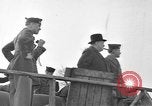
U.S. General Eisenhower and British Prime Minister Churchill inspect equipment, supplies and review a parachute jump in England.
U.S. 101st Airborne Division in England during World War 2.British Prime Minister Winston Churchill, U.S. Army General Dwight D Eisenhower, and Lieutenant General Omar Bradley, with other officials and officers, visit RAF Welford airfield in Berkshire County, England (then home to the 435th Troop Carrier Group). They are hosted by Brigadier General Maxwell Davenport Taylor, Commander of the 101st Airborne Division, together with members of his staff, including: Brigadier General Don F Pratt and Brigadier General Anthony C. McAuliffe. They tour various exhibits of engineers, artillery, anti aircraft and paratroop units. They inspect equipment, gliders, and supplies. From a reviewing stand, they observe a paratroop exercise involving formations of C-47 transport planes, from which large numbers of paratroopers jump, filling the skies with parachutes. Generals Eisenhower, Brigadier General Taylor and Prime Minister Churchill salute colors as they review troops. They walk among displays of troopers, equipment, and U.S. CG-4A gliders. Assisted by General Taylor, Prime Minister Churchill climbs aboard a British Horsa glider to examine it. He shakes hands and converses with Colonels of the 101st, including: Col.George S. Wear, commander, 327th Glider Infantry Regiment; Col. George V. H. Moseley, Jr., Commander, 502nd Parachute Infantry Regiment; Colonel Howard R.Johnson, commander, 501st Parachute Infantry Regiment; and Col. Thomas L. Sherburne, 101st Airborne Division's Artillery Commander.
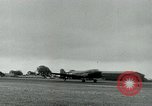
Gliders, carrying Allied infantry, take off for the invasion of Normandy in World War II.
A British Dakota (or U.S. C-47) taking off from an airfield towing a British Airspeed AS.51 Horsa glider. Both aircraft are painted in D-day stripes. Formation of C-47 aircraft towing WACO CG-4A Gliders. A C-47 in D-day stripes parked in front of a hangar.
CRITICALPAST.COM: About Us | Contact Us | FAQs - How to Order | License Agreement | My Account | My Lightboxes | Shopping Cart | Advanced Search | Featured Collections | Website Terms & Conditions | Privacy Policy ©2026 CriticalPast LLC.
License Agreement |
Terms & Conditions |
Privacy Policy
©2026 CriticalPast LLC.