


 Francais
 Deutsch
 Italiano
Refine Your Search
British-Gliders stock footage and images
- Showing 1945 to 1950 of 3412 results more
more Hide
Hide
50th Indian tank brigade and Yorkshire and Lancashire regiment soldiers cross River Kalapanzin in Buthidaung, Burma.
50th Indian tank brigade and Yorkshire and Lancashire regiment soldiers carry ammunition and supplies across Kalapanzin River in Buthidaung, Burma. Tanks on raft. British-Indian soldiers stand on raft past tank. Soldiers carry bundle of barbed wire and place it on raft. Japanese held position on the other side of river. British soldiers of the 27th Field Regiment Royal Artillery and 63rd Indian field Company, ferry pontoon raft with guns and ammunition. Water flows in river. Yorkshire and Lancashire regiment soldiers carry ammunition and supply in field and place it on ground. They ferry equipment and supply on sampans, down river. Soldiers push artillery and load United States jeep on sampans and ferry it. (World War II period).
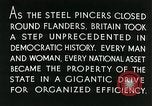
Guns, trucks and submarines developed and tested in Canada, during World War II.
British and Canadian preparations for World War II. Britain converts personal properties into State properties. Men and women work in factory. A banner with the phrase 'Go to it' coined by the Britisher Morrison. Workers construct buildings in Canada. White smoke comes out of factory. Workers at gun factory. Worker checks barrel alignment of a gun. Man checks firing capacity of gun. Workers at shipyard work on submarine. Steel plates used to lessen the weight. Trucks, tractors and ambulances made in factory. Testing and standardization of truck by National Research Council. They use X-Ray for testing of parts of machinery. A Canadian Pacific railroad train moves on tracks carrying train cars loaded with weapons and war supplies. Aircraft, trucks, tanks and ships as weapons of Canada. Industrial workers work in steel factories to make these machines.
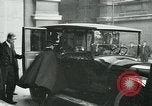
Arrival of dignitaries at Quai D' Orsay for The Paris Peace Conference in Paris.
Arrival of dignitaries at Quai D'Orsay (37, Quai d'Orsay - 75007 Paris), the French ministry of Foreign and European Affairs, for the Paris Peace Conference. The dignitaries include Vittorio Emanuele Orlando- prime minister of Italy, Italian Foreign Minister Baron Sidney Sonnino, British prime minister David Lloyd George, United States advisor of the supreme war council General Tasker Bliss, Secretary of State Robert Lansing, Admiral Cary T. Grayson, French Prime Minister Georges Benjamin Clemenceau, French President Raymond Poincare, French statesman Stephen Pichon, British politician and statesman Lord Arthur James Balfour.
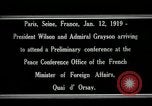
President Woodrow Wilson of United States and other dignitaries arriving at Quai d' Orsay for the Paris Peace Conference .
Arrival of United States President Woodrow Wilson and Admiral Cary T. Grayson, Physician to President Wilson. They arrive at Quai d' Orsay (37, Quai d'Orsay - 75007 Paris) - French Ministry of Foreign and European Affairs to attend a preliminary conference. President Woodrow Wilson bows his hat to greet the dignitaries. Other dignitaries arriving include Prime Minister of Italy Vittorio Emanuele Orlando, Italian Foreign Minister Baron Sonnino, Secretary of United States Robert Lansing, British Prime Minister David Lloyd George, British statesman Lord Arthur J. Balfour, American advisor of the supreme war council General Tasker H. Bliss, Prime Minister of France Georges B. Clemenceau, French Minister of Construction M. Loucher. View of Salle d' Horloge- the interior of the Quai d'Orsay where the conference was arranged. Cameramen with their camera mounted on stands seen standing. Reporters and guards can be seen. (World War I; World War 1; WWI; WW1)
Marshall plan construction, export, and industry growth and recovery of Europe after the devastation of World War 2
British workers crowd into a dining hall and have lunch. A radio broadcast credits improvements in the British standard of living to the Marshall Plan. Examples of increase attention to developing European self-sufficiency, with advent of Marshall Plan ending in 1952. A train runs on the railway track. Men ascend on the wires above the railway track and work on them. Construction workers seek improved methods and efficiencies. They pack Camel Cigarettes in a box for the purpose of export. Cars in a showroom on which a slip indicates, 'Austin Motor Company Ltd'. The work of expansion of industries going on, with emphasis on increasing exports to the United States. Modern machines and equipment used in the work. Discussion of post Marshall Plan times in Europe.
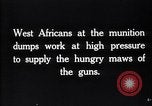
French West African Colonial troops working in ammunition dump during World War I
Opening slate refers to West Africans working at Allied munitions dumps. Scene shows French Colonial Senegalese infantrymen (Tirailleurs Senegalais) carrying ammunition boxes in a huge storage dump, under supervision of British officers. Some wear steel helmets, others wear British-style caps. They walk over paths between stacks of artillery shells. One appears to have a cigar in his mouth. They are followed by Several Allied soldiers, also carrying ammunition boxes. An Allied soldier in steel helmet smokes a cigarette, while standing next to large artillery shells. View of dirt road at side of the munitions dump, with a truck backed up to it. Many Allied soldiers are seen working around the periphery of the dump throughout the film.. (World War I; World War 1; WWI; WW1)
CRITICALPAST.COM: About Us | Contact Us | FAQs - How to Order | License Agreement | My Account | My Lightboxes | Shopping Cart | Advanced Search | Featured Collections | Website Terms & Conditions | Privacy Policy ©2026 CriticalPast LLC.
License Agreement |
Terms & Conditions |
Privacy Policy
©2026 CriticalPast LLC.