


 Francais
 Deutsch
 Italiano
Refine Your Search
British-Gliders stock footage and images
- Showing 1939 to 1944 of 3412 results more
more Hide
Hide
General Eisenhower returning home to Washington, DC after World War II, by way of Paris and London.
With the war ended, General Dwight D. Eisenhower is feted in London, on his way home to America. He is seen stepping into a ceremonial horse-drawn carriage, as throngs of spectators line the sidewalks to watch. Accompanied by British Air Marshal Arthur Tedder, Eisenhower rides in the carriage, escorted by police on white horses. Crowds cheer Ike from the sidewalks as the carriage passes. The carriage stops at the London Guildhall. (A sign reads: "Site of the Guildhall Chapel, 1299-1822.") Inside, Sir Frank Alexander, Lord Mayor of London, is seen making Ike an honorary citizen of London and presenting him a token sword that once belonged to the Duke of Wellington. Outside, the streets are jammed with London well-wishers who applaud and cheer the Supreme Allied Commander as his carriage passes them on the way to Mansion House. At some points, Eisenhower stands and acknowledges the crowds cheers and he sometimes salutes, while seated. Glimpse of spectators jammed side-by-side in the streets. Eisenhower is seen standing on the balcony of Mansion House, flanked by Prime Minister Winston Churchill, in a top hat. The balcony is decorated with British and American flags. Sounds of the cheering crowd can be heard as Ike says: "Whether or not you know it, I am now a Londoner, myself." The crowd cheers. He continues: "I have just as much right to be down in that crowd, yelling, as you have." He goes on to make other remarks about the peaceful state of things. He bids all farewell and he and Churchill turn to enter the building. Scene shifts completely to the Arch of Triumph in Paris, where General Eisenhower is seen ceremoniously laying a wreath at the tomb of the unknown soldier. He steps back to stand beside French General Charles de Gaulle. They and accompanying military officers salute. The memorial flame at the tomb fills the foreground. Next, in a closeup, General de Gaulle is seen decorating Eisenhower with the Medal of Liberation. Glimpse of enthusiastic French citizens cheering as Eisenhower tours the city with de Gaulle, in an open car escorted by police on motorcycles. They proceed along the Champs Elysees, with the Arc de Triomphe in the background. Ike and de Gaulle both stand as they drive along. Closeup from moving vehicle passing close to crowd. Views from rear as the car and escorts move through the spectator-lined streets. Similar views from ahead. Scene shifts to Eisenhower finally arriving in the United States. A pointed arch supports a large American flag above a "Welcome Ike" banner. General Eisenhower steps from an airplane in Washington,DC, where Mrs. Mamie Eisenhower greets him. The two pose for the camera. Next, a motorcade of jeeps travels along Pennsylvania Avenue. The Post Office building is seen on the right and the capitol in the far background. District Commissioners present Ike keys to the City. Views of jeep motorcade proceeding along Pennsylvania Avenue. Eisenhower standing in a jeep acknowledging the crowds. As they reach the capitol, a disabled veteran gives something to Ike. Inside, Eisenhower makes his way to the podium to address a joint session of the Congress. View of Ike addressing the session, with Speaker of the House, Sam Rayburn and president pro tempore of the United States Senate, Kenneth Douglas McKellar, behind him. (The latter was serving as President of the Senate, in the temporary absence of a Vice President, after Harry Truman became President upon the death of Franklin D. Roosevelt.)
Japanese leaders Prince Higashikuni and Prince Kaya Tsunenori visit Hankow. Triumphant celebration after invasion of China.
Japanese occupation of Wuhan and Hankou or Hankow region during the Second Sino-Japanese War. Street level views of burning buildings in Wuhan region and Japanese forces taking over the city. Elevated wide view of Japanese ships at anchor in the Yangtze River. View of French captives under Japanese Guard, and view of British soldiers saluting Japanese soldiers and relinquishing control of a building guarded by the British (possibly Embassy). Japanese leader Prince Naruhiko Higashikuni disembarks from plane. Troops stand on the sides of road to salute Japanese leaders. During a victory celebration, Japanese aircraft fly over the city and Japanese officers on ships at harbor salute and celebrate. Aboard a Japanese ship, Japanese officers gather on the deck at a series of tables and toast victory with sake. Celebrants include Prince Kaya Tsunenori. Scene changes to mainland Japan, with celebrations underway in many cities. Children march waving Japanese flags. In Tokyo, a group celebrates with the Imperial Palace seen in the distance along with Emperor Shōwa (Emperor Hirohito) on his favorite white horse Shirayuki. Back in China, Chinese citizens are indoctrinated to the "ways of the Empire". Japanese soldiers are seen teaching Chinese crowds and having them wave Japanese flags. Chinese citizens seen in the cities receiving rice and other food under supervision from Japanese forces. Chinese citizens cooking and preparing food and eating the food. Farmers in China irrigating fields and tilling farm fields. An elderly Chinese woman is seen sewing a flag of Japan. Japanese troops on horseback and driving capture Chinese tanks advance, along with artillery.
Beginnings of the Second Sino-Japanese war
Sign over American Embassy in China. Colonel William Mayer, former military attache in that embassy relates events precipitating Second Sino-Japanese war. Scenes of the Marco Polo bridge near Peking, on night of July 7, 1937, as Japanese artillery bombards the area. Animated map shows movement of Japanese forces out of Manchuria to occupy Peiping and Tientsin. Victorious Japanese troops stand atop a building, raising their flags and shouting cries of victory. Japanese army officers sit around a table smiling and contended and others walk in a group. Chinese artillery crews are seen retaliating as they fire field pieces at Japanese positions in Shanghai. Shells explode in background, and Chinese infantry advance through damaged buildings and rubble. Animated map shows Shanghai and other cities, and film transitions to view of the bustling city of Shanghai on the Yangtze River. In the seaport, large ocean liners and freighters, as well as tug boats and Junks, are seen. What looks like a Japanese Tachikawa Ki.54 Type 1 transport plane takes off over a Chinese pagoda. Double-decker buses travel through the streets. Rickshaws are also seen. Map outlines the foreign residential areas of the French Concession and the International Settlement. American, British and Japanese flags are shown in the International Settlement. Detachments of troops from Japan, Britain, France, and United States Marines are seen. A U.S. Marine is posted as a sentry at the Shanghai Power Company. Coolies carry heavy bucket on a long pole. British, French and Japanese troops also performed sentry duties. Japanese troops and armored cars are seen. A scuffle breaks out in August, 1937, and Japanese soldiers start moving in trucks, take up firing positions, and begin firing guns from their armored cars. Map shows Chinese counterattack pushing the Japanese contingent toward the Khangpoo River. Next it shows Japanese warships and reinforcements in the Yangtze River and their advance toward Woosung and Shanghai. Views of Japanese warships bombarding the shore and large explosions from their striking shells. Beachhead is shown South of Shanghai, where two divisions of Japanese infantry are seen arriving in landing craft. They advance across the fields toward Shanghai. Map shows Chinese withdrawals to West and South, toward Nanking and Hangchow. Chinese medics along with infantry march in retreat. Japanese pilots are seen being briefed. Next, Japanese Mitsubishi G3M bombers are seen in flight, and bombardiers and other crew in them. Bombs falling on the city. Civilians running for cover as bombs explode. Aichi D3A1 aircraft dropping bombs. The Shanghai waterfront being bombed and civilians running.
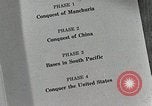
Japanese aggression in China and various events leading to Japanese attack on U.S. at Pearl Harbor (WW2)
A hand writes check marks beside “Bases in the South Pacific” and “Conquer the United States” on the summary report purporting to reflect phases of Japanese so-called "Tanaka Plan". Animated map shows pressure by German forces in offensive against Soviet Union and illustrates German air war against Britain. Scenes of bombing destruction in Britain, including overturned double-decker bus in ruins of buildings. A Nelson Class British battleship viewed from dead ahead. She is followed by the aircraft carrier HMS Illustrious. The U.S. Capitol building in Washington, DC. American newspaper headline reads: "Navy Bill Passes House." and "Huge Sum Voted for Two Ocean Navy." A line of U.S. Navy battleships underway, led by the USS Mississippi (BB-41). A field full of U.S. M3 Lee tanks moving in formation, as they are overflown by several Douglas B-18 bombers. Assembled Japanese leaders in a forum. Japanese Naval officers in a planning conference. Closeup shows Admirals Shigeyoshi Inoue and Raizō Tanaka pointing at a chart and conversing as other officers look on. Next, bomb bursts and black smoke rises as the attack on Pearl Harbor is underway. The USS West Virginia, USS Tennessee, and the USS Arizona, burning on Battleship row, during the attack. Generalissimo Chiang Kai-Shek with staff officers walks to a waiting car. Forces allied with China, including American troops marching; British troops marching; and Dutch Colonial troops marching (in Batavia, the Capital of the Dutch East Indies). Japanese troops continuing their conquest of China, firing a field piece, and infantry charging. Newspapers announce Japanese advances into Malay Peninsula and Hong Kong. Others cite the Fall of Singapore and the Fall of Corregidor in the Philippines (6 May, 1942). Animated map shows Japanese occupation encompassing Indochina, Thailand, and Burma (with loss of the Burma Road) all of which compounded China's war efforts.
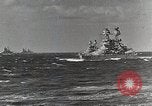
Montage of scenes related to the China-India-Burma theater during World War II
Two U.S. Pennsylvania class battleships underway at sea, with other warships in background, during World War 2. One fires to starboard with her 14-inch guns from the forward triple turrets. U.S. Army Air Forces B-24 Liberator bombers flying in formation over mountains. Glimpse of General Douglas MacArthur with General Joseph (Vinegar Joe) Stilwell in gunner's station of a bomber. Montage of brief glimpses showing U.S. forces engaging Japanese forces in: amphibious assaults; firing weapons in New Guinea and other Pacific islands. U.S. warship firing naval guns. U.S. ship firing at attacking Japanese aircraft, with sky full of black flak clouds. Admiral William (Bull) Halsey. Mitsubishi A6M Zero kamikaze aircraft blown up close to flight deck of U.S. aircraft carrier. It misses the ship and crashes in flames, exploding in the water, astern. U.S. General Joseph Stilwell, Madame Chiang Kai-Shek, British Allied commander Lord Louis Mountbatten, and Chinese Generalissimo Chiang Kai-Shek, photographed together in India. Chinese Generalissimo Chiang Kai-Shek seated for a picture with U.S. President Franklin D. Roosevelt. Camera moves back revealing British Prime Minister Winston Churchill, and Madame Chiang Kai-Shek, also seated. Behind them stand key allied military leaders, including (from the right) Field Marshal Archibald Percival Wavell, Commander-in-chief in India; Admiral Louis Mountbatten, Supreme Allied Commander of South-East Asia forces; George Giffard — commander of Eleventh Army Group; U.S. General Daniel Isom Sultan, deputy to General Stilwell; General Joseph Stilwell, Commander China-Burma-India (CBI) Command; and General Albert Coady Wedemeyer, Chiang Kai-Shek's Chief of Staff. General Joseph Stillwell is seen stepping from a military cargo plane, and being greeted by another officer. Stilwell is wearing a campaign hat. He has the CBI patch on his jacket shouder. A B-24 Liberator bomber takes off from a Chinese base at Liuchow, or possibly, Luiliang, China. (ostensibly carrying Chinese soldiers to India for training). U.S. marked P-40 aircraft are parked beside the runway. They display the shark teeth nose art of the Flying Tiger All volunteer Group of Claire Chennault. But this is 1944 and the aircraft are from the U.S. 23rd Fighter Group. Chinese soldiers are seen being armed and trained in India, with modern small arms. They are also seen fording a river with military supplies and moving in jeeps through jungle-like settings. Various views of Ledo Road construction in Burma. bulldozers, trucks, caterpillar tractors, explosives and men are shown in construction work. A jeep rides along a muddy section of the new road while U.S. and Chinese soldiers patrol on either side to protect it. Allied soldiers firing a small field piece. A C-47 aircraft airdrops supplies to the road builders. General Stilwell, standing with a Chinese officer, looks skyward at the aircraft. A C-46 Commando plane taking off from a field in India carrying supplies. Men loading a jeep aboard a C-46, plus ammunition and other supplies. Rare sight of supplies being loaded into nose cargo compartment of the one-of-a-kind XC-108A transport plane (modified B-17 bomber, tail number 41-2593). A formation of USAAF C-45 transport aircraft flying "over the Hump." Chinese P-36 Hawk aircraft in formation demonstrate firepower. Newly trained Chinese pilots marching and walking on flightline where solid-nose B-25s and P-40s are parked. Chinese and American pilots wave to each other from their P-40 aircraft. A B-25 takes off flanked by two P-40s. Bombs being dropped by Chinese B-25s. Japanese ship being strafed by Chinese fighter plane. Chinese laborers at work building an airfield without machinery. A large group pull a paving roller by hand. Chinese troops in combat with Japanese forces. One firing a Czech ZB vz. 26 light machine gun. Madame Chiang Kai-Shek addressing the U.S. Congress, 18 February, 1943.
Allied troops in the city and throng witness demonstration in Dusseldorf, Germany against post war reparation demands
British, French and Belgian forces occupy city following refusal of post World War I reparation demands by the Allied countries. Allied troops advance into city of Dusseldorf, Germany. People gather on street. Cavalry patrols on road of the city and people watch them. British tanks stand on road, driven on road and soldiers walk past tank. Soldiers visible from the window of tank. Troops run past train. Crowd gathers to witness demonstration in a square of the German city, as citizens protest the demands and their effect on the German economy. Men stand on platform. One man holds board of Baron Von Lersner. Scene of a building with tome. Flag on a building half staffed. Cavalry soldiers walk past the crowd. Soldiers make human chain in front of crowd. Soldier stands on road.