


 Francais
 Deutsch
 Italiano
Refine Your Search
British-Gliders stock footage and images
- Showing 2131 to 2136 of 3412 results more
more Hide
Hide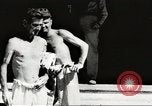
Allied prisoners shares his experiences after being released from the Cabanatuan prison camp in the Philippines.
United States prisoners and British prisoners after being released from a Japanese prison camp at Cabanatuan in the Philippines during World War II. 511 Allied prisoners after being liberated from the Japanese prison camp. Soldiers get off a truck. Liberated soldiers share their experiences of the life at Japanese prison camps. British Sergeant Robert Fell speaks and says that he was taken prisoner in Singapore. He says that a number of prisoners lost their lives due to diphtheria, cholera and other diseases. He was taken to Thailand and brought back to Singapore from where the prisoners went aboard a Japanese ship. Majority of the prisoners lost their lives after the Japanese ship was sunk due to American air attack near Luzon. Then he was taken to the Cabanatuan prison camp. Another liberated prisoner Sergeant Samuel Goldy expresses gladness on being released by the Americans after 3 years of imprisonment.
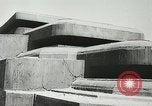
Allies penetrate into Normandy during D-day in World War II. Germans defend from Atlantic Wall and counter attack
Film begins showing the formidable German Atlantic Wall fortifications in place during World War 2. German soldiers look through binoculars. British troops are seen in the distance, where they have penetrated the River Orne, in an amphibious assault near the village of Ouistreham in Normandy. Obstacles are seen planted by the Germans all along the shorelines. German artillery and machine guns fire on those troops with devastating effect. German soldiers are seen examining abandoned British landing craft after the battle. One is labeled LC P L208. Closeup of German SS soldier. View of beach with markers on it and debris strewn along it. Closeup of a German soldier. A camouflaged German Marder tank destroyer heading to join in counterattack against Allied forces. German armor crossing a field, and then firing from wooded areas. German infantry running forward beside tanks.
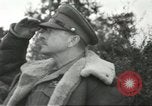
Allied tanks take position and fire as a commander gives orders in Anzio, Italy during World War II.
Allied tanks support infantry in Anzio, Italy during World War II. British Army General Harold Alexander looks at the sky. An Allied officer looks through binoculars. Allied artillery and other equipment move away. British tanks move past a wooded area. Tank guns being fired. A tank commander gives firing orders over a wireless.

U.S. soldiers being hit by shell fragments and their recovery after surgery in Naples during World War II.
A film titled 'Soft Tissue Wounds' shows U.S. soldiers being hit by shell fragments and their recovery after surgery in Naples during World War II. Bombs stacked on a field. U.S. sailors work around. A battleship's gun firing salvo. Fragments are removed by surgery from battle casualties. Reports of four cases handled in the Italian campaign of January 1944. The first case shows a soldier hit by a shell fragment. U.S. troops carry the soldier hit by the shell fragment in Italy. A truck moves ahead on a road. Wounded being carried into an evacuation hospital tent. A wound just below the buttock of a soldier. Primary infusion is given to the patient. The bleeding is controlled. The wound is dusted. Dressing completes an operation. The healing of the wound after a few weeks of the operation. The patient walks after healing. A U.S. soldier shows a scar under scapula. A U.S. LST (Landing Ship Tank) fires towards Anzio Harbor. [Note: script refers to British Hospital Carrier Leinster (#37) although footage appears to be of (British) Hospital Ship St. David (#27), later sunk by the Germans at Anzio in January, 1944]. A wounded soldier is carried on a stretcher aboard the hospital ship. Surgery is performed on the wounded soldier. The soldier on a bed after the operation. A ship underway at sea. A Red Cross ambulance and a truck transport the wounded soldiers to a hospital in Naples. The wound after one week of injury. The wound margins are refreshed. The wound edges are stitched. Removal of stitches after eight days. The soldier smokes a cigarette after recovering.
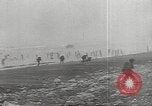
Allied troops and reinforcements hit the beaches of Normandy during D-Day invasion in World War II.
During invasion of France, in World War II. Allied troops land and advance in Normandy on D-Day. U.S. troops run across a beach. Troops disembark from assault boats and wade through surf toward beach. Soldiers rescue wounded soldiers from water. Wounded soldiers being helped out from water. Medics treat wounded soldier on beach. British troops arrive on beach with a team of medics. British troops advance inland. LCIs (Landing Craft Infantry) unload troops in the background. Allied reinforcement troops arrive on beach. Heavy engineering equipment on beach. Allied bombers drop bombs over enemy targets. From edited film produced in 1947.
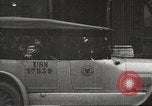
Rear Admiral William Moffett, Chief of U.S. Navy Bureau of Aeronautics. Admiral William Sims, commander of U.S. naval forces in Europe.
Brief glimpse of a U.S. Navy staff car parked in front of a Federal Government building entrance, where several naval officers and at least one army officer prepare to board the car. Attending the car are two sailors wearing dark watch caps. Next, Rear Admiral William A. Moffett, Chief of the U.S. Navy Bureau of Aeronautics, is seen leaving the building on crutches. His right foot is heavily bandaged. A sign in the window of the building reads: "U.S. Navy Aviation." A cadre of naval officers follows the Admiral to the sidewalk, where he cheerfully engages in conversation with several. To his left is a Captain. The other officers are of lessor rank. They appear to be awaiting a car to pick up the admiral. Following a break, two of the naval officers are seen conversing alone at the building entrance. The admiral has left. Change of scene shows a man in military uniform seated at a desk in what appears to be a law office. He is making notes on a pad. The room is filled with shelves full of books. Abrupt change of time and place shows Vice Admiral William S.Sims, Commander of all U.S. Naval forces in Europe, at a railroad train station in London, England, at the end of World War 1. People around him show him some papers and converse with him. A British Bobbie stands nearby. Sims shakes hands with a British official. School boys in the background watch the goings on with interest.
CRITICALPAST.COM: About Us | Contact Us | FAQs - How to Order | License Agreement | My Account | My Lightboxes | Shopping Cart | Advanced Search | Featured Collections | Website Terms & Conditions | Privacy Policy ©2026 CriticalPast LLC.
License Agreement |
Terms & Conditions |
Privacy Policy
©2026 CriticalPast LLC.