


 Francais
 Deutsch
 Italiano
Refine Your Search
British-Gliders stock footage and images
- Showing 2617 to 2622 of 3412 results more
more Hide
Hide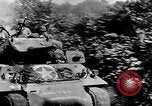
United States infantry and tank units in France; focus on U.S. tanks, camouflage techniques, and mine detection and demolition
United States tanks on a road in France during World War 2. United States infantry and tank units in France. Sand bags are packed tight around a tank to fortify and dampen effect of enemy fire. U.S. tanks camouflaged, first with painting (a tank with lettering 'Warhawk" on the side is shown); then with branches over top to help conceal it. Nets and haystacks used for covering and obscuring tanks. Snow covered fields near St Vith. Tanks painted white with a whitewash to camouflage for winter battle. Tanks with lettering on side, "Kathleen", is whitewashed. A tank hits mines and explodes. A British tank outfitted with flails is used to find and detonate land mines. An explosive 'Snake' deployed in a field and used for demolition of enemy mines.
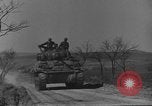
A tank battle between United States and German tanks in France (WW2)
A tank battle between United States and German tanks in France during World War II. Several U.S. Sherman tanks advance on a road. German Panther tanks advance on a nearly parallel road that eventually merges and tank battle ensues at the road junction. Wrecked early-war French and British tanks are seen. Mountains in the background. U. S. infantry move through woods behind Sherman flamethrower tank. Several German soldiers surrender to U.S. troops. Sherman tanks move through woods. A sherman dozer tank knocks down a tree. American Sherman tanks moving through a town or city as troops fan out.
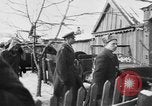
German 6th Army surrenders to Soviet forces at battle of Stalingrad in World War II
German Field Marshal Friedrich Paulus, enters a wooden building near Stalingrad where he surrenders the German 6th Army. He, and Arthur Schmidt, General-lieutenant, Chief of the 6th Army Staff; take seats,surrounded by Soviet Army officers. Scene shifts to the twenty two Divisions (300 thousand men) of the 6th Army trudging through the snow as they surrender. Most of them are seen in open fields near Stalingrad, Russia. Closeups of some make their way along a street in the city. Many wear makeshift shoes and other contrived clothing. They are clearly suffering from their lack of any cold weather equipment. Aerial view of a long line of surrendering German soldiers making their way on snow-covered street in Leningrad. Closeups of some of the German soldiers. One soldier walking slowly, alone, across a stretch of snow. He wears woven homemade coverings over his feet.He heads, alone, toward an open stretch of barren snowy land. Camera focuses on ice strewn Volga River. A dead German soldier lies on its bank. View of Russian countryside, the following Spring. An animated map depicts the extent of the Soviet advance in the previous winter with the occupation of 185 thousand square miles of territory (more than previously occupied by the German forces). Film shows weapons captured during the 6th Army surrender, including German aircraft, tanks, heavy artillery guns, light machine guns, rifles, artillery shells and small arms ammunition. Glimpse of dead German soldiers in the snow. Aerial view of rail cars containing captured German military supplies. Lines of surrendering German soldiers making their way in the snow. Numerous dead German soldiers in body bags, in the snow. Animated film reviews the German operation Barbarossa and subsequent events in the German invasion of Soviet Russian in 1941, 1942, and 1943. Glimpses of Russian troops dressed in white and British troops advancing. Film concludes with artistic representation of United Nations flags and troops marching to victory.
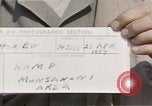
Large ambulance trucks arrive at Camp Munsan-Ni in Korea
Large ambulance trucks arrive at Camp Munsan-Ni in Korea during Operaton Little Switch, the first phase of Operation Big Switch prisoner repatriation efforts. United States Marine rides along the side of a running board of a truck and guides the driver to the parking area. Prisoners get out of the ambulance trucks. British flag and large tents in the background. Activities of the troops. Trucks and tents in the entire camp area.
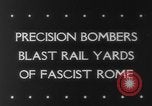
Precision bombing of Railroad yards in Rome, Italy by over 500 Allied bombers during World War 2
Allied aircraft parked at North African airbases. The British and American crews study charts and maps of Rome and mark bombing locations. Pilots and navigators board the planes. Bomber aircraft in flight. Railroad yards in Rome bombed with pinpoint precision by Allied bomber planes in broad daylight. Targets included the San Lorenzo freight yard and steel factory, the "Scalo del Littorio" on the north side of Rome, and the Ciampino airport.

NATO (North Atlantic Treaty Organization) air exercises
NATO (North Atlantic Treaty Organization) air exercises in Western Europe. Air power of the Atlantic Pact Nations exhibited. Americans, French and British join in a mass transport and parachute exhibition at strategic points. Thunder jet fighter-bomber aircraft stand at the airbase. General Eisenhower confers with officers. Tent in the background. Pilots seated in the cockpit. Planes in flight. Troops trained with U.S. equipment.
CRITICALPAST.COM: About Us | Contact Us | FAQs - How to Order | License Agreement | My Account | My Lightboxes | Shopping Cart | Advanced Search | Featured Collections | Website Terms & Conditions | Privacy Policy ©2026 CriticalPast LLC.
License Agreement |
Terms & Conditions |
Privacy Policy
©2026 CriticalPast LLC.