


 Francais
 Deutsch
 Italiano
Refine Your Search
British-Gliders stock footage and images
- Showing 2635 to 2640 of 3412 results more
more Hide
Hide
Queen Elizabeth II raises a toast at the 40th anniversary of the Royal Air Force in London, England.
Gala dinner celebrating the 40th anniversary of the British Royal Air Force (RAF) in London, England. Queen Elizabeth II, Prince Phillip, the Duke of Edinburgh, Queen Mother Elizabeth Bowes- Lyon and Princess Margaret arrive at the 40th anniversary celebrations of the Royal Air Force. The Queen and the other members of the royal family are seated at the dinner table. The Queen raises the toast at the occasion and drinks followed by others.
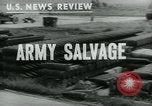
Old military equipment and armament being scrapped at Aberdeen Proving Grounds in Maryland, United States.
Scrap processing operations at Aberdeen Proving Grounds in Maryland, United States, for the World War 2 war effort. Shells piled up. Tanks in a sling as they are being placed for the scrap. Mortars, tanks, cannonballs and a German 42 cm Howitzer being scrapped at the proving grounds. British, German and French tanks are scrapped. Guns and field pieces are also scrapped. A man cuts a barrel of a gun. Old equipment so scrapped saves on steel, coal, man power and time.

German submarine UB-35 leaves port on mission during World War I
Early slates allude to failed attempts at peaceful resolution of issues between Germany and England, in World War 1, and the Kaiser's consequent decision on February 1, 1917, to intensify German submarine warfare against Britain. Slate refers to Churchill's admitted concerns expressed in the "Sunday Pictorial," about the resulting constraint on England's control of the seas around the British Isles, referring to the U-boats creating a magic girdle (Magischen Gurtel) around England, which becomes the title for the film. In the first part, Captain, Lothar von Arnauld de la Periere of the German U-boat UB-35, stands in a skiff as he is rowed out to his submarine. He exchanges salutes with his officers, as he boards the U-35, nestled against a German ship. He gives the order to cast off the lines and proceed half power in reverse. The crew scrambles to get underway. German sailors on the nearby ship watch from her railings. Sailors use a long pole to help move the submarine away from the ship. Officers and men on the ship wave as the U-boat pulls away. Views from the submarine deck as it moves on the surface of the water heading toward the Mediterranean Sea. (World War i; World War 1; WWI; WW1)

German U-Boat sinks Greek ship "India" in 1917 during World War I. U-Boat crew captures and examines sea turtles, in 1915.
Opening scene shows a tramp steamer listing to starboard.during World War 1. She displays "India, Greece" in large letters on her side. Slate indicates that an explosives technician from a U-Boat had climbed aboard and set charges on the Greek Steamer, "India" as she is stopped in the Atlantic during World War 1. The India is carrying a cargo of coal from Cardiff Wales, to Oran. The ship is seen listing. Smoke still rises from her stack. Slate states that the cross on the hull of the sinking "India" is the Greek national emblem. The ship sinks lower and finally slides out of sight, with smoke rising above the water from her exploding boilers. (Note: This German U-boat is the SM U-35, which was operating in the western approaches to the Straits of Gibraltar after leaving the Mediterranean on 11-12 April. It carried a professional cinematographer on board. Two years earlier, on June 12, 1915 , the U-35 also sank the British ship, "Crown of India." ) The next sequence shows an image of the German Daily Express newspaper for Monday May 10, 1915. Dead! it reports in bold print: The world has a duty to conduct a Hunt for turtles. Scene shifts to deck of surfaced German U-boat, showing a dinghy arriving alongside, from which several giant sea turtles are unloaded. Crew members examine the turtles on the deck of the submarine. At least one appears to be dead. Next scene shows lookouts on conning tower of the U-Boat, as they see smoke on the horizon. (The Imperial German Naval war flag is displayed on the conning tower.) The Captain calls for full speed ahead on both engines, and the controls show that being selected. (World War i; World War 1; WWI; WW1)
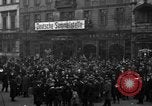
Citizen residents of Upper Silesia voting to determine whether they will be associated with Germany or Poland.
After World War 1, in accordance with Article 88 of the Treaty of Versailles, residents of Upper Silesia are deciding by ballot, whether to be attached to Germany or Poland. Citizens in Kattowitz (Katowice) milling about in front of a building with a sign that reads ' Deutsche Sammelstelle. ' A horse and wagon passes them. Armed French occupation troops climb aboard an open truck. A small boy watching is chased away by a soldier.The truck drives away, past crowds of people on sidewalks. Three uniformed French soldiers pose in front of crowd of spectators. Three uniformed men with Red Cross arm bands stand under red cross flag flying from building. People massed at entrance to a building move into it under sign reading "eingang." A French officer (General Henri Le Rond) standing with a British officer (Colonel Henry Percival) and an Italian officer (General Antonio de Marinis), reads a newspaper and converses with the others in garden at Oppeln (Opole). Views from moving train of industrial complexes with numerous smoke stacks and factories, in the Oppeln region of Upper Silesia. A map showing area of plebiscite, and the coal reserves and coal mines of the region.

Women run a food kitchen in Britain, during World War I
A Group of women pose, holding trays and dishes, next to a slate chalk board, containing a menu and pricing for food items on Friday, May 17th, 1918. The items are priced in British pennies. In a change of scene, women customers are seen leaving the building with food purchases.(one has a small dog on a leash.) Several stand and chat while they sip cups of tea. Back inside the building, three women smile as they hold food and empty dishes.
CRITICALPAST.COM: About Us | Contact Us | FAQs - How to Order | License Agreement | My Account | My Lightboxes | Shopping Cart | Advanced Search | Featured Collections | Website Terms & Conditions | Privacy Policy ©2026 CriticalPast LLC.
License Agreement |
Terms & Conditions |
Privacy Policy
©2026 CriticalPast LLC.