


 Francais
 Deutsch
 Italiano
Refine Your Search
British-Gliders stock footage and images
- Showing 3301 to 3306 of 3412 results more
more Hide
Hide
Delegations from the US, Britain and the Soviet Union attend the Dumbarton Oaks Conference in Washington DC, U.S.
Delegations from three Allied nations arrive in Washington DC, United States to study post-war security during World War II. Delegates disembark from aircraft and review a parade of troops. Soviet Ambassador to the United States Andrei Gromyko, U.S. Secretary of State Cordell Hull, British Permanent Under Secretary for Foreign Affairs Alexander Cadogan, U.S. Under Secretary of State Edward Stettinius arrive and attend the Dumbarton Oaks Conference. Secretary of State Hull speaks at the conference. Alexander Cadogan speaks.
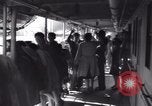
Jewish Zionist immigrants carrying their baggage disembark from a ship in Haifa, Palestine, during World War II.
Jewish refugees arrive in Haifa, Palestine during World War II. Jewish refugees aboard a ship docked in Haifa. View from inside the ship, as they disembark. A wagon filled with baggage drives by the front of the ship. A group of young adults dance the Hora on the bridge of the ship. Jewish refugees walking across the pier, past British soldiers and officials, after disembarking from the ship.
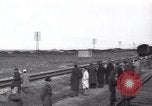
Jewish refugees arrive at a Palestine internment camp at Athlit in Haifa, Palestine during World War II.
Jewish refugees arrive in Haifa, Palestine during World War II. Jewish refugees in front of a train. The train is to take them to the disembarkation point and then to Palestine internment camp at Athlit. The train reaches and stops in Athlit. Members of Jewish agency stand along a road in front of the train. The refugees get off the rail cars. A sick person is helped by two nurses. A sick person on a stretcher is placed in an ambulance. The first column of the refugees leaves the station at Athlit and walks toward the quarantine camp. In the background is the sea and and nearer is the train which brought them. Palestinian and British police count the refugees on their entry into the camp.
U.S. Brigadier General Frank L. Howley speaks about Berlin blockade before a map after end of Berlin blockade.
A film titled 'Berlin Blockade Ends' depicts the conditions which existed during blockade, the Berlin Airlift operation, and final lifting of blockade in Berlin, Germany. Rooftops of Berlin. A damaged building. A plane flies high over damaged buildings. Pedestrians crowding streets. A group around newsstand. U.S. Brigadier General Frank L. Howley stands before a map of Berlin as he speaks about Berlin blockade. Interiors of Air Safety Center with French, British, and U.S. representatives working side by side. Brandenburg Gate in Berlin. Crowd on a street. Two Soviet officers walk along a deserted railroad track. Deserted Charlottenburg railroad station.
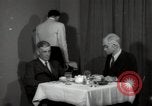
Meeting of Dr. George Pegram and Dr. Vannevar Bush in the United States concerning atomic bomb during World War II.
Reenactment shows a meeting of Head of American Physics Department George Pegram and Dr. Vannevar Bush in the United States concerning atomic bomb during World War II. Dr. Pegram and Dr. Bush talks at dinner. Pregram, just returned from Britain, reports to Bush that the Germans are working on an atomic bomb. He says that the British scientists are of the opinion that a uranium bomb is practicable but big industrial output necessary makes it imperative. Therefore work must be done in America. Bush says he is to see the President the next day, and he is confident they will get all the help they need.
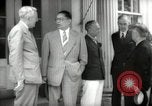
Foreign diplomats leave the White House in Washington D.C., United States during World War II.
Foreign diplomats at the White House in Washington D.C., United States during World War II. Foreign Diplomats leave White House. Diplomats from left to right includes Canadian Minister to United States Leighton McCarthy, Chinese Foreign Minister T. U. Swong, Finance Minister of New Zealand Walter Nash, Australian Diplomat Owen Dixon, British Ambassador to United States Viscount Halifax, President of Philippine Commonwealth Manuel Quezon. Diplomats get into cars.
CRITICALPAST.COM: About Us | Contact Us | FAQs - How to Order | License Agreement | My Account | My Lightboxes | Shopping Cart | Advanced Search | Featured Collections | Website Terms & Conditions | Privacy Policy ©2026 CriticalPast LLC.
License Agreement |
Terms & Conditions |
Privacy Policy
©2026 CriticalPast LLC.