


 Francais
 Deutsch
 Italiano
Refine Your Search
British-Gliders stock footage and images
- Showing 3361 to 3366 of 3412 results more
more Hide
Hide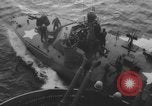
Allied bombers drop bombs on French towns, infantrymen land in Normandy beachheads during WW2
Allied ships and aircraft invade Normandy during D-Day landings in World War 2. Overhead view of PT boat (patrol torpedo boat) alongside ship as it heads towards shore. Allied aircraft flying, approaching Normandy beachheads. POV of United States infantrymen on an LCM (Landing Craft Mechanized) approaching Normandy. A bomber (Martin B-26 Marauder) flies over the English Channel. Two bombers (Martin B-26 Marauder) flying over Normandy. Aerial view of Normandy being bombed by bomber planes. Smoke from bomb attack in Normandy. Aerial view of various areas bombed in Normandy from Allied invasion. Two British commandos with faces darkened by camouflage makeup look towards shore from landing craft. Allied ships, LCM (Landing Craft Mechanized) and LCI (Landing Craft Infantry) ships sailing towards Normandy beachheads. Bomb explodes on ship off the coast of Normandy.
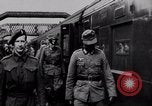
German prisoners-of-war enter their prison camp in Britain after their capture in Normandy during WW2
Arrival of German prisoners-of-war in Britain after their capture during the Invasion of Normandy (D-Day) in World War 2. German officers with downcast expressions leave their train in Britain. German prisoners-of-war are herded out of the train station by Allied soldiers. Captured German soldiers rounded up, entering their prison camp. A British soldier counts how many German prisoners arrive in the camp. German soldiers enter their camp in groups.
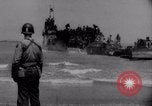
Reinforcements arrive in Normandy after its capture by Allied forces on D-Day during WW2
British, Canadian and United States soldiers clear up beachheads, receive reinforcements in Normandy after D-Day in World War 2. Soldiers sit on the beach, a sign says “Navy Beach C.P.”. Infantrymen dig in on the beach for protection. Sitting behind sandbags, a soldier fixes his belongings. Reinforcements and new supplies arrive in Normandy. Reinforcement troops and equipment land on beach. Soldiers in moving US Army truck. M4 Sherman-dozer, a tank with a bulldozer blade and outfitted with snorkel exhaust to make it a wading tank, also known as a tank dozer, clears the beach. This M4 dozer was named "Double Trouble" and operated by the 70th Tank Battalion. A body is seen in the foreground. Soldiers land on beach from LCM (Landing Craft Mechanized). Reinforcements carry supplies on their backs. Heavy machinery and vehicles land on beach from ships. GMC CCKW cargo trucks on beachhead in Normandy. Armored tanks (M4 Sherman tanks) move into a French town. Soldiers walk in meadow. A light tank enters a road towards Ver-sur-Mer. The location might be La Platine, just outside Courseulles-Sur-Mer. A sign reading “Dump Mae West” indicates to soldiers where to drop their life preservers. An M10 tank destroyer crosses a bridge. Infantrymen move into beach and grassy field. A Mk IV Centaur tank crosses a bridge. United States soldiers march along wall, one carrying a metal detector. A soldier carries carries a heavy machine gun, possibly a Browning M1917, and ammunition belt on his shoulders. United States Infantrymen wade through muddy water, passing by the corpse of a German soldier.
General Eisenhower and Admiral Sir Bertram Ramsay monitor D-Day from ship; General Montgomery visit, Allied fighters strafe Luftwaffe aircraft.
Allied invasion of Normandy (D-Day) during World War 2. United States General Dwight Eisenhower and British Admiral Sir Bertram Ramsay observes the invasion of Normandy onboard a ship. Sailors stand in formation onboard a warship as General Bernard L. Montgomery comes aboard. Two bombers (Martin B-26 Marauder) in flight. Aerial view of French countryside. German Luftwaffe fighters engage in a dogfight with Allied fighters. German plane (likely a Focke Wulf Fw-190) flies low over the ground, gets strafed by an Allied plane’s MG guns. German fighters explode in mid-air after being directly hit. German planes on the ground are strafed.

United States General Joseph Stilwell and Colonel Lewis A. Pick supervise the construction of the Ledo Road in India during WW2
Tree falls during construction of Ledo Road in World War 2. Aerial view of Ledo Road construction. United States General Joseph Stilwell and Colonel Lewis A. Pick closely watch the construction of the Ledo Road. A bulldozer push away soil in jungle roadwork. Truck drives on muddy road. A bulldozer pushes a fallen tree away. Chinese infantry arrive in Assam, India to help defend construction of the Ledo Road to China. Chinese soldiers wearing both United States and British military helmets marching. Chinese soldier fires artillery. Chinese soldiers move through jungle, shoots at Japanese invaders.
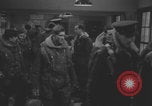
RAF crew of Vickers Wellington OJ-F start engines during WWII.
Period dramatization: British Royal Air Force (RAF) bomber pilots, part of No. 149 Squadron RAF suit up after a briefing on a mission during World War 2 at RAF Mildenhall. A pilot finds his helmet under a seat after a meeting. View of a Vickers Wellington OJ-F 'F for Freddie'. Crew disembark from a military truck after their arrival at bomber. Crew climbs ladder into bomber. View inside Wellington bomber as crew prepares for mission. Radio operator seated and adjusts radio. Pilot puts on his helmet inside the cockpit. A nose gunner climbs through fuselage of Wellington bomber to the nose gun. View outside bomber as gunner prepares inside nose gun. Pilot yells, "start her up" as ground crew members hold bag against engine manifold during startup. Propeller of Vickers Wellington OJ-F begins to move. Other engine is similarly started. Vickers Wellington bomber running its engine before takeoff. Ground control equipment that appears to be ground controlled approach radar equipment (GCA) is towed into place on the airfield.
CRITICALPAST.COM: About Us | Contact Us | FAQs - How to Order | License Agreement | My Account | My Lightboxes | Shopping Cart | Advanced Search | Featured Collections | Website Terms & Conditions | Privacy Policy ©2026 CriticalPast LLC.
License Agreement |
Terms & Conditions |
Privacy Policy
©2026 CriticalPast LLC.