


 Francais
 Deutsch
 Italiano
Refine Your Search
Bruchsal Germany 1945 stock footage and images
- Showing 6313 to 6318 of 10471 results more
more Hide
Hide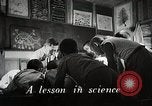
Japanese students gaining practical knowledge in school
A teacher teaching anatomy of fish in a science class as a diagram of fish is drawn on the board.A lot of practical work is included in school curriculum to ensure youth's contribution to the progress of the nation.A science teacher teaching with a magnifying glass as students work on some tools to get practical knowledge.In a geology class a girl draws a diagram of a volcano as the teacher and other students look on.Students work on factory tools in a class with wires and screwdrivers.Students are made to do light assembly work to impart technical and practical knowledge.
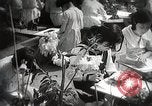
Students learn making ceramic products and music in arts class of school, Japan.
Japanese films show school activities to explain the school system and its deficiencies. The films emphasize the role of schools in developing nationalism, Japan. Students make drawings with colors and brushes in art class. Students seated around the teacher. Teacher teaches students to make natural scenery. Chart of objects displayed. Ceramic products have great importance in Japan and teachers impart their knowledge to students: Students make clay bodies. Clay objects displayed. A man takes clay product out from kiln. Students learn the national flag song in music class. Female teacher plays the musical instrument and teaches songs to children about nationalism and soldiers of country. (World War II period).
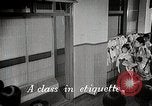
Elementary schoolgirls learn traditional Japanese tea ceremony and sewing in Japan.
The Japanese school system and its deficiencies up to World War II. The film emphasizes the role of schools in developing nationalism, Japan. Girls are taught the traditional Japanese tea ceremony. Female students learn to bow their heads and sit well. The teacher and other students watch a girl demonstrate good tea ceremony etiquette. The girl slides a door open and bows to another girl in kimono. Teacher teaches etiquettes of receiving guest. Girls wearing kimonos learn the ritual for serving and drinking tea. The girl brings a tray of rice cake or wagashi. Teacher teaches etiquette of drinking tea to girls. Japanese sewing class: Students make embroidery in sewing class. Geometrical designs for embroidery displayed. A Japanese sewing kit with thread, thread snippers and seam ripper. Girl takes out a needle from a sandal-shaped pincushion. The girl puts a thread into the needle before sewing the fabric. Girls sew the clothes and put kimono on mannequins. Girls sew at sewing machine.

Children entertain audience, play and learn to care babies in school, Japan.
Japanese films show school activities to explain the school system and its deficiencies. The films emphasize the role of schools in developing nationalism, Japan. A school program for parents: Two girls play musical numbers on koto (2nd popular musical instrument in Japan) in a program. Young Japanese perform play to entertain the audience of parents. Audience gives huge round of applause. Banzai cheers on stage. Teacher is in black uniform and students are in native kimonos. Teacher teaches students to rock the babies when they cry. Students are told to bring infants or their young brother and sister to learn care of baby. Students learn to make babies sleep and take care of them. Babies are rocked to sleep in a poor school.
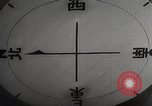
View of typical Japanese school room for the study of history and outdoor class of ethics in school, Japan.
Japanese films show school activities to explain the school system and its deficiencies. The films emphasize the school's role in developing nationalism, Japan. Typical Japanese school room: Teaching charts, geological drawings, Japanese paintings, picture of Beethoven, clock, electrical diagrams and various equipment and materials for the study of natural history. Class of Ethics: Japanese students learn the loyalty to emperor and devotion to country in outdoor class of ethics.
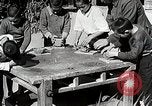
Students in outdoor classes shape and bake pottery; draw nature sketches in Japan.
Japanese films show school activities to explain the school system and its deficiencies. The films emphasize the school's role in developing nationalism, Japan. In outdoor class, Japanese students make and shape pottery roughly. They apply the color on pottery. Students learn to bake pottery in oven under guidance of teacher. Teacher puts the pottery out from oven. After drying process, pottery is painted and decorated. Students draw nature sketch in outdoor class. Teachers give instruction to sketch natural objects like flowers, leaves, bamboo and cherry blossom. Students learn to draw Snow capped mountains.
CRITICALPAST.COM: About Us | Contact Us | FAQs - How to Order | License Agreement | My Account | My Lightboxes | Shopping Cart | Advanced Search | Featured Collections | Website Terms & Conditions | Privacy Policy ©2026 CriticalPast LLC.
License Agreement |
Terms & Conditions |
Privacy Policy
©2026 CriticalPast LLC.