


 Francais
 Deutsch
 Italiano
Refine Your Search
Bruchsal Germany 1945 stock footage and images
- Showing 61 to 66 of 10461 results more
more Hide
Hide
Aircraft strafing industrial targets in Germany near end of World War II in Europe
Aircraft strafing a factory. Dark view of strafing railroad. Aircraft industrial targets in Germany in 1945, near the end of World War Two in Europe.
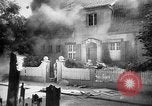
Russian feature film reenacting Soviet forces advancing in Germany and a German civilian family prepares to leave their house
From a Russian feature film "Meeting on the Elbe" (dubbed in Korean). Reenactment of the "East Meets West" meeting of the American and Russian soldiers at the River Elbe near Torgau Germany on April 25, 1945. Reenactment : A burning house. Smoke rising from the house. Russian troops in tanks move along the road in front of the house. The interiors of the house of a German civilian. The damaged interiors of the house. The German civilian rushes with his baggage. A Russian soldier behind the civilian. The civilian sits in a chair with the baggage. A girl and a boy beside the man sitting in the chair. A man in the room talks to the soldier. The civilian with the woman and the boy beside him. A soldier outside the entrance gate to the house as Russian forces take over the German town. (World War II period).
Views of captured Me 262 factory at Walpersberg, Kahla, Germany, near the end of World War 2
Scenes of captured site where Me 262 jet aircraft were assembled by Flugzeugwerke Reichsmarschall Hermann Göring (or Goering) (REIMAHG) in an old porcelain sand mine in the Walpersberg mountain, near Kahla. Germany. (The secret project was codenamed "Lachs" or Salmon). View of a tunnel entrance, from inside. .A partial Me 262 with wings, is silhouetted against tunnel entrance and several in stages of assembly can be seen darkly inside.a bombproof bunker. A middle/rear fuselage of an Me 262 is seen on a wagon outside the bunker buildings. Two bombproof bunker buildings are seen on their own. A tall derrick crane is seen moving objects from the facility. (Existing mining tunnels within the Walpersberg razorback mountain were expanded for production and bombproof buildings were constructed around its perimeter. An inclined lift was used to raise Me 262's from the perimeter building area to the top of the mountain, where a takeoff strip had been created for delivery of the aircraft to the Luftwaffe. The U.S. Army occupied the site on April 12th 1945, and reportedly removed enough partial assemblies and parts to produce five Me 262s for testing and research.)
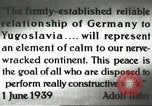
Tripartite Pact signed by Germany, Italy and Japan in Berlin, Germany. Ensuing attacks by Germany and Japan in World War II
This film is a scattering montage of World War 2 scenes from 1939 through 1945. Part of an agreement between Nazi Germany and Yugoslavia is shown in English. It is dated June 1, 1939 and ostensibly signed by Adolf Hitler. Next, German Ju 87, Stuka dive bomber aircraft are shown peeling off from formation, on April 6, 1941, to attack Yugoslavia. Bombs bursting on the ground. Closeup of a Stuka airplane in a dive, making its characteristic whine, and dropping bombs. Bombs exploding just outside some concrete walls. German infantry running along railroad tracks and entering backyard of house in a village. German soldiers observing from overlooking hill; climbing over rubble; and marching along a road toward a village. Animated map showing German invasion areas early in World War II, extending through most of Europe and into Norway, by 1941. Animated map shows further invasions into France, Belgium, low countries, the Balkans, and Eastern front towards the Soviet Union. Map highlights Tokyo, Rome, and Berlin. Delegations walking in hall of Reich Chancellery in Berlin, to sign Tripartite pact, on September 27, 1940. The group is led by by Count Galeazzo Ciano (Italian Foreign Minister, and Mussolini's son-in-law); Joachim von Ribbentrop, Germany's Foreign Minister and Japan’s Ambassador Saburō Kurusu. The diplomats are seen, next, standing near a table as Adolf Hitler enters rendering Nazi salute. He shakes hands with Count Ciano and Ambassador Kurusu. Hitler is seated to watch the proceedings. Von Ribbontrop is seen signing for Germany. Next scenes show German armored units heading East in Operation Barbarossa (June of 1941). A sign identifies the town of Eydtkau (Eydtkuhnen) on the German-Lithuanian border. German armor and artillery moving eastward. German troops destroying international crossing barriers. German troops firing siege guns. Montage with glimpses of German battle scenes showing tanks, guns, rockets in action with attendant explosions, fires, and destruction. Formations of German warplanes in flight, including Junkers Ju-52s that carry troops, including paratroops. View from above of Junkers Ju-87 Stuka dive bombers in formation. Battle of Britain scenes, with view of St. Paul's Cathedral in London, England (which miraculously survived the Blitz). The Tower Bridge in London, seen through a haze following blitzkrieg. German Junkers 87 Stuka dive bombers peeling off from formation to attack. British anti-aircraft searchlights shining beams skyward. Diving bombers illuminated by the lights. Anti-aircraft guns firing. Nighttime scenes showing gunfire flashes, explosions, tracer bullets and fires in London. British fire brigades fighting fires in London buildings as some collapse from the German bombing during the so-called "Blitz." Scene shifts to Pearl Harbor, December 7, 1941, as a Japanese bomb explodes on a U.S. Navy warship. The USS Arizona billowing smoke and listing as it succumbs to Japanese bombing. Another view of the Arizona sinking. Smoke rising from Battleship Row, at Pearl Harbor. Glimpse of postwar Nuremberg trial.
End of World War II and signing of UN charter in San Francisco, United States
United States and Soviet Union soldiers celebrate their victory as world War 2 comes to an end in Germany. "Elbe Day": Soviet and American soldiers meet at the River Elbe on 25-26 April, 1945. View of Nazi swastika being blown up at Zeppelinfeld in Nuremberg Germany in 1945. Scenes of celebration in the streets of Paris with French civilians cheering American and French soldiers and celebrating the end of World War 2. French women kiss soldiers. Crowd gathered in Times Square in New York celebrating VE-Day (Victory in Europe Day). Foreign Ministers of fifty nations arrive at San Francisco to sign the United Nations Charter. United States President Harry S. Truman addresses the delegates at the closing ceremony of the conference on June 26, 1946. Ships bring American soldiers back home, including some wounded, after World War 2. Women and families on dock at harbor wave and smile at arriving troop ship with American soldiers returning home. Also seen are soldiers of other countries including Soviet Russian soldiers returning to their families at a train station, with smiling and tearful family reunions. Cemeteries with headstones honoring soldiers who died in the war. Military hardware being scrapped to make peacetime goods. Views of explosive charges being set and military aircraft being blown up for scrap. Piles of scrapped military vehicles. A woman in a factory organizes newly manufactured clothes irons. Workers in a factory perform final assembly on newly manufactured ovens and stoves for homes.
Londoners celebrate VE Day, the end of World war II, in Europe
With the surrender of Germany, World War 2 in Europe ends, on VE (Victory in Europe) Day, May 8, 1945. Scene opens with church bells ringing and view of west front of St. Paul's Cathedral, on Ludgate Hill, in London, England. Crowd is celebrating in the square. around the statue of Queen Anne. Amongst the crowd are men and women in uniform. Here and there Union Jack flags are seen, one held by a little girl hoisted upon a man's shoulder. Camera pans across various parts of the celebrating crowds. View from above, of several couples dancing within a circle of people. Several uniformed U.S. Air Force officers in a jeep celebrate with the crowd. High altitude view of Trafalgar Square in London, England. 'Victory over Germany 1945' banner draped on base of Nelson's Column. Crowd of British citizens celebrating on streets of Whitehall and closeup of the Cenotaph with inscription "The Glorious Dead".
CRITICALPAST.COM: About Us | Contact Us | FAQs - How to Order | License Agreement | My Account | My Lightboxes | Shopping Cart | Advanced Search | Featured Collections | Website Terms & Conditions | Privacy Policy ©2026 CriticalPast LLC.
License Agreement |
Terms & Conditions |
Privacy Policy
©2026 CriticalPast LLC.