


 Francais
 Deutsch
 Italiano

Refine Your Search
Bruchsal Germany 1945 stock footage and images
- Showing 55 to 60 of 10470 results more
 Hide
Color Sound
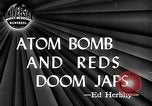
Allies demand the unconditional surrender of Japan in World War II. Entry of Soviets and use of atomic bomb ends the war.
Representatives of three nations, seated around table at Potsdam Conference held at Cecilienhof in Potsdam, Germany. British prime minister, Clement Attlee; President of United States, Harry Truman; and representative of Soviet Union, Joseph Stalin at the Potsdam Conference, July 1945. They deliver an ultimatum of unconditional surrender to Japan. Swarms of B-29 bombers and Aircraft Carrier Task Forces destroy Japanese homeland. Planes on carrier decks.Navy Grumman carrier-based TBF aircraft dropping bombs.. Destruction of ships at sea. Mushroom cloud due to atomic bombing. Chart depicts the power of one atomic bomb. Britain's 'grand slam' bomb, most destructive conventional bomb ever produced. Doctor Ernest Orlando Lawrence, inventor of the cyclotron (atom smashing machine). A man works at the Cyclotron at the University of California, Berkeley. General Leslie Groves, head of the project speaks. He is seated with Dr Vannevar Bush, government director of science and research, and Dr Richard Tolman, technical expert. Quantities of uranium shipped from Alberta, Canada are used in bombs. The atomic bomb process (Manhattan Project) is developed in widely separated areas; scenes from Hanford Project plant in Richmond, Washington. Project personnel exit cars and enter into the search area before starting their work day. Lieutenant colonel Franklin T Matthias with the army corps of engineers, appointed to the Hanford Project. Sign of 'Oak Ridge' in Tennessee. Largest of the three atomic bomb plants located near the Tennessee Valley Authority (TVA) dam. Employed personnel in atomic bomb plants are seen going to work. Man and woman employees at the plan read and smile at a Knoxville Journal newspaper in August 1945 with news headline "Power of Oak Ridge Atomic Bomb hits Japs" after the atomic bomb was dropped in Hiroshima. View of dense prefabricated home communities to house large number of Oak Ridge plant workers. View of families setting up their houses in trailer towns after the prefabricated homes were full. People come out from the Henebry's Jewelers and supermarket, among stores setup to meet the needs of the quickly built city. Scenes changes to show view of Soviet leader Joseph Stalin at conference. Russian artillery and troops in a parade at Red Square in Moscow, Russia (these parade scenes are from the May 1, 1945 May Day parade, just days before Germany's surrender). President Harry Truman reports on the latest developments regarding the war with Japan. He states that the United States is prepared to destroy every productive enterprise in Japan and the U.S. shall completely destroy its power to make war. He warns of an attack by the U.S. due to the rejection of the July 26th ultimatum at Potsdam. He warns that Japan "should expect a rain of ruin from the air; the like of which has never been seen on this earth." Truman notes that it will be followed by an unprecedented sea and land invasion of Japan.
Tripartite Pact signed by Germany, Italy and Japan in Berlin, Germany. Ensuing attacks by Germany and Japan in World War II
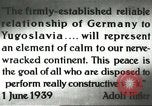
This film is a scattering montage of World War 2 scenes from 1939 through 1945. Part of an agreement between Nazi Germany and Yugoslavia is shown in English. It is dated June 1, 1939 and ostensibly signed by Adolf Hitler. Next, German Ju 87, Stuka dive bomber aircraft are shown peeling off from formation, on April 6, 1941, to attack Yugoslavia. Bombs bursting on the ground. Closeup of a Stuka airplane in a dive, making its characteristic whine, and dropping bombs. Bombs exploding just outside some concrete walls. German infantry running along railroad tracks and entering backyard of house in a village. German soldiers observing from overlooking hill; climbing over rubble; and marching along a road toward a village. Animated map showing German invasion areas early in World War II, extending through most of Europe and into Norway, by 1941. Animated map shows further invasions into France, Belgium, low countries, the Balkans, and Eastern front towards the Soviet Union. Map highlights Tokyo, Rome, and Berlin. Delegations walking in hall of Reich Chancellery in Berlin, to sign Tripartite pact, on September 27, 1940. The group is led by by Count Galeazzo Ciano (Italian Foreign Minister, and Mussolini's son-in-law); Joachim von Ribbentrop, Germany's Foreign Minister and Japan’s Ambassador Saburō Kurusu. The diplomats are seen, next, standing near a table as Adolf Hitler enters rendering Nazi salute. He shakes hands with Count Ciano and Ambassador Kurusu. Hitler is seated to watch the proceedings. Von Ribbontrop is seen signing for Germany. Next scenes show German armored units heading East in Operation Barbarossa (June of 1941). A sign identifies the town of Eydtkau (Eydtkuhnen) on the German-Lithuanian border. German armor and artillery moving eastward. German troops destroying international crossing barriers. German troops firing siege guns. Montage with glimpses of German battle scenes showing tanks, guns, rockets in action with attendant explosions, fires, and destruction. Formations of German warplanes in flight, including Junkers Ju-52s that carry troops, including paratroops. View from above of Junkers Ju-87 Stuka dive bombers in formation. Battle of Britain scenes, with view of St. Paul's Cathedral in London, England (which miraculously survived the Blitz). The Tower Bridge in London, seen through a haze following blitzkrieg. German Junkers 87 Stuka dive bombers peeling off from formation to attack. British anti-aircraft searchlights shining beams skyward. Diving bombers illuminated by the lights. Anti-aircraft guns firing. Nighttime scenes showing gunfire flashes, explosions, tracer bullets and fires in London. British fire brigades fighting fires in London buildings as some collapse from the German bombing during the so-called "Blitz." Scene shifts to Pearl Harbor, December 7, 1941, as a Japanese bomb explodes on a U.S. Navy warship. The USS Arizona billowing smoke and listing as it succumbs to Japanese bombing. Another view of the Arizona sinking. Smoke rising from Battleship Row, at Pearl Harbor. Glimpse of postwar Nuremberg trial.
Funeral of United States General George Patton and key moments and accomplishments during his life.
On the life of U.S. General George S Patton Junior (with narration by Ronald Reagan). Fight at the Siegfried Line during World War 2. U.S. 3rd Army cross the Siegfried Line. General Patton with his officers. Patton's troops cross the Rhine. American soldiers in the streets of Germany. Patton presents the Medal of Honor to a soldier. Patton sees dead people at a concentration camp in Germany. Patton's army moves towards Denube Valley. Civilians in the streets. Patton with officers. Written on a wall 'Hitler is kaput'. Trucks loaded with soldiers. A gun thrown on a pile of guns on the ground. Patton in a barge. A welcome ceremony for General Patton on his return to US: A parade along Broadway in Los Angeles on June 9, 1945, as over 1 million citizens welcome General Patton home and cheer. Shops and offices on Broadway in Los Angeles. Patton waves at the people from an open jeep. Patton and General Doolittle in Los Angeles. General Doolittle makes a speech at a ceremony and introduces General Patton. Patton addresses the gathering and talks about the war and the accomplishments of the Third Army. He notes that from aerial view, Germany and Austria "look like hell from the top." And "that's what any place that the 8th Air Force and the Third Army worked on looks like." Also Patton says, "You must remember this. That from Brest, to various towns in southern Germany and Austria whose names I can't pronounce, but whose places I have removed," (laughter in crowd), "the trail of the Third Army and the 19th Tactical Air Command and the 8th Air Force is marked by more than forty thousand white crosses; forty thousand dead Americans." View of a military cemetery graveyard. General Patton lays flowers at the grave of one of his soldiers. Patton watches a race at Soldiers Field Academy. He shakes hands with the winners. Soldiers carry Patton's coffin wrapped in American flag. Patton's grave with flowers on it. Two soldiers stand beside it. Patton's statue at the West Point Military Academy.
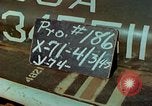
Crash landed USAAF P-47D Thunderbolt at Eschborn Airfield, Germany, near the end of World War II in Europe
Germany about a month before the end of World War 2 in Europe. A crash landed United States Army Air Force Republic P-47D Thunderbolt aircraft, nicknamed "Mom's Irish Mick." It was assigned to the 404th Fighter Squadron, 371st fighter Group, and crash landed on Advanced Landing Ground Y-74 Frankfurt/Eschborn that had been seized by advancing U.S. forces, in 1945. The aircraft carries tail number 44-33253 and was piloted by Charles T. Martin III. Officers retrieve ammunition from the wing gun. Crane brought in to lift the fighter plane also known as the Jug. Crane pulls the P-47 off field. The hulk of a Gotha 242 transport glider stands next to the American flag at half mast with air field tents in the background. A formation of P-47s flies over the flag. Four P-47s buzz and pull up with the flag in foreground. P-47s flying in 'V' formation with American flag in foreground and officers on the ground. Four P-47s circle for landing. A North American T-6 Texan training plane, a.k.a. Harvard, with occupants in both cockpits, taking off and pulling up.
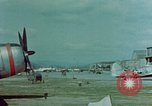
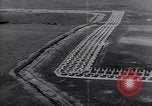
American P-47 aircraft at an Allied occupied airfield in Germany.
Aircraft P-47s parked around hangars at Allied occupied airfield in Germany in 1945. P-47aircraft taxiing and taking off. 'Chick' written on side of one airplane. (World War II period).
Aircraft strafing industrial targets in Germany near end of World War II in Europe
Aircraft strafing a factory. Dark view of strafing railroad. Aircraft industrial targets in Germany in 1945, near the end of World War Two in Europe.
CRITICALPAST.COM: About Us | Contact Us | FAQs - How to Order | License Agreement | My Account | My Lightboxes | Shopping Cart | Advanced Search | Featured Collections | Website Terms & Conditions | Privacy Policy ©2026 CriticalPast LLC.
License Agreement |
Terms & Conditions |
Privacy Policy
©2026 CriticalPast LLC.