


 Francais
 Deutsch
 Italiano
Refine Your Search
Bruchsal Germany 1945 stock footage and images
- Showing 127 to 132 of 10461 results more
more Hide
Hide
Russian troops leave Iran in 1945 and street riots in Iran in 1950.
Russian troops leave Iran and street riots in Iran. Russian troops leave Iran in 1945 after the end of World War II. People walk carrying bouquets. A Russian officer gets into a jeep. People of Iran look at the departure of the Russian troops from the balcony of their buildings. People stand on both sides of a road. Russian Army vehicles move past. Last part of clip is unrelated, and shows scenes of street riots in Iran in 1950. Police or military guards ride horses during the riots to push back the crowd of Iranian civilian protestors.
German Junkers JU-29 and U.S. P-80 shown on Air Force Day at Wright Field in 1945. Orville Wright attends the event
Celebration of the 38th anniversary of the U.S. Army Air Forces, dating back to establishment of the Aeronautical Section of the U.S. Army Signal Corps, in 1907. Airmen of the Army Air Forces march in formation on the flight line at Wright Field in Dayton,Ohio. Aviation pioneer, Orville Wright, is seen in the reviewing stand. A color guard marches past the the reviewing stand. A 4-engine German Junkers JU-290 transport aircraft is seen parked on the field. (It arrived on July 31, 1945, after being flown to Wright Field from Europe, by U.S. Air Forces Colonel Harold E. Watson and co-pilot Captain Fred McIntosh,who were delivering it to Air Technical Intelligence Headquarters.) The crew of the JU-290 (named "Alles Kaputt") pose in front of it. Colonel Watson, is seen holding a Dachshund dog. The JU-290 takes off on a demonstration flight. A new U.S. P-80 "Shooting Star" jet airplane (serial number 44-84995) is rolled out for all to see. It takes off in a demonstration flight. (Late in World War 2.)
Philadelphia fetes Generals Spaatz and Bradley, on Returning Heroes Day, June 4,1945
Returning Heroes Day, June 4, 1945, in Philadelphia, Pennsylvania during World War II. Officials and soldiers in a celebration arranged in honor of U.S. Army Air Force General Carl Andrew Spaatz, and U.S. Army General Omar Nelson Bradley. The Generals on special guest seats with Pennsylvania Governor, Edward Martin and Philadelphia Mayor, Bernard Samuels. An Army Major General sits with them. Soldiers, in a park, fire artillery gun in salute. Civilians shower ticker tape and confetti from the top of a building. They raise American flags. Army guards line the parade route, standing at parade rest with rifles. Policemen on motorbikes escort motorcade.. The Generals sitting with Governor Martin in an open customized jeep. A military band on a road side plays music. The Generals salute them. Spectators stand at the road sides. They shower ticker tape and confetti on the motorcade of the Generals. As they pass a park, soldiers fire an artillery gun in salute. In the downtown commercial district, banners across the street advertise E bonds. A band plays on the sidewalk as the motorcade passes.
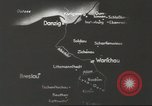
German forces defending against Soviets on the Vistula line in World War II Winter of 1945. Kriegsmarine operations in the Baltic
Opening scene shows map with principal cities of Danzig, Königsberg, Warsaw, Breslau and the Vistula River and Baltic Sea (Ostsee) among other places shown. Gernan forces forming a defense against Soviets on the Vistula line in the Winter of 1945, during World War 2. German troops are seen in white winter gear manning positions in deep snow. They are seen in midst of high winds and snowstorm. Only a couple of motorcycles move through the storm. Closeups of some of the German soldiers. Scene shifts to a Baltic seaport, where German troops and war materiel are being loaded for transport to the front. Views of German supply convoy underway through ice floes in the Baltic. Glimpse of German sailors on deck in cold weather gear. View from snow covered deck of an accompanying warship of the convoy steaming ahead. At TC:01:09, the German Cruiser Prinz Eugen is seen underway in the Baltic. She carries a an observation aircraft amidship. Next, German warships are seen firing multiple salvos from their naval guns.
American ships of Task force 58 defend against Japanese Kamikaze attacks during April and May, of 1945 in World War II battle of Okinawa.
Film opens with shaky views of Japanese Kamikaze airplane attacking and being shot down by gunners on a U.S. Navy aircraft carrier of Task Force 58, during the Okinawa campaign of World War 2. Burning wrecked aircraft seen on the carrier flight deck. Firefighters run across flight deck with hoses. A landing F4F fighter plane number 59 runs into the flaming wreckage on the deck, and explodes. View from the side of F4F number 58 engulfed in flames as it sits in a pool of firefighting foam. Black flak clouds in the air. A Kamikaze aircraft crashes harmlessly into the sea. Deck crewmen help a pilot out of the cockpit of a fire scorched F4F. View of sailors standing next to a pair of heavy gun barrels on a U.S. warship. Parachuting U.S. pilot seen touching down in the water after bailing out of his aircraft. Sailors running across the flight deck of a carrier. View of the pilot in his life vest being helped aboard the carrier. More views of flak filled sky and a flaming Japanese airplane diving straight down to crash harmlessly in the water. View of American flag at half mast on a U.S. Navy warship. It is April 12, 1945 and President Franklin D. Roosevelt (FDR) has just died. View of sailors on deck in a memorial service for the President. Closeup of mourners singing with hymnals open. Closeup glimpse of FDR. More views of mourners. Scene changes to Japanese Kamikaze being blasted out of the air in pieces, by anti-aircraft fire from a U.S. carrier. The remains fall into the sea. View from U.S. ship, of a Japanese Nakajima L2D transport aircraft with flames coming out of its right wing, as it descends close to the water near the ship, with its landing gear down. View from a more distant ship of the transport plane exploding in the water near a U.S. Escort aircraft carrier. Twin Bofors anti-aircraft guns firing from a U.S. ship. Tracer bullets fill the sky aimed at a Japanese Kamikaze plane. Slates overlay the scene announcing Japanese aircraft shot down: "April 6th: 277 aircraft; April 12th: 100; May 3rd: 97;" Film ends showing more anti-aircraft fire from ships against attacking Japanese aircraft.
Warships of the U.S. Navy fleet in the Hudson River on Navy Day in 1945
View of the Hudson River from an aircraft flying North, over the New Jersey shoreline. United States Navy warships are seen in the Hudson River, on the occasion of President Truman's first official visit to New York City, on Navy Day, October 27, 1945. Approximately 50 ships were anchored in the Hudson. The first clearly identified is the Battleship, USS Missouri(BB-63) with the Destroyer USS Renshaw (DD-499) tied alongside (bringing President Truman aboard during his review of the fleet). Others seen include the USS Midway (CVB-41); the USS Enterprise (CV-6); The USS Augusta (CA-31); and the USS Boise (CL-47). Several more surface ships are seen followed by six submarines on the surface, as the aircraft approaches the George Washington Bridge. More warships seen North of the bridge. Scene shifts to the USS Missouri and USS Renshaw, again. Next, the aircraft flies past a Navy blimp hovering below, over the river. The Aircraft Carriers, Enterprise and Midway are seen again. Glimpses of the New York City shore and buildings are seen at times in the film, as well as the palisades on the New Jersey shore, near the George Washington Bridge.
CRITICALPAST.COM: About Us | Contact Us | FAQs - How to Order | License Agreement | My Account | My Lightboxes | Shopping Cart | Advanced Search | Featured Collections | Website Terms & Conditions | Privacy Policy ©2026 CriticalPast LLC.
License Agreement |
Terms & Conditions |
Privacy Policy
©2026 CriticalPast LLC.