


 Francais
 Deutsch
 Italiano
Refine Your Search
Bruchsal Germany 1945 stock footage and images
- Showing 1543 to 1548 of 10461 results more
more Hide
Hide
Brigadier General Milton B. Halsey inspects liberated concentration camp in Flossenbürg, Germany, at end of World War II.
View from an overlooking hillside of the Flossenbürg concentration camp in Germany, in the closing days of World War 2. Camera pans over rows of large barracks in the distance. A water supply pond is in the foreground. Scene shifts to Brigadier General Milton B. Halsey, of the U.S. 97th Infantry Division, as he strides into the camp, accompanied by a full Colonel and other officers on his staff. A civilian photographer stands near the iron gates of the camp. The General pauses to speak with another officer, who had arrived at the camp earlier (possibly with the 2nd Cavalry Regiment). Halsey and staff, now accompanied by several more officers and soldiers, walks past an area from which white smoke is rising. They pass clothing and equipment piled on the ground. An officer leads them and points out features of the camp. They descend steps beneath steel grating and look at a wooden cell with bunks in it. Next, they are seen, outdoors, conversing near a fence line. Several civilians are now with them. Halsey and his staff retrace their path underground and ascend steps from under the steel gratings. They pause near a wooden barracks building and then continue across a camp yard, where several vehicles are parked, and board waiting jeeps, in which they drive away. General Halsey's jeep displays a star on its bumper. (His driver has been identified as Glen E. Miller of Calhoun, Illinois.)

Soldiers and civilians take out corpses from from different areas in Flossenburg, Germany during World War II.
Liberated slave labor camp in Flossenburg, Germany during World War II. Soldiers and civilians stand on a field. They take out corpses from different areas. Mutilated corpses on the field. They dig out the bodies of the slave laborers, killed during the evacuation of the concentration camp.
Bayonets and bullet wounds on the heads and chests of dead bodies in Flossenburg, Germany during World War II.
Slave labor camps in Flossenburg, Germany, soon after liberation during World War II. U.S. soldiers and civilians stand on the field. They take out corpses from different areas of Flossenbürg Concentration Camp. Mutilated corpses on the field. Bayonet and bullet wounds on the heads and chest of the bodies. A cross pendant on a dead body, a victim of Nazi atrocities.

The male displaced persons doing calisthenics and drill under the direction of UNRRA workers in Wetzlar, Germany.
Displaced person camp in Wetzlar, Germany after the end of World War II. The United Nations Relief and Rehabilitation Administration (UNRRA) workers arrive at the camp. Male displaced persons march on the ground. Buildings in the area. The workers discuss amongst themselves. Men do calisthenics and drill under the direction of UNRRA workers.
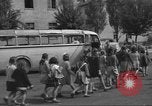
Children play with the adult displaced persons under the direction of UNRRA workers in Wetzlar, Germany.
Displaced person camp in Wetzlar, Germany after the end of World War II. The United Nations Relief and Rehabilitation Administration (UNRRA) workers arrive at the camp. Children enter a bus for the tour of local area. They wave their hands towards the people standing outside as the bus leaves the area. The UNRRA workers stand outside a building. A sign reads: 'Headquarters' on the building gate. Children on playground with adult displaced persons. Children play on the grounds of the facility. A large number of children on a giant see-saw together. Women talk to them.
Children play and receive food in Wetzlar, Germany after the end of World War II.
Displaced person camp in Wetzlar, Germany soon after World War II. The United Nations Relief and Rehabilitation Administration (UNRRA) workers arrive at the camp. Children on playground with adult displaced persons. Children play on the ground. The adult displaced persons direct their games under the supervision of the UNRRA workers. Children receive food.
CRITICALPAST.COM: About Us | Contact Us | FAQs - How to Order | License Agreement | My Account | My Lightboxes | Shopping Cart | Advanced Search | Featured Collections | Website Terms & Conditions | Privacy Policy ©2026 CriticalPast LLC.
License Agreement |
Terms & Conditions |
Privacy Policy
©2026 CriticalPast LLC.