


 Francais
 Deutsch
 Italiano
Refine Your Search
Bruchsal Germany 1945 stock footage and images
- Showing 295 to 300 of 10461 results more
more Hide
Hide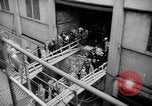
A large number of visitors board the USS Wasp at the Puget Sound Navy Yard, Bremerton, Washington
Visitors board and crowd the deck of the USS Wasp (CV-18) in June, 1945, near the end of world War II. The Wasp is about to depart again, for the Western Pacific, following repairs at Puget Sound Navy Yard, Bremerton, Washington. Two U.S. marines are escorting two women, and showing them an F4U Corsair airplane on the deck. Some of the visitors look up toward the camera. The aircraft on deck have been arranged for this static display. visitors are seen departing across a gangplank. Views from deck of the Wasp, of Navy personnel on the pier, below. Camera pans across the pier where spectators still stand. A few people stand on the water side of a building. A large group of visitors coming up from the hangar deck. Civilians and sailors wave at the camera. Visitors leaving the carrier on the gangplank.
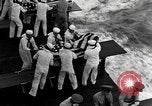
Bodies committed to ocean and Marine rifle salute in mass funeral ceremony aboard USS Hancock (CV-19) in the Pacific Ocean.
Mass funeral aboard the USS Hancock (CV-19) in the Pacific Ocean. Bodies committed to ocean in Mass Funeral Ceremony. Multiple crews of six men each carry dead sailors, wrap each in the U.S. flag, place them on a board and tip them into the ocean. Marines fire rifle salute. View of sheet covered bodies on lower deck awaiting burial at sea. The 50 men were killed in a January 21, 1945 accident when a TBF Avenger returned from a sortie in the area of Formosa (Taiwan). It landed on the deck and taxied near the island, and then exploded killing 50 men and injuring 75. (World War II period).
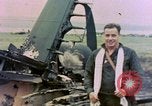
U.S. Navy fliers examine wreckage of FG-1D Corsair airplane, at the Omura airfield in Nagasaki, Japan, after World War II.
U.S. Navy flyers at the Omura Air Field in Nagasaki, Japan after the end of World War 2. They poke around the wreckage of a U.S. Navy Corsair(FG-1D Corsair BuNo.88056 flown by Lt.Col. D.K. Yost of MAG-51, US Navy, lost on 11 September, 1945.) They are accompanied by a Sergeant, carrying a long handle axe that he jokingly swings a couple of times at the fuselage of the Corsair. Camera shows numerous Japanese military airplanes parked randomly on the grass field.
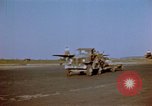
A ground crew loads bombs on a B-26 bomber of the USAAF 323rd Bombardment Group near the end of World War II in Europe.
Film opens showing armorers riding atop bombs being towed by an M6 Bomb Service Truck, at Denain-Prouvy Airdrome, France (A-83) in March, 1945. The truck drives slowly along the field, past parked Martin B-26 Marauder medium bombers of the 323rd Bombardment Group. One of the airmen plays a harmonica as he rides along. After a while the truck turns to a parked B-26, tail number 41-34942, where the armorers climb down and begin loading bombs on the aircraft.
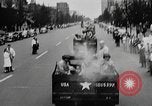
A motorcade of U.S. Generals in Philadelphia, Pennsylvania during World War 2
Returning Heroes Parade on June 4, 1945, in Philadelphia, Pennsylvania. Generals Carl Spaatz and Omar Bradley sit on either side of Pennsylvania Governor Edward Martin, in an open jeep. Spectators stand at road sides. Large number of school children waving American flags. A policeman on a motorbike with the American flag escorts the motorcade. . Spaatz and Bradley pose with Governor Martin and Philadelphia Mayor, Bernard Samuels, for photographs. The Generals and the officials march on a street. The Generals stand, with Governor Martin, in an open jeep. People standing on railroad platform.

Reinforcements for U.S. 35th Infantry Division are briefed. U.S. troops occupy Houffalize, Belgium during World War 2
The United States Army on the Western Front during World War II. A map depicts Allied offensives at Malmedy, Houffalize and Bastogne. New reinforcements for the 134th Infantry Regiment of the U.S. 35th Infantry Division are briefed by an officer near Bastogne, Belgium, on January 10, 1945. Aerial view of tanks and infantry of the U.S. 6th Armored Division moving across a snow-covered barren landscape as they attack German troops in Belgium West of the Luxembourg border. Officers observe through binoculars. U.S. patrols of 1st and 3rd United States Armies meet on January 16 as they capture Houffalize. View of bombed out buildings in Houffalize on January 18.. U.S. troops occupy Houfflaize. A damaged German Pz.III tank on a street and an overturned Panther tank with a hole in its underside in a river. The troops walk along bombed out buildings in Houffalize.
CRITICALPAST.COM: About Us | Contact Us | FAQs - How to Order | License Agreement | My Account | My Lightboxes | Shopping Cart | Advanced Search | Featured Collections | Website Terms & Conditions | Privacy Policy ©2026 CriticalPast LLC.
License Agreement |
Terms & Conditions |
Privacy Policy
©2026 CriticalPast LLC.