


 Francais
 Deutsch
 Italiano
Refine Your Search
Bruchsal Germany 1945 stock footage and images
- Showing 3685 to 3690 of 10471 results more
more Hide
Hide
Kalmyk people, Buddhist monks pray at Ingolstadt Displaced Persons Camp in West Germany.
600 displaced Kalmyk people living in Ingolstadt Displaced Persons (DP) Camp, West Germany. A German girl rides her bicycle in front of a former army barracks now housing Kalmyk refugees from the Soviet Union. Kalmyk people and pets in refugee camp. A Kalmyk man goes downstairs. A Kalmyk woman mopping floors of a corridor. A stone statue of Buddha. A man spins a Buddhist prayer wheel and smokes incense from an incense burner. A tapestry depicting Buddha on display. Kalmyk Buddhist monks praying. Buddhist monks offer a plate of grain and glass beads. A Kalmyk woman hang laundry in front of a Christian cross adorned with garlands. Kalmyk men drinking beer and smoking cigarettes. Kalmyk women sit on the grass while holding babies. A pet goat is seen with the women. A Kalmyk boy and a little girl looking pensive. Kalmyk children playing with ball in the refugee center. Men drinking in front of a makeshift barber with sign reads “Friseur”. Children climbing up stairs. Kalmyk children attend a language class in English, French, or Spanish.
Dr. Sandcha Stepanow ; Kalmyk refugees work as artist, barber, and teachers in Ingolstadt, Germany
A photographer takes pictures of Dr. Sandcha Stepanow, a Russian-born lawyer and leader of the 600 displaced Kalmyks in Ingolstadt Displaced Persons Camp, West Germany after World War II. Dr. Stepanow meets with journalists in the camp. A Kalmyk family inside their flat in the refugee camp. A woman uses a sewing machine. The man plays with a young toddler. A woman tries on a new dress as a dressmaker adjusts the dress sleeves. An elderly Kalmyk man holds an infant playing with keys. An artist draws a charcoal illustration of an elderly man in traditional Kalmyk attire. A Kalmyk woman applies shaving cream on a man’s face at a barber shop inside the Ingolstadt Displaced Persons Camp. A Kalmyk man walks through The Kreuztor gate in Ingolstadt on his way to work. A German man greets the Kalmyk man. Displaced refugees, including a young woman, study at vocational training school in Ingolstadt. Kalmyk professor teaches in class. The Kalmyk instructor assists a man during a lesson.
United States soldiers driving trucks on muddy road in Merode, Germany (WW2)
United States Army soldiers drive a 1/4-ton truck on muddy road in Merode, Germany during World War II. Wheels of 1/4-ton Army truck spinning and moving in the mud. A soldier follows the trucks in the forest road. A man stands on the running board of a moving medic Jeep “Skippy”. Soldiers push a Jeep stuck in muddy road. Wheels spinning while stuck in mud. Soldier fastens chains into Jeep’s front bumper. The vehicle slowly moves through the muddy forest road.
United States Army soldiers moving through muddy roads in Germany (WW2)
United States Army soldiers walking through flooded, muddy forest road in Merode, Germany following heavy rains during World War II. The American soldiers walk carefully through soft mud. Close-up views of legs and boots of U.S. Army soldiers walking in deep mud that completely covers boots. Soldiers’ feet lift out of the mud as they move. Soldiers and medic tie cables onto two trucks’ bumpers as they prepare to free a truck stuck in mud.
Propellers run on high speed during engine tests at a research facility in Stuttgart, Germany
German Aeronautical research facility in Stuttgart, Germany before World War 2. German technicians opening doors on top of aircraft engine test room. Propellers run on high speed during engine tests. A technician opens door. A large machine that runs engine tests. Technicians operating test consoles. A Tacho Waage speedometer measures engine test speed.
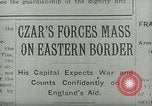
Russia, Germany and Romania mobilize for World War I.
Tsar Nicholas II of Russia mobilizes ten million men on the Eastern border during the early stages of World War 1. The Tsar inspects Russian troops and consults with his uncle the Grand Duke Nicholas. Russian troops and the military band march. German Kaiser Wilhelm II, and the king of Wurttenberg step from a car in Germany. Officers and civilians gathered around. The Kaiser reviews soldiers in Germany. The Crown Prince Wilhelm of Germany readies to command an army. Field Marshall August Von Mackensen, readies to fight the Romanian Army.
CRITICALPAST.COM: About Us | Contact Us | FAQs - How to Order | License Agreement | My Account | My Lightboxes | Shopping Cart | Advanced Search | Featured Collections | Website Terms & Conditions | Privacy Policy ©2026 CriticalPast LLC.
License Agreement |
Terms & Conditions |
Privacy Policy
©2026 CriticalPast LLC.