


 Francais
 Deutsch
 Italiano
Refine Your Search
Bruchsal Germany 1945 stock footage and images
- Showing 4519 to 4524 of 10471 results more
more Hide
Hide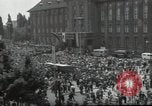
Official addresses a large crowd in West Berlin, Germany; Protestors are arrested
A large crowd assembled in a square. White banner with image of Berlin Bear on it, hangs from one side of building entrance and German tricolor hangs from the other. Crowd listens to speaker. Demonstrators unfurl a traditional civil flag of Berlin and move through the crowd. Police surround and arrest the demonstrators, placing them in police vans and taking them away.
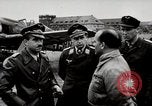
General Adolf Galland with fellow pilots and Fw 190 design team officials at air base in Berlin-Staaken, Germany.
German Ace pilot and General of the German Air force Adolf Galland also called General Der Jagdfleiger visits fellow pilots and Fw 190 design team officials at German AFB. Galland, Streib, and Trautloft are seen inspecting the latest Focke Wulf 190 developments as guests of the design team. Prof. Tank is seen with his assistant Obering. Also seen are Willi Kaether, chief test pilot Hans Sander, and test pilot Alfred Thomas who was later killed testing the Ta 152 H. General inspects telemetry documents of Focke Wulf Fw-190 fighter. Pilots demonstrate capabilities of Fw-190's. General enters inside Fw-190 and takes off. Clip shows another scene where General Galland is welcomed by German pilots and Air force officials at a function. Timing and location of the footage can be determined through review of flight test reports of the Ta 154 A-0, Werknummer 0014, TQ+XD glimpsed briefly in the footage and the Fw 190 V17/U1, an airframe that served as a Fw 190 D-9 prototype -- Galland made flights in both these aircraft on 2 June 1944 in Berlin-Staaken. The first aircraft seen in the footage is Fw 190 A-8, Werknummer 174 014, BH+RN. The camera pans to Galland pulling on his parachute pack in front of Fw 190 V17/U1, CF+OX -- the ‘O’ of the code can be made out, and reveals for the first time elements of the changes made to the airframe in modifying it into Fw 190 D-9 configuration. There then follows a short clip of the V17/U1 in the air. Galland´s flight appears in the flight testing log of the V17/U1. There are brief views of the Ta 154 in the clip showing the forward fuselage and the open canopy. Streib also flew the Ta 154 in Staaken.
President John F Kennedy gives a short speech in West Berlin, Germany.
Scenes of Clayallee Street and red carpet on platform being swept. President Kennedy arrives by police motorcycle escort and speaks after introduction by Major General James H. Polk, Commandant, Berlin. Others on platform include U.S. Aide Brigadier Gen Clifton, General Lucius D. Clay (Ret) and an unidentified Brigadier General.
U.S. President John F Kennedy at Clay Allee Street in West berlin, Germany.
Scenes of Berlin Wall and Vopo standing guard. President arrives at Clay Allee Street and addresses crowd. Expressions on the faces of the people. VIP's on speaker's stand including General Clay (Retd.), Major General Polk and other U.S. officials. President leaving with party.
U.S. Soldiers arrive at border of Berlin, Germany during Berlin Crisis between East Berlin and West Berlin.
Berlin Crisis troop standoff: United States soldiers arriving at border in vehicles. German people applauding. jeep with 106 mm recoilless rifle backs up. truck with United States soldiers turn and drives off. Military Police standing near M-48 tank. Soldiers in street. Soldier speaks into walkie talkie.
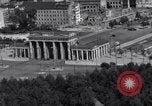
View of Brandenburg Gate in Berlin, Germany.
Aerial view of the Brandenburg Gate in Berlin. Panoramic view of city as seen from West Berlin. Scenes of buildings nearby, some reconstructed after World War 2, and others still in rubble and ruin after bombing during the war more than 15 years prior. The Quadriga sculpture on top of the Brandenburg Gate.
CRITICALPAST.COM: About Us | Contact Us | FAQs - How to Order | License Agreement | My Account | My Lightboxes | Shopping Cart | Advanced Search | Featured Collections | Website Terms & Conditions | Privacy Policy ©2026 CriticalPast LLC.
License Agreement |
Terms & Conditions |
Privacy Policy
©2026 CriticalPast LLC.