


 Francais
 Deutsch
 Italiano
Refine Your Search
Bruchsal Germany 1945 stock footage and images
- Showing 4771 to 4776 of 10471 results more
more Hide
Hide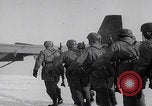
German soldiers loading ammunition trailers, motorcycles, and guns into Go-242 glider (WW2)
A group of 30 marching German soldiers enter the open fuselage of a Gotha Go-242 transport glider in Germany during World War II. Other soldiers push two hand-pushed ammunition trailers and one side-car motorcycle into the Go-242 aircraft parked on snow covered ground. View of the rear part of the Go-242 as its fuselage closes. Interior view of aircraft as all soldiers sitting on both sides of fuselage with motorcycle, ammunition trailers, and one anti-tank gun between them. In front can be seen the backs of the pilot and co-pilot of the Go-242. Rear view of Go-242 parked on snow-covered ground. The rear of fuselage is closed and through opening in the glass-covered rear, a soldier mans a heavy caliber machine gun. Machine guns protrude from two openings on each side of the fuselage and an opening on top of the fuselage is also seen. The Go-242 airborne over airfield after takeoff. Wheels and the undercarriage are seen dropping off from the Go-242 in flight.
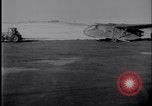
German Junkers Ju-52 transport aircraft towing a Go-242 taking off from a runway (WW2)
A small truck towing a Gotha Go-242 transport glider from right to left over snow-cleared runway in Germany during World War II. A Junkers Ju-52 transport aircraft towing Go-242 over a snow-cleared runway. Both aircraft take off and fly low past camera after a short run. The undercarriage drops off from the Go-242. Front view of Junkers Ju-52 transport aircraft towing Go-242 taking off from runway.
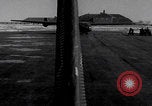
A Junkers Ju-52 transport aircraft towing a Go-242 during take-off and in flight (WW2)
German Junkers Ju-52 transport aircraft towing a Gotha Go-242 transport glider over a snow-cleared runway in Germany during World War II. Both take off as seen from camera placed in rear top turret of the Ju-52 towing the Go-242. Aerial, in-flight shots of the Go-242 glider taken from rear of the towing Ju-52. Interior shots of rear of the two pilots inside Go-242 glider cockpit. A Go-424 pilot demonstrates use or control wheel and movability of the pivoted instrument panel which can be swung from one side to other with pilot's foot. Go-242 releases toe line and continues to glide on its own power as seen from the rear camera of the Ju-52. View of gliding Go-242 from left to right. After a while three pair of spring skids are let out from-bottom of fuselage. Go-242 pilots as they pilot the glider. Two pilots at the nose section of the Go-242 glider. The nose section is half glass covered through which can be seen the two pilots. On top of nose is an opening through which a soldier climbs and shows a heavy caliber machine gun; another opening is on the right bottom side of nose where another opening is made for machine gun. One soldier demonstrating use of machine gun and a small rectangular opening just below pilot's seat where another soldier holds a light machine gun at the front section of Go-242 glider.
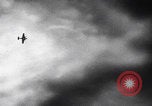
German pilot uses radio directional finding equipment aboard a Junkers Ju 52 aircraft
Shortly before World War 2: Animation showing an aircraft emitting radio waves towards German cities of Berlin and Leipzig. A man sits behind a radio directional finding network. A radio antenna receives signals. Animation showing radio directional finding networks in Berlin and Leipzig detects aircraft in Germany. A man’s hand plotting a map with a long ruler. Animation depicts German radio directional finding network detecting aircraft location. A Junkers Ju 52 transport aircraft in hangar. A second Ju 52 on ramp with tail being elevated in flight position on snow-covered airfield. Nose and engine of the Ju 52. Pilot using directional finding equipment onboard the Ju 52.
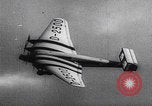
Junkers G.38 transport aircraft in flight; Fieseler Fi 156 in short takeoff; Focke-Wulf Fw 61 helicopter demonstration
A Junkers G.38 transport aircraft (D-2500) in flight over Germany in the late 1930s, before World War 2. A small, single-place, tailless monoplane with turned down wing tips in flight. A Fieseler Fi 156 Storch making short takeoff and steep climb over control tower of an airfield. The first functional helicopter, the Focke-Wulf Fw 61 helicopter (D-EKRA) (later Focke-Achgelis Fa 61), demonstrating its hovering ability.
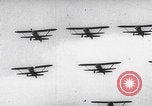
German Henschel Hs 123 and Dornier Do 23 bomber aircraft with Nazi Swastika empennage in flight
A large formation of Henschel Hs 123 dive bomber aircraft in flight. A formation of Dornier Do 23 medium bombers flying over Germany. Nazi Swastika on empennage of the bombers is seen. A low angle view of German Dornier Do 23 bombers and Junkers Ju 52 transport planes in flight overhead.
CRITICALPAST.COM: About Us | Contact Us | FAQs - How to Order | License Agreement | My Account | My Lightboxes | Shopping Cart | Advanced Search | Featured Collections | Website Terms & Conditions | Privacy Policy ©2026 CriticalPast LLC.
License Agreement |
Terms & Conditions |
Privacy Policy
©2026 CriticalPast LLC.