


 Francais
 Deutsch
 Italiano
Refine Your Search
Bruchsal Germany 1945 stock footage and images
- Showing 4963 to 4968 of 10471 results more
more Hide
Hide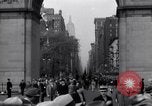
Large crowd in New York City marches to demonstrate against the barbarism of Adolf Hitler and Nazi Germany
Anti Nazi marchers parade down Fifth Avenue in New York City, demonstrating against German leader Adolf Hitler and Fascism, in a rally and protest organized by the American Jewish Congress. American flags carried. Empire State Building seen in background. Protestors demonstrate against Adolf Hitler.and the Nazis. Jewish war veterans of World War 1 are seen, some in World War I uniforms. They parade through Washington Square Park.
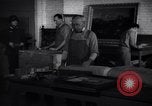
Dramatization: German guard supervises workers packing and shipping art from U.S. Museum of Modern Art in New York to Germany
Dramatization: Shipping room of the Museum of Modern Art in New York. U.S. workers packing up art. Several paintings and art subjects. German guard supervises. Man brings in box to be stenciled. It reads 'Brooklyn museum of Art.' Box stenciled with destination address 'ReichsMarschall Hermann W. Goring..."
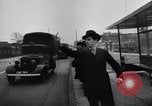
British night bombers attack Bremen,and Germany retaliates by bombing Coventry, in World War II
A British citizen is seen waving and giving the "V for Victory" sign to trucks passing by carrying British troops during World War 2. View of British fliers assembled on the tarmac in front of a Vickers Wellington twin engine bomber, as a string of trolleys carrying bombs moves along the ground near them. Closeup of the bombs on the trolleys. British RAF officers at telephones discussing a night's planned mission involving 10 aircraft. Glimpse of Vickers Wellington bombers and trolleys of bombs on an airfield. RAF officer and assistants (including 2 women) discussing targeting. Officer mentions photographs of submarine yards and they study them. Scene shifts to the targeting officer briefing air crews about their night's mission, to bomb the German submarine and ship building yards at Bremen. View of photographs. View of aircrew members in briefing room. Views of aircrew boarding their Welllington bomber; engine running; and pilot in cockpit. Other Wellington bombers cranking up. The bombers takeoff at dusk. Pilot in one checking with his rear gunner, and radio operator, while they are in flight. Two bombers silhouetted against sky while in flight. Crew member annotating navigation log. Scene shifts to German pilots on the ground, being scrambled to their Messerschitt Bf 109 aircraft. German searchlights scan the sky and soldiers run to man their 12.8 cm Flak 40 antiaircraft guns. Flashes from these guns are seen in the darkness. Some British Wellington bombers flying through clouds with Flak bursts around them. Pilot in a bomber tells his crew they are entering a glide. View of bomber in sharp decent. Antiaircraft batteries firing rapidly. Bombardier at station in a bomber. View of bomb in bomb bay. Bombardier presses button releasing several bombs. Explosions on the ground. Antiaircraft batteries firing furiously. Pilot in cockpit illuminated by flare of bombs and fires. Camera pans across burning buildings on the ground. Closeup of Adolf Hitler vowing revenge. Slate reads: "November 14th, 1940." Views of German bomber aircraft in night raid over Britain during Battle of Britain. Bombs bursting and antiaircraft fire during blitz. View of Coventry, England, in the dawn after the raids. Destroyed and severely damaged buildings, some still burning. Aerial views of some of the destruction. People walking past rubble. Camera captures image as remains of one building collapse. Skeletons of buildings silhouetted against the foggy sky. Survivors on the streets huddle at a bulletin board to read news posted there. Teams of firefighters and others trying to deal with the destruction and pulling victims from the rubble and carrying them for burial in a common grave. Survivors placing garlands of flowers on the graves.
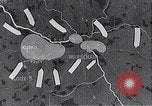
Abandoned war equipment and Polish prisoners of war during the Invasion of Poland by Germany in 1939
The German viewpoint of events during the Polish Campaign in Poland. A map of Poland shows Kutno and Warsaw. Abandoned war equipment and Polish prisoners of war. Damaged tanks and other war equipment in a water body.
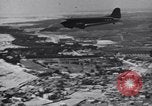
Leaders of U.S., Britain, and the Soviet Union meet in Teheran, Iran, to plan actions against Nazi Germany during World War II
Film begins showing a U.S. Army Air Forces C-47 transport plane in flight over the city of Cairo and Pyramids, in Egypt during World War 2. U.S. President Franklin D. Roosevelt's voice is heard speaking in his 1943 Christmas report to the Armed Forces. He states that following the Cairo Conference, he and Prime Minister Winston Churchill flew to Teheran, Iran. View of city of Teheran from an airplane overhead. View of front of the Soviet Embassy building there. Wider view showing conference principals on the porch with reporters and photographers below the steps. Next, a closer look with Soviet Marshal Stalin, President Roosevelt, and Prime Minister Churchill, seated on chairs, conversing. Closeup of the Big Three with their military commanders standing behind them. Views of ongoing Soviet operations on the Eastern Front. Russian troops firing field artillery from a snowy field. (A transport airplane is in the far background.) Shells bursting on snowy hillside. Soviet soldiers training in white arctic clothing rush through toward tanks and lie down in the snow. Three Soviet aircraft buzz a snow covered field. A huge explosion is seen and then Soviet cavalry charge across snow. View shifts to U.S. Army troops operating in Italy. A jeep filled with soldiers tows an artillery field piece across a shallow river. U.S. soldiers ride across a stream in a truck. Rear view of artillery piece being towed toward an italian town. Glimpses of aerial combat between Allied and German aircraft. General Dwight D. Eisenhower and General Mark Clark are seen riding in a jeep across a bridge in Italy. Glimpse of Italian people trying to clean up destroyed section of a town. Portrait of Benito Mussolini in the debris. General Eisenhower walking with a local British commanding officer and General Mark Clark, in Italy. Eisenhower and Clark at an outdoor briefing by British officers. Eisenhower pinning the Legion of Merit medal on U.S. Army Air Forces Lieutenant General Carl Spaatz, deputy commander of the Mediterranean Allied Air Forces who President Roosevelt says has been selected to be commander of Strategic Air Forces in Europe. Glimpse of B-24 Liberator bombers dropping bombs in Europe. Film shifts back to Teheran and the Big Three Leaders sitting in chairs. Closeups of them. Then their foreign secretaries step being them (Molotov, Hull, and Eden.) Nazi swastika flag. German armed forces marching on parade. German boys playing on artillery pieces under watchful eyes of German soldiers. Children at a playground. European farmers harvesting grain by hand. German troops in black parading. Glimpse of Adolf Hitler giving impassioned speech. Several views of Teheran conferees. President Roosevelt holding a ceremonial sword. Scenes of good will with hand shakes among conferees. Glimpses of British, Soviet, and Chinese troops attacking. Massed flags of the Allies.
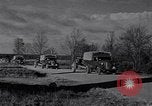
A hidden gun emplacement and Swedish troops fire with guns to forestall move by Nazi Germany in Sweden (WW2)
Swedish troops, guns and aircraft on alert to forestall Nazi German offensive move in Sweden. A truck tows a field gun and moves on a road. The barrel of an artillery piece visible as it is raised from a hidden gun emplacement. Swedish soldiers run between sandbags and take up positions. Swedish troops wearing M21 helmets fire a double-mounted Kulspruta m/36 water-cooled 8mm machine gun (a modified Browning design dual mounted). Next scene shows aerial view of biplanes: Swedish J8 Gloster Gladiator MK I bi-wing pursuit aircraft seen in formation. Brief closeup of a J8 in flight. Next, Swedish T3 aircraft seen in formation, flown by Swedish Wing F 17. These aircraft are Junkers Ju 86 K-13 aircraft built by SAAB, under license, and converted to torpedo bombers. Aerial views of the J8 biplanes conducting mock attacks on the formation of T-3 bombers, for training purposes. (World War II period).
CRITICALPAST.COM: About Us | Contact Us | FAQs - How to Order | License Agreement | My Account | My Lightboxes | Shopping Cart | Advanced Search | Featured Collections | Website Terms & Conditions | Privacy Policy ©2026 CriticalPast LLC.
License Agreement |
Terms & Conditions |
Privacy Policy
©2026 CriticalPast LLC.