


 Francais
 Deutsch
 Italiano
Refine Your Search
Budapest Hungary 1916 stock footage and images
- Showing 235 to 240 of 876 results more
more Hide
Hide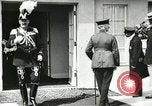
Kaiser Wilhelm II dedicates Germany's new Olympic Stadium on the 25th Anniversary of his Coronation
On June 8, 1913, the 25th anniversary of his coronation, Kaiser Wilhelm II presided over the inauguration of the new stadium (Deutsches Stadion) built near Berlin, to host the 1916 Olympics. These scenes were recorded immediately after the ceremonies. A German Admiral exits from a stadium building in Deutsches Stadion (Deutsches Stadion, Olympischer Platz 3, 14053 Berlin). Soon after, Kaiser Wilhelm II, exits, conversing with German Chancellor, Theobald von Bethmann-Hollweg. The Kaiser is attired in Hussar full dress uniform with fur busby. A German officer salutes and directs the Kaiser to athletes (German Olympic hopefuls) standing to the side, whom he introduces to the Kaiser. The Chancellor turns back into the building, and Empress Augusta Viktoria emerges and stands nearby, as the Kaiser speaks with the athletes and shakes hands with several of them. He chats amicably with the introducing officer, who smiles and salutes. The Kaiser then climbs into a waiting carriage in which the Empress is already seated. She holds a booklet or program in her hand. Attendants place a carriage robe over the Royal Couple and the carriage departs. Spectators watching the Royals are seen behind a railing at the Grunewald Racecourse track (part of the complex). The broad expanse of athletic grounds is behind them. Final scenes show many youths, walking along at the end of the ceremonies. in various uniforms (representing schools or clubs). some carry programs. some wear sashes on their outfits. Family groups are also seen. Stadium seats are seen briefly in the background to the left. A group of girls wearing dark skirts and white blouses with dark ties, are among the various small groups of youth walking together. (Note: The Deutsches Stadion was located in an area reserved as a Peoples' Park, by the Kaiser, in 1904. The property was leased for 30 years, in 1907, by the Union-Klub for the Grunewald Racecourse. But it also continued to serve general sports activities. The stadium was built on the racecourse grounds.)
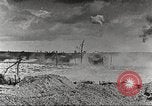
Extract from British feature film "The Somme," made in 1927, depicting warfare on the Western Front during WWI.
Reenactment of scenes from 1916 in World War 1, filmed in 1927 in Southwest England. Two British Mk V Tanks advance through shellfire. One has its gun mountings plated over and has dummy guns; the other has its gun mounts intact, though the guns might be dummies, and carries anti-grenade mesh on its roof. (These are by historical errors by the film makers, since this type of anti-grenade protection was not carried on Mark V [Mark 5] tanks, and the Mark V did not enter service until 1918.) The tank advances towards enemy trenches, followed by British soldiers who pursue German soldiers fleeing along the network of trenches. The tank, filmed from below, in the trench, as it moves over the trench. Note: (The film "The Somme" can be seen in full on the British Film Institute website.)
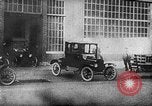
Scenes related to the Ford Motor company and the Ford Model T automobile in the United States.
Ford Model T cars being driven out the exit door of the Highland Park factory, Michigan,circa 1916. Numerous Model T cars driving on both sides of a divided highway. The Ford Highland Park Plant, circa 1920. Panoramic exterior views of the Ford River Rouge plant and factory buildings, circa 1930. A Ford Freighter ship, docked at the River Rouge plant. A view of the home of Henry and Clara Ford, at 66 Edison Road (now 140) Dearborn, Michigan, in 1914. Sketch of children coming home from school, singing song from McGuffey reader school book. View of schoolroom with McGuffey readers on desk. Narrator relates story of Henry Ford trying to buy a McGuffey reader and being unable to obtain one. Narrator states that Ford realizes from this incident "the changes that are reordering his culture. The modes of life which Henry so loved are passing, disappearing into history." Street scene outside Ford Plant, during shift change, and street filled with workers. A car driving on empty road in Sudbury, Massachusetts. The historic Wayside Inn (immortalized in Henry Wadsworth Longfellow's "Tales of the Wayside Inn") which Henry Ford purchased in 1923, to preserve for posterity. View of the original Pennsylvania Railroad Station in New York City, circa 1912. View of crowded sidewalks and street on 5th Avenue, and other street scenes in New York City, circa 1920. Model T Ford cars driving in U.S. National Parks. A visitor feeding a bear from his Ford car, as a U.S. National Park Ranger stands nearby. People in Ford Model T, stopped by side of road to pick wild flowers. Two men remove a seat back from their Model T car to make a camper. Both men lying down in the car. Man carrying picnic basket from Ford Model T, parked beside a beach, where he joins the rest of his party on the sand. Children run along the beach, and stop to play with seaweed.
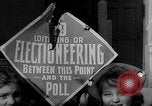
The 1944 U.S. Presidential election in World War II
On Election Day, November 7, 1944, in World War 2, Americans are seen waiting patiently to vote. They stand in a long line extending down a city sidewalk next to brick and stone buildings. Views of several persons in the line. Scene shifts in flashback to the election of Woodrow Wilson, in 1912. Four men on horseback arrive at a polling place. Another travels to vote, in his 1910 Ford Model T truck. Change of time and place shows farmer arriving by horse-drawn wagon and walking to polling place past 1930s car and truck. A fully laden truck stops at a rural gasoline station, temporarily serving as polling place. American town residential street scene in the 1930s. Citizens gathering to vote at a polling place set up at a laundry shop, in the Bronx Borough of New York City. Views of various places in the United States, serving as polling places. Americans seen waiting to vote at various places, in the 1944 national election. Among the sites shown is Bridgeport Central High School, built in 1916, (which later became Bridgeport City Hall), at 45 Lyon Terrace in Bridgeport, Connecticut. Persons in various places, registering to vote, including actor Lewis Stone, actress Esther Williams, and USO entertainer, Bob Hope. Voter closing curtain behind him as he votes in a voting booth. Views of voters' feet, below curtains, as they vote. Various types of boxes. Newspaper headline speaks of the large voter turnout in millions during the 1944 election. Shipyard workers at end of their shift, are seen heading to the polls to vote.
U.S. Army soldiers guard German SS-Totenkopfverbände (SS-TV) prisoners of war being held near a village.
United States Army soldiers guarding a group of German SS prisoners of war who are being held near a village. Cameraman slate indicates location of "Wittring" (presumably Wittring France, just outside the German border, in the Moselle region), but U.S. government record accompanying the film indicates "Wittring, (?) Germany" (sic). A wheel cart is seen on the street. The German prisoners of war have SS markings on their right lapel and also the SS skull insignia on the cap, identifying them most likely as part of the SS-Totenkopfverbände or SS-TV; also called Death's Head units. (Theories on these captured soldiers include: 1) SS-TV units were primarily in charge of administering the Nazi Concentration Camps in World War II. Hinzert Concentration Camp was possibly the closest camp to Wittring. Perhaps these soldiers came from it or another camp; 2) They may have been part of the 3rd SS Panzer Division. Reportedly, whole platoons and elements of the 3rd SS Panzer division were not following orders and were giving up prior to the Budapest and Vienna battles to avoid Soviet captivity, as early as Jan 1945). Prisoners rub their hands to warm them in the cold. Camera shows a close-up view of one of the prisoners, as an American soldier attaches a Prisoner of War identification tag over around the neck of the prisoner.
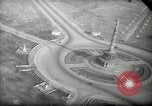
The ruined Reichstag and other buildings seen in aerial views of Berlin, Germany.
Aerial view of Berlin two years after World War 2. Aerial view of the Siegessäule (Großer Stern, 10557 Berlin, Germany) and the Großer Stern in the Großer Tiergarten. View of the ruins of the Kaiser Wilhelm Memorial Church (Kaiser-Wilhelm-Gedächtniskirche Breitscheidplatz, 10789 Berlin, Germany) and the Budapester Strasse in the Tiergarten district of Berlin. Aerial view of the Potsdamer Platz, the Reich Chancellery (Reichskanzlei Wilhelmstraße 77 Berlin, Germany), and the Reichstag building (Platz der Republik 1, 11011 Berlin, Germany), showing further damage caused by bombing. Aerial view of bomb damaged Zoo Flak G-tower bunker at Tiergarten. Aerial view of Mitte district, showing the Ministry of Aviation building (now known as the Detlev-Rohwedder-Haus Wilhelmstraße 97, 10117 Berlin, Germany).