


 Francais
 Deutsch
 Italiano
Refine Your Search
Chalons-en-Champagne France 1921 stock footage and images
- Showing 31 to 36 of 5759 results more
more Hide
Hide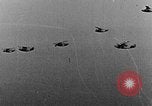
German Battleship Ostfriesland is sunk by U.S. Army Air Corps bombers during test
A medium bomb (probably dropped by a U.S. Navy aircraft) is seen hitting the German Battleship Ostfriesland on July 20, 1921 in the Atlantic Ocean off the coast of Cape Hatteras, North Carolina, United States. A formation of U.S. Navy Curtiss F5L flying boats is seen in the air. The following day, July 21, 1921, 2000 lb. bomb is seen exploding near the Ostfriesland. The bomb is dropped by an airplane from an Air Corps unit commanded by Army Brigadier General Billy Mitchell (neither seen). Several other 2000 lb. bombs explode on and near the Ostfriesland, causing it to roll over and sink.

FFI soldiers examine German strong point and look at propaganda pictures in Paris, France during World War II.
Liberation of Paris during World War II. FFI (French Forces of the Interior) soldiers examine German strong point as they look through a field glass. Soldiers examine a table laden with sauerkraut and champagne left by the Germans. Soldiers look over captured German propaganda photographs. Men and women on street. Cars parked on street. FFI men unload crates from a truck. Commander of a German garrison comes out of a building.

Seamstresses make holiday costumes and Italian artisans display papier-mâché figures during carnival celebrations in Europe.
People prepare costumes for pre-Lenten carnival celebrations in Europe. Seamstresses sewing and preparing costumes for carnival in Vienna, Austria. A woman tries out a tulle carnival dress. A hairdresser fixes the hair of a woman. A woman puts on a conical hat. A matron wears an elegant sequined dress with a fan made of peacock feathers. Men and women in costumes dancing. A man opens a bottle of champagne. Men and women in costumes and masks toast with their champagne glasses. Italian artisans display papier-mâché figures and floats during a carnival parade in the seaside town of Viareggio, Italy. A papier-mâché effigy head moves mechanically. Giant papier-mâché effigies are featured in the carnival. A papier-mâché effigy of a king with a long nose. Grotesque effigies on top of floats.
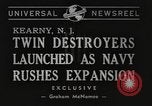
USS Edison and ISS Ericsson being launched in Kearny, New Jersey.
Launching of United States Navy destroyers in Kearny, New Jersey. A man hands over a bottle of champagne to the widow of Thomas Alva Edison who breaks it against the bow of USS Edison. The ship takes to water. Crew members on the deck of the ship. A woman breaks a bottle of champagne against the bow of USS Ericsson as the ship is launched.
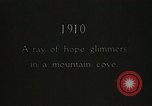
Rural water mill and the rise of Kenneth Killinger as a preacher in the southern Appalachians
Depicts life near the southern Appalachian region of Marion, Virginia in Smyth County, and specifically the path of Kenneth G. Killinger from being a mill operator to becoming a mountain missionary of the Lutheran Synod of Virginia. Man carries sack of corn to a water powered mill. Sign "Corn Ground." Young man actor portraying Kenneth G. Killinger weighs the corn with a simple scale and then pours it into the stone grinder. He gives the ground corn to the customer, along with a booklet that reads, "The Augsburg Sunday School Teacher, 1910." Close view of the contents page of the booklet. The young man standing at the edge of the mill, water wheel turning beside him. Scenes portraying two memories from his youth: A woman taking a paddle to a boy as punishment. Next scene is a group of teenage and younger boys gathered together and taking drinks of moonshine whiskey alcohol from a bottle. They cringe from the taste and pass the bottle around. Scene of men digging a grave in a graveyard beside a rural church. Killinger reenters the mill. Scene of young Killinger sitting on the porch of a rural home, reading to young children. Killinger counseling a bed-ridden elderly woman. On screen text reads, "Kenneith G. Killinger. 'The Mountain Missionary' of The Lutheran Synod of Virginia. Marion, Virginia. July 24, 1921." View of Killinger in 1921, preaching to congregation sitting under a tree. The congregation entering a small makeshift church building. The congregation entering an abandoned rail car turned into their church. The congregation later in a larger church building. Killinger preaching. Rural children singing from hymnals. Churchgoers exiting the church.
Army Air Service bombing and other practice operational activities during the 1920s in the United States
Several Keystone LB-5s (triple tails) and LB-5As (double tails) move across an airfield, circa 1928. Test bombing of captured German battleship, Ostfriesland, in 1921. Smoke arises due to bombing. A formation of four Martin NBS-1 bombers over the former USS Alabama (BB-8), in the Chesapeake Bay, on September 23, 1921. A white phosphorus bomb explodes atop the ship raising a huge white cloud. One of the Martin bombers flies low over the water drops a smoke curtain. (World War II period).
CRITICALPAST.COM: About Us | Contact Us | FAQs - How to Order | License Agreement | My Account | My Lightboxes | Shopping Cart | Advanced Search | Featured Collections | Website Terms & Conditions | Privacy Policy ©2026 CriticalPast LLC.
License Agreement |
Terms & Conditions |
Privacy Policy
©2026 CriticalPast LLC.