


 Francais
 Deutsch
 Italiano
Refine Your Search
Chalons-en-Champagne France 1921 stock footage and images
- Showing 5587 to 5592 of 5759 results more
more Hide
Hide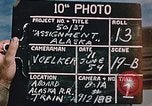
Railroad train underway beside Susitna River in Alaska.
View from window of railroad car as a train runs alongside the Susitna River in Alaska. ('Probably south of Curry en route to Wasilla and Anchorage.)
U.S. orientation film for Allied occupation forces, to provide background for understanding Japanese and their society
Background information for United States occupation forces in Japan after end of World War II. At start, the film shows sky filled with U.S. Navy airplanes flying in formations. They include Vought F4U Corsair aircraft, among others, and are seen overhead above the Battleship USS Missouri (BBB-63). Closeup of the USS Missouri with her crew in formation on deck wearing dress whites. Next, General Douglas MacArthur is seen and heard speaking from a podium on the Missouri's deck. He invites the representatives of the Emperor of Japan, and the Japanese Government, and the Japanese Imperial headquarters, to sign the instrument of surrender. The date is September 2, 1945, just after the end of World War 2. Closeups of the Japanese delegation, which includes envoys Foreign Minister Mamora Shigemitsu and General Yoshijiro Umezu, and of MacArthur. Japanese Foreign Minister Mamora Shigemitsu sits at a table. Closeups of him signing the surrender document. Change of scene to Japan, where camera pans over many thousands of Japanese people assembled to learn of their fate. Closeups of Japanese soldiers and family members, as Narrator asks how should the U.S. occupying force treat them. View of soldiers in plain non-military uniforms. Views of Japanese responding en masse to a leader, during World War 2. Views of child victims of the war. Closeup of Japanese soldier firing a short barrel light machine gun. Views of Japanese pedestrians including families, most in western dress. Japanese workers in an office. Film shows artists view of one worker's brain, and then many brains, as Narrator refers to need for reorienting Japanese thinking. View of learned wise Japanese leader at a podium. View of a Japanese soldier posed with his sword above the head of a war prisoner. Japanese mother feeding her baby. Closeups of Japanese babies. Closeups of Japanese school age children, in a group, and some doing things in school, and some at a playground. Group of uniformed Japanese students studying the art of Japanese calligraphy. Students doing artwork, studying nature outdoors, and paying attention to a teacher using a black board to explain how to calculate volumes of different shaped vessels. Students in classes of Geography and of geology. Japanese chemists, architects, and lawyers at work. Telephone switchboard operators at work. Electrified train moving on a track.
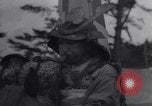
U.S. Army film showing history of Japanese militarism from the days of the Samurai to the 20th Century
Segment of U.S. film orientation film to help Allied Occupation Forces to understand background of Japanese traditions and rise of militarism prior to World War 2. Film begins showing a Japanese man dressed as a Trumpeter (kai yaku) in an army of the Feudal Period, blowing a conch shell horn. Japanese reenact Feudal period ceremonial exercises using pikes. Closeup of the way the pikes interlock as they wield them. Next young Japanese men are seen practicing Bōjutsu (the martial art of using a staff weapon called bō). A large formation of Japanese men practice in unison. A Japanese man dressed as a traditional Samurai warrior of history. Reenactment of Samurai engaged in war showing mounted Samurai warriors and foot soldiers carrying pikes. Image of the sun with Japanese sun flag gradually superimposed upon it. Slate intervenes reading: "The Sun Goddess Created the Japanese to Rule All the Other People of the Earth." Japanese people assembled near large building and tents in a park-like setting. A Japanese military officer addressing a large gathering. Japanese politicians, dressed formally, address a large gathering that includes many military officers. A crowd of Japanese people responding to a speaker by raising their arms in unison, several times. Japanese men in formation, bowing. Japanese women in formation, bowing. Large gatherings of Japanese people bowing en masse. Another politician addressing a gathering in an outdoor arena. Glimpse of Japanese school children being addressed by officials. A room full of banking officers being addressed by an official and farmers also being addressed. Young people and others marching in close order drills. A cadre of Japanese uniformed soldiers marching. A contingent of Japanese army troops marching with shouldered rifles displaying bayonets. More soldiers marching with high stepping gait. Film ends showing Japanese soldiers marching through Tori Gates at various places in Japan.
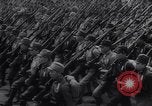
Orientation film for U.S. Occupational Forces in Japan. Militaristic Japan in past wars. Converting Japan into Peaceful Nation
Segment of orientation film for American troops occupying Japan after World War 2. First scene shows Japanese troops marching shouldering rifles with fixed bayonets. Viewed from more distance they are seen marching past the Japanese Imperial Palace on a hill in the background. Slate is superimposed over the scene reading: "Created to Rule the Whole Earth." Japanese soldiers rising from trenches to charge their enemy. Shells bursting all around them. Views of some huge explosions. Dead Chinese woman and child lying in rubble. Japanese soldier holding Rising Sun flag, charging past building. More dead women and children. Japanese troops advancing against wooden houses. Dead soldier lying on ground, with pistol held in his upraised hand. Japanese troops advancing past burning rural dwellings. Dead Chinese civilians in wreckage. Japanese troops holding Japanese flags celebrate a battlefield victory. Views of wounded Allied soldiers being transported on litters by American soldiers, interwoven with views of Japanese troops celebrating. Japanese civilians celebrating en masse. View of a human brain superimposed over scenes of celebrating Japanese soldiers and people. A slate superimposed at this point reading: "This is Japan's Last War." Views of Japanese workers busy in war production plants and factories, with Japanese war production workers building armament, war planes, and tanks; Japanese military officers walking in full dress uniforms ; Japanese warships; and Mitsubishi Ki-21 bombers in formation ("Type 97 Heavy Bombers") . All these views of war machinery are symbolically ended by intervening views of explosions. View of crashed Japanese warplane. Several American soldiers are seen among many Japanese people. Several American soldiers check identification of a Japanese man. U.S. soldiers standing guard in a roadway, as many Japanese stand in background. American soldier searching an unarmed Japanese soldier. Two American soldiers use a phrase book as they ask directions from a Japanese woman and her daughter. Japanese youth clapping hands and holding a homemade American flag. U.S. military officers accepting Chrysanthemum flowers from girls in traditional Japanese attire. A U.S. soldier reads a comic book to a Japanese boy. Other American GIs talk with a Japanese soldier. American troops in a chow line at a dining hall. U.S. soldiers with Japanese children at the Great Buddha of Kamakura at the Kotoku-in Temple in Kamakura, Kanagawa Prefecture, Japan. American soldier riding a bucking bronco in a Western Rodeo put on by U.S. forces. U.S. soldier and Japanese police sentries standing side by side.
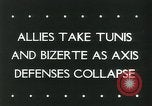
British Eighth and U.S. Army advance in to Tunisia defeating German and Italian Armies in North Africa during World War II.
British Eighth Army advances in to Tunisia defeating German and Italian Armies in North Africa during World War II. General Montgomery briefs British soldiers near sea coast. Tanks and trucks advance into Tunisia on a road with wrecked German machine gun post near road. General Eisenhower and General Montgomery during a meeting. Highland fighter troops on victory march on roads of a town in Tunisia. A British warship in sea and an anti aircraft gun alert on a post on Mediterranean Sea shore. United States Army advances in trucks and fights German resistance in a battle. Graves of German soldiers nearside roads. U.S. and British soldiers meet from two ends on April 7, 1943. Soldiers meet and shake hands with warmth. U.S. and British bombers on a mission to Nazi posts. Aerial views of B-25 bombers and B-26 bomber aircraft en route to targets. German antiaircraft guns fires at Allied bomber aircraft. Posts destroyed by series of bomb explosion. Surrendered Italian and German soldiers in large numbers. Injured Nazi soldier treated by Allied medics. Views of General Eisenhower, Field Marshal Montgomery, and Field Marshal Alexander. A French General is also shown (possibly General Georges Barré).
German JU-87 Stuka dive bombers attack Westerplatte in Gdansk, Poland, during World War II
A formation of German JU-87 Stuka dive bomber aircraft en route to attack Polish forces at Westerplatte peninsula in Gdansk, Poland, during World War 2 invasion of Poland. Alternating scenes of the Stukas in flight and views of the ground as they approach Westerplatte. View from inside a Stuka as it commences dive over the target. Smoke rising from exploding bombs on the ground. Sequence shifts to several JU-87s landing at their home field. German soldiers stripped to the waist lift bombs and carry them to the aircraft. Several more Stukas landing. Then a Stuka is seen flying over the field, with no landing gear visible. (Some Stukas were fitted with explosive charges to jettison the gear in emergency.) The pilot makes a successful belly landing, although the aircraft sustains considerable damage. German fliers gather around the JU-87 and examine it and converse. (It appears that the aircraft may have suffered some battle damage, as well.) Fliers look over photographs of their next target, while armorers move a heavy bomb to an aircraft with the aid of a dolley lift. Groups of ground crew carry smaller bombs. Several men together lift a bomb under a wing. An aircraft is refueled, and hand cranked to start, and takes off. A Stuka in flight, and view from the rear seat, of the pilot and his cockpit bomb sight. Slow motion view from aircraft as it dives toward a rail marshaling yard and pulls out upon release of its bomb. It flies through smoke from exploding bombs. View as it begins to strafe a column of Polish military vehicles at low altitude.
CRITICALPAST.COM: About Us | Contact Us | FAQs - How to Order | License Agreement | My Account | My Lightboxes | Shopping Cart | Advanced Search | Featured Collections | Website Terms & Conditions | Privacy Policy ©2026 CriticalPast LLC.
License Agreement |
Terms & Conditions |
Privacy Policy
©2026 CriticalPast LLC.