


 Francais
 Deutsch
 Italiano
Refine Your Search
China 1963 stock footage and images
- Showing 787 to 792 of 1923 results more
more Hide
Hide
Progressive aggression leading to the take over of Tibet and fleeing of the Dalai Lama.
Progressive aggression leading to the take over of Tibet and fleeing of the Dalai Lama to India in exile. Men raise the People's Republic of China flag on a mountain as armies of Communist China conquer Tibet. 1950: The Dalai Lama and Panchem Lama are brought to Peking in China. They are received by Chinese officials, presented with bouquets. A function at their arrival. 1955: African and Asian delegates at the Bandung Conference in Indonesia. China agrees to the 5 principles of peaceful co-existence. Delegates including Chinese Premier Zhou Enlai and Indian Prime Minister Pandit Jawahar Lal Nehru. 1956: The Dalai Lama and Panchem Lama are permitted to visit India to celebrate the 2500th birth anniversary of Lord Buddha. They are greeted by Pandit Nehru, Premier U Nu of Burma and other Indian officials an arrival. The Lamas with Indian officials seated for a meal on the ground in a hall. The Lamas are welcomed in a ceremony and Dalai Lama addresses the gathering. Tibet: China begins to impose Communist system on Tibetan borders. Construction work and forced labor. March 1959: Communist bombardment over Lhasa. The Potala monastery. Tibetans take up alms. Handcuffs and confinements. Demonstrations and protests outside the Chinese Embassy in Delhi. Former Prime Minister Of Tibet, Lukhangwa and other monks pay their respects at Mahatma Gandhi's samadhi (mausoleum) in New Delhi. Indian government officials and members of the international press reach Tezpur in Assam. They welcome the Dalai Lama. Photographers take pictures. The Dalai Lama addresses a gathering. Statues of Lord Buddha all over India and Asia. Tibetan monks pray. People sing Indian devotional song.
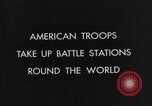
As the United States enters World War II, U.S. military forces are seen, deployed in various places throughout the world.
American troops are seen in arctic gear moving on skis through blustery snowy weather in Iceland, during World War 2. They were sent in 1941 to relieve British troops occupying Iceland since 1940, during World War II. A guard post at the American camp, with Quonset Hut in background. Closeup of U.S. sentry in arctic gear holding rifle with bayonet affixed. View from above, of numerous tents partially covered with snow in the American camp. Change of scene shows U.S. troops disembarking from transport ships at the British Isles. They march with their combat gear onto a square where Army trucks wait to transport them inland. Another scene shows the American troops, viewed from behind, parading in London. Other scenes show them marching in various areas of London. Saint Paul’s cathedral is seen in the background of one scene. A large number of American M3 Stuart Light tanks move on a railroad train in Britain. Scene shifts to the Middle East, where railroad cars and various military supplies for Russia are be offloaded from American ships. A Russian officer is seen signing receipts for war materiel, from a U.S. Army Technical Sergeant. A row of American Army trucks are lined up behind them. The Russian and American exchange salutes, and shake hands. Next, a troop ship carrying American troops is seen arriving at a port in India, where they disembark with their gear. An American Army Sergeant in a pith helmet pays attention to a little Indian girl. Scene shifts to China, in 1942, where Brigadier General Claire Lee Chennault, Commander of the China Air Task Force, of the Tenth Air Force, that replaced the American Volunteer Group (Flying Tigers), is seen with Brigadier General Caleb V. Haynes, Commander of the India Air Task Force. A colonel joins their discussions. A Consolidated B-24 Liberator bomber is parked behind them. View of Curtiss P-40 Warhawk fighter planes, with Flying Tiger markings, parked on a flight line. A B-24 bomber landing on a runway, between hills, deep in China. Closeup of Nationalist China Generalissimo Chiang Kai-Shek, saluting. Huge numbers of Chinese troops assembling in a formation. Next, an expeditionary force of American troops is seen arriving on a troop ship in Australia. They line the ship’s deck and wave. General Douglas MacArthur arriving in Australia to assume the office of Supreme Commander, South West Pacific Area (SWPA). .Glimpses of U.S. Navy activities in Australia: setting up defenses of islands; unpacking a Kingfisher float plane and making it ready for use on a desert island. The final segments of the film show American forces in August ,1942 sailing to Adak in the Aleutian Islands, to strengthen American defenses there. Troops seen descending by rope ladder from the American transport ship USS J Franklin Bell (PA-34), into her landing craft for deployment on Adak Island. Scenes of landing craft reaching the beach and offloading troops, vehicles, and supplies. View of beach filled with supplies. One landing craft is clearly marked with ""P34" showing that it belongs to the USS J Franklin Bell ( later reclassified as APA-16).
Wounded Chinese soldiers treated and presented with gifts in Taipei, Taiwan after defecting.
Aircraft in flight over sea. Convoy of ships underway on their way to Taipei, Republic of China (Taiwan) from Incheon, Korea. Liberated Chinese prisoners (originally from People's Republic of China) are preparing to start new lives in Taiwan (Republic of China) having decided to defect from mainland China, becoming "anti-Communist Heroes." The soldiers sing and play music aboard ship. Freed Chinese prisoners repatriated to Taiwan after their release from Korean prison camps in the Korean War. A Chinese prisoner playing an erhu fiddle. United States Navy warships escort the ship of Chinese Prisoners. Crowd and officials lined up at Taipei Songshan Airport (No. 340-9, DunHua N Rd, Songshan District, Taipei City, Taiwan 10548) awaiting the arrival of wounded soldiers from war. Large crowds hold bouquets, signs, and banners. Plane lands on the runway and taxis. Crowd waves flags. Man directs plane. Large crowd cheers. A crowd surrounds ambulance moving ahead. Wounded Chinese soldiers are carried on stretchers to ambulance. They receive bouquets from the crowd. Soldiers disembark from the plane. Nurses serve drinks and food to soldiers. Members of Chinese Civil and Government organizations enter hospital in outskirts of Taipei. Wounded soldiers on bed. Members of Overseas Chinese National Salvation Association and Overseas Chinese students present gifts and greetings to wounded soldiers. Another group of soldiers in a nearby hospital receive gifts. A soldier speaks at mike and makes a symbolic representation of blood-stained flag. Men with signs and flags in hospital. Aircraft in flight over Keelung, northeast of Taipei. Chinese prisoners return on ship from Incheon, South Korea. Troops disembark from ships. The crowd lined up with flags and signs at the dock. Band plays music. Ship enters Keelung harbor. Chinese prisoners aboard ship. Large crowd cheers.
U.S. Army Air Forces employ air power in the India-Burma theater during World War II. Chinese troops are equipped and trained by U.S. soldiers.
Camera pans across scenes showing masses of Chinese. Narrator cites their large population as a war asset. Lt Gen. Daniel Sultan Commander of US Forces, India–Burma Theater (USFIBT) describes the Allied mission as simply "placing guns in the hands of men in order that they can kill our common enemy." He describes Japan's 1942 strategy of completely isolating China from outside help. Animated map shows Japanese forces attacking China from bases in Thailand and advancing north, driving British forces into India, and leaving Burma in Japanese hands.Glimpse of Japanese troops occupying Burma. Views of American troops evacuated to India. View of Chinese soldiers boarding U.S. Air Transport Command C-46 transport planes for flights from Kunming to Dinjan and Chabua, India. Closeup of some troops inside the cabin of a plane. Chinese soldiers await transport as a C-47 aircraft takes off in the background. Aerial view of two C-47 planes in formation. View from the air of high cloud covered mountains. Storm clouds over the mountains. Downward view from an aircraft flying over the Himalayan Mountains (called flying the "hump" by U.S. pilots). View of Chinese soldiers inside a transport plane. View out the window of a transport plane landing in India. A C-46 airplane taking off. A large formation of Chinese troops seen after more were brought from China to India, later in the war. American soldiers training troops of the Chinese 38th and 22nd Divisions. General Sultan speaks of the need to build up the U.S.Air Transport Command. Two C-47 airplanes on the ground. One named "The Joker." View of sky filled with B-24 Liberator bombers. Sky filled with C-47 transport planes. Chinese soldiers training in Kunming, climbing out of trench in live fire exercise with machine guns firing over their heads and explosive charges detonating near them. Air frame of a P-47 aircraft being loaded and several of Bell P-39 Airacobra aircraft being loaded aboard ship bound to strengthen the U.S. Army 10th and 14th Air Forces in Burma, in 1944. Covered P-47 aircraft without engines being towed by jeeps along a street in Burma. A large airfield with many U.S. fighter planes parked on its ramps. Engines being installed on P-39 aircraft. A flight line filled with P-40 aircraft displaying Chinese roundels. Some fly over a flight line of U.S. Army Air Forces P-39 aircraft. Glimpse of a fighter plane escorting a transport aircraft. A formation of B-24 Liberator bombers dropping bombs and exploding on Japanese ground targets. Workers are seen unloading large amounts of cargo from a B-24 bomber. Workers rolling a large bomb from the plane onto the tailgate of a truck.
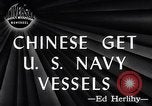
Newsreel titled 'Chinese Get U.S. Navy Vessel' depicts naval commanders and sailors on a ship in San Diego, California.
Newsreel titled 'Chinese Get U.S. Navy Vessel' depicting Lend-lease arrangements between the U.S. and China. Two destroyer-escorts and six smaller warships leave for China. Chinese sailor raises a flag on the deck of one of the ships. Chinese and U.S. Navy commanders shake hands. Chinese commander inspects the Chinese sailors. U.S. Navy sailors talk and exchange tips, tricks, and games with Chinese sailors. U.S. sailor unravels a poster of a partially nude woman as a gift for the Chinese sailors. Ship sails for China.
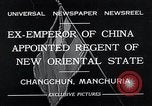
Henry Pu Yi newly appointed Regent of Manchuria at his palace in Changchun in Manchuria
A film titled “Ex-Emperor of China appointed Regent of New Oriental state” shows carriages passing by a road as soldiers stand on both side of it in Changchun in Manchuria (Manchukuo). Newly appointed Regent (Chief Executive) and former Qing Dynasty Emperor of China, Henry Puyi, along with new Prime Minister Chang Hsiao-hsu in the Imperial Palace, now the Museum of the Imperial Palace of Manchukuo (No.5 Guangfu North Road, Kuancheng District, Changchun 130052 China).