


 Francais
 Deutsch
 Italiano
Refine Your Search
Colombey-les-Belles France 1918 stock footage and images
- Showing 91 to 96 of 6520 results more
more Hide
Hide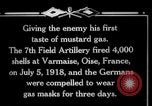
Combat in World War I. U.S. Army 7th Field Artillery troops firing mustard gas shells. American soldiers fighting while under gas attack.
American gunners of the 7th Field Artllery fire mustard gas shells from a French 75 field piece in a sandbagged revetment at Varmaise in Oise, France, on July 5, 1918. As they rapid fire, traces of mustard gas emerge from their gun, so they all don their personal gas masks, and continue firing the gas shells. Change of scene shows American troops at a trench in a field, donning gas masks when warned of a German gas attack. With gas masks in place, they commence firing a trench mortar. A string of explosions is seen in the distance, presumably from a number of mortars firing. Scene shifts, again, to troops wearing gas masks, firing their Springfield rifles, from their trench. It appears that they are following a reported World War I practice of loading their magazines to capacity with a 5-round stripper clip, and then firing only single rounds, with the magazine cutoff in "off," to save the reserve for emergencies.
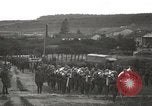
A U.S. band leading a funeral ceremony and clergy leading burial ceremony following Battle of Saint-Mihiel in World War 1.
U.S. soldiers near St. Mihiel, France during World War I. A band of American soldiers leads a funeral procession. A caisson moves across a field towards a graveyard. Houses in the background. Newly dug graves in the graveyard. Closeup view of cross at the grave of Major Harry A. Harvey of the 103rd Field Artillery, who died on September 12, 1918. Clergy and soldiers seen during the funeral ceremony for Major Harry Aloysius Harvey and other soldiers killed in the Battle of St Mihiel.

U.S. soldiers decontaminate combat vehicles and tanks during training; also flashback WW1 mustard gas aftermath scenes
World War 2 training film teaching U.S. soldiers about decontamination of combat vehicles, at Aberdeen Proving Grounds in Maryland. Soldiers during a decontamination procedure with real mustard gas. The soldiers in armored vehicles. A group of soldiers prepares for the decontamination. An aircraft flying at low height. A stationary U.S. Army Pershing tank. Two soldiers in a jeep. Soldiers wearing gas masks decontaminate a vehicle. Flashback scenes to August 1918 in World War I in France, with many mustard gas attack victims being cared for at a field hospital (which narrator says is Field Hospital number 326). Medic washing eyes and face of a World War 1 gas attack victim. Next view is a soldier in 1942 with mustard gas burns on his hand, being treated by a medic. Next scene returns to World War 1 in 1918, showing mustard gas burns on arms, hands, legs, and feet of U.S. Army soldiers.
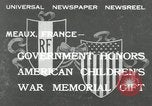
U.S. presents monumental statue, commemorating Battle of the Marne, to people of France.
The scene is on a hill top overlooking the plateau along the Marne River where the Battle of the Marne took place 18 years earlier. The occasion is the presentation, from the people of the United States, of a 130 foot high granite monument, commemorating the heroic defense by French troops in the Battle of the Marne. The monument, designed by Frederick MacMonnies, depicts La Belle France, supporting a wounded French infantryman, and was reportedly underwritten in part, by the contributions of pennies, nickles, and dimes from four million school children in the United States. French and American officials unveil the monument. Numerous spectators stand by to cheer and applaud. Armed soldiers hold national flags and salute in honor. U.S. Ambassador to France, Walter Evans Edge, gives presentation speech, as other dignitaries and people listen. (Note: At the time of this event, this was the largest carved granite monolith monument in the world, and viewed, by many Americans, as a gift of thanks to France for the statue of Liberty.)
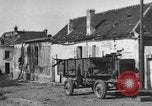
U.S. 111th Infantry troops returning to Coulonges, France. French officers at headquarters of French 3rd Army Corps in World War I
The Aisne-Marne Operation in France during World War 1. U.S. 111th Infantry returns to Coulonges. A damaged truck parked near a dwelling in the village. Five American soldiers walk past it, followed by a small dog. Two American soldiers talking to the driver of a field ambulance parked by a severely-damaged church, where about 20 other soldiers are relaxing in the church yard. Damaged trees still stand near the church. Camera focuses on the damage to the church which has section of its bell tower destroyed. Its clock is stopped just a minute after 6 O'Clock. Gravestones are seen in churchyard. Soldiers are seen standing near pews inside the church, looking at its interior. Roof beams have fallen and rubble is piled outside. A chandelier still hangs from the center of an archway. Soldiers clamber over the rubble at the rear of the church. A lone soldier walking along a rubble-filled street near damaged buildings. Change of scene shows field ambulances parked amongst trees lining a grand boulevard. An American soldier cranks the nearest one to start it and climbs aboard. Two soldiers (one with binoculars) standing by damaged buildings, looking over the scene. Complete change of scene to the Chateau Chenye, headquarters of French 3rd Army Corps, apparently unscathed. French officers rush to greet another senior officer who steps from an automobile at the chateau. A gathering of French officers posing on steps of the chateau. (Several American officers are also present.) Closeup of General L. Lebrun, Commander of the French 3rd Army corps.
French and 3rd army troops enter Strasbourg and advance in the Metz area, France (WW2)
French and United States Army 3rd Army troops liberate Strasbourg, France during World War II. Tanks of the French 1st Army moves from the Swiss border. Sign reads “Mülhausen Elsaß” (“Mulhouse, Alsace”). Troops find the body of a dead German soldier along the road. They advance in the Metz area. The 9th army advances through villages in bordering Germany. Soldiers walk on the battlefield. German prisoners of war (POWs) walk along with the soldiers. Civilians holding the French flag return to their homes after the battle. Strasbourg sign in German reads “Straßburg Schiltigheim”. Bell tower of the Cathedral of Notre Dame in Strasbourg, France. Damaged buildings near the Cathedral. The street is littered with pile of handheld, small Nazi flags with swastika emblem. Men gather outside buildings discussing amongst themselves. U.S. Third Army soldiers walk in the mud. Winter weather overshoes are distributed to troops. Soldiers put on the all-weather boots. More German soldiers and officers are captured in Metz. United States Ninth Army troops enter the town of Weisweiler, Germany. Soldiers moving through backyards, chicken houses and engage in house-to-house fighting. A mortar crew fire mortars behind trench made of sandbags. A wounded U.S. Army soldier crawls to reach the outstretched arm of a fellow soldier. Injured U.S. soldier receiving treatment in aid station. Medical aid stations at various places on the battlefield. Medics treat a wounded soldier. A dying soldier lies down on the street. Soldiers carry a patient to top of a tank. They march forward on the battlefield as officers in Jeep watch.
CRITICALPAST.COM: About Us | Contact Us | FAQs - How to Order | License Agreement | My Account | My Lightboxes | Shopping Cart | Advanced Search | Featured Collections | Website Terms & Conditions | Privacy Policy ©2026 CriticalPast LLC.
License Agreement |
Terms & Conditions |
Privacy Policy
©2026 CriticalPast LLC.