


 Francais
 Deutsch
 Italiano

Refine Your Search
Colombey-les-Belles France 1918 stock footage and images
- Showing 97 to 102 of 6533 results more
 Hide
Color Sound
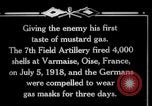
Combat in World War I. U.S. Army 7th Field Artillery troops firing mustard gas shells. American soldiers fighting while under gas attack.
American gunners of the 7th Field Artllery fire mustard gas shells from a French 75 field piece in a sandbagged revetment at Varmaise in Oise, France, on July 5, 1918. As they rapid fire, traces of mustard gas emerge from their gun, so they all don their personal gas masks, and continue firing the gas shells. Change of scene shows American troops at a trench in a field, donning gas masks when warned of a German gas attack. With gas masks in place, they commence firing a trench mortar. A string of explosions is seen in the distance, presumably from a number of mortars firing. Scene shifts, again, to troops wearing gas masks, firing their Springfield rifles, from their trench. It appears that they are following a reported World War I practice of loading their magazines to capacity with a 5-round stripper clip, and then firing only single rounds, with the magazine cutoff in "off," to save the reserve for emergencies.
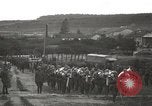
A U.S. band leading a funeral ceremony and clergy leading burial ceremony following Battle of Saint-Mihiel in World War 1.
U.S. soldiers near St. Mihiel, France during World War I. A band of American soldiers leads a funeral procession. A caisson moves across a field towards a graveyard. Houses in the background. Newly dug graves in the graveyard. Closeup view of cross at the grave of Major Harry A. Harvey of the 103rd Field Artillery, who died on September 12, 1918. Clergy and soldiers seen during the funeral ceremony for Major Harry Aloysius Harvey and other soldiers killed in the Battle of St Mihiel.
Contribution of African American soldiers during the Spanish American War and World War I.
A film about the role of African American soldiers during various wars in the United States. A dramatization shows a black soldier during the Spanish American War. He also talks about his role in Cuba and the construction of the Panama Canal. Footage of the Panama Canal being constructed and ships underway in the canal. United States Army forces including black soldiers boarding troop transport ships bound for Europe during World War 1. A railroad train carries African American soldiers to France during World War I. African American soldier units under General Pershing march in formation with an Army band in France during World War 1. African American soldiers work and fight against the Germans, including the 813th Pioneer Regiment near Marseilles, the 332nd Labor Battalion, and the 808th Pioneer Regiment near Verdun. African American soldiers racing for front lines including the soldiers with the 8th Illinois and the 372nd regiment and the 371st, and the 369th Infantry Regiment (sometimes called the "Harlem Hellfighters") in the Argonne. View from behind soldier as he fires a machine gun, and United States Army infantry firing artillery. African American soldiers of the 369th regiment "Harlem Hellfighters" being decorated and receiving the French Croix de Guerre for their heroic actions in World War I. The African American soldiers march at a parade in New York City following World War I and are greeted by throngs of enthusiastic African American civilians attending the parade. View of Henry Johnson being congratulated by civilians after he and Needham Roberts performed with exceptional heroism and received the Croix de Guerre. Close up view of the Croix de Guerre medal on a uniform. Graves of African American soldiers who lost their lives during World War I at Arlington National Cemetery in Virginia. View of the All-Wars Memorial to Colored Soldiers and Sailors in Logan Square in Philadelphia (Logan Square, SE corner 20th Street & Benjamin Franklin Parkway, Philadelphia, Pennsylvania). View of a stone memorial erected in the Meuse-Argonne region, north of Sechault, as a tribute to the efforts of the African American soldiers of the 371st Infantry Regiment who fought and died there on April 21, 1918 during World War 1.
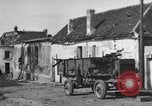
U.S. 111th Infantry troops returning to Coulonges, France. French officers at headquarters of French 3rd Army Corps in World War I
The Aisne-Marne Operation in France during World War 1. U.S. 111th Infantry returns to Coulonges. A damaged truck parked near a dwelling in the village. Five American soldiers walk past it, followed by a small dog. Two American soldiers talking to the driver of a field ambulance parked by a severely-damaged church, where about 20 other soldiers are relaxing in the church yard. Damaged trees still stand near the church. Camera focuses on the damage to the church which has section of its bell tower destroyed. Its clock is stopped just a minute after 6 O'Clock. Gravestones are seen in churchyard. Soldiers are seen standing near pews inside the church, looking at its interior. Roof beams have fallen and rubble is piled outside. A chandelier still hangs from the center of an archway. Soldiers clamber over the rubble at the rear of the church. A lone soldier walking along a rubble-filled street near damaged buildings. Change of scene shows field ambulances parked amongst trees lining a grand boulevard. An American soldier cranks the nearest one to start it and climbs aboard. Two soldiers (one with binoculars) standing by damaged buildings, looking over the scene. Complete change of scene to the Chateau Chenye, headquarters of French 3rd Army Corps, apparently unscathed. French officers rush to greet another senior officer who steps from an automobile at the chateau. A gathering of French officers posing on steps of the chateau. (Several American officers are also present.) Closeup of General L. Lebrun, Commander of the French 3rd Army corps.
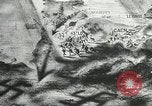
U.S.troops advance to Saint Lo in operation Cobra. U.S. 3rd Army advancing rapidly into Rennes, France, in World War II
Map showing path of Allied advance after D-day invasion in World War 2. German Marshal Rommel with staff. German artillery and armor firing. American heavy artillery, armor, and infantry advancing toward St. Lo in operation Cobra. Lieutenant General Omar Bradley, Lieutenant General Lesley James McNair, and Major General J. Lawton Collins, walking near the battle front. U.S. Army Air forces B-26 bombers dropping bombs at the front lines.(General McNair was killed by friendly bombers on July 25th in these operations.) U.S. infantry entering Saint Lo. House to house fighting and German soldiers taken prisoner.U.S.Sherman tanks firing point blank at houses and buildings.Large number of German prisoners being marched under guard with their hands over their heads. A wounded Allied officer being helped into a vehicle. Women and children refugees walking and in horse drawn wagons.French woman sorts through rubble trying to salvage some belongings. African American tank crewmen of the 761st Tank Battalion, operating with the U.S. 3rd Army, seen relaxing against a stone wall; cleaning their tank guns; and driving their Sherman tanks at high speed along dirt roads.General George Patton, Commander of the 3rd Army, looking through binoculars. French civilians waving enthusiastically as American armor drives through their villages. American forces arriving in Rennes, France, greeted by huge crowds and church bells ringing.

A fighter attack on B-17s flying in formation in France.
Outtakes from the film "Memphis Belle" shot in France. An aerial view of a B-17 plane in flight. B-17 number-4 engine on fire. A fighter attack on B-17s. Tracers fire at the same. B-17s flying in formation. Vapor trails left behind by the B-17s. (World War II period).
CRITICALPAST.COM: About Us | Contact Us | FAQs - How to Order | License Agreement | My Account | My Lightboxes | Shopping Cart | Advanced Search | Featured Collections | Website Terms & Conditions | Privacy Policy ©2026 CriticalPast LLC.
License Agreement |
Terms & Conditions |
Privacy Policy
©2026 CriticalPast LLC.