


 Francais
 Deutsch
 Italiano
Refine Your Search
Colombey-les-Belles France 1918 stock footage and images
- Showing 4681 to 4686 of 6521 results more
more Hide
Hide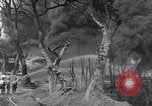
British soldiers fight fire at a bombed oil supply depot near their base in England, during World War II.
United States soldiers at a base camp in England, prior to D-Day invasion in Normandy, France during World War II. Immense smoke rises off a bombed oil supply depot. British soldiers use chemical foam apparatus to fight fire at the oil depot. Flames come out of a building on fire.
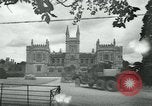
Military vehicles and supplies from the United States arrive in United Kingdom warehouses and bases (WW2)
Trucks arrive at Toddington Manor (Toddington, Cheltenham GL54 5DN, United Kingdom) in Gloucestershire, England. British children playing jump rope as vehicles transport tanks on the road. Rows of aircraft are transported by vehicles into town. The preparations for the D-Day invasion of France by Allied Forces, during World War II. A crane moves boxes. Boxes move in conveyer belts. Sacks, boxes, and crates stored at a distribution point. A man drives a forklift transporting boxes inside a warehouse. Military supplies arriving in Britain from the United States. Piles of tires, barbed wires, concrete tubes stored in docks and warehouses. Cranes move oil barrels into a pile. Military locomotives and freight cars bound for continental Europe at a railway yard. Soldiers open a crate containing a United States Army truck. A crane lowers a tank. A man inspects a row of military trucks. Rows of M3 half-track armored personnel carriers and M4 Tractors in England. A man helps a tank back up. Rows of tanks, artillery, and guns from the United States. Men stocking shells inside an underground storage. Piles of shells outdoors. A truck transports shell. Rows of fighters at an airfield. A man moves a search light at night. Anti-aircraft guns fire at German night bombers attempting to attack bases in the United Kingdom. Barrage balloons fly above warships. A sailor drops an anti-ship mine in the sea. Minesweepers seek and destroy such mines from the sea. Consolidated PBY-5A attacks a German ship.
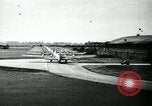
British and American aircraft and paratroopers attacking German positions in later years of World War II.
US Army Air Force and British Royal Air Force bombers attacking German cities and German production centers in France during World War 2. Allied bomber aircraft take off for mission on German strategic positions. B-17 bombers and P-38 Lightning aircraft taking off and aerial views of them flying in formation. Gunner in plane firing at German Luftwaffe fighter aircraft attacking the formation. A B-17 bomber explodes in air during combat. Bombers drop bombs on oil refineries, munition factories and strategic positions. Ground view of Allied Infantry soldiers marching in Europe. Allied paratroopers dropped from planes. Many views of paratroopers jumping and landing. Mustangs fighter planes flown by Poles with their insignia, bombers with Free French symbol flown by French pilots, and B-25 Mitchell and B-26 Marauder bomber aircraft in action during World War 2. Avro Lancaster bomber aircraft also seen. Gun camera footage from low level bombing flights against enemy German positions in World War 2. Dogfights with German fighter airplanes and Allied guided bombs dropped on munition factories, military and air bases of Germany.
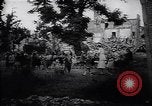
Soviet Union backs out of 4-power administration of Berlin and blockades the City. U.S. Army Air Forces supply the city by airlift.
Teacher and school children playing amid rubble in Berlin, in the aftermath of World War II. Children receiving food outdoors. Children in a school classroom being given cups of soup by their teacher. In March, 1948, a Soviet soldier is seen lowering their flag from one of four flag poles displaying it, along with flags of the British, American, and French flags. (They no longer wished to share occupation of Berlin with the other Allied powers.) View of Western representatives preparing to issue a new stable currency. Next, the Soviets block all access to West Berlin (the "Berlin Blockade.") Open rail cars filled with coal are brought to a halt in their tracks. Trucks servicing West Berlin are stopped from moving over a highway. West Berlin citizens stand at a fence watching a U.S. Army Air Forces C-47 transport plane flying supplies to them. View from below of a C-54 transport plane descending to land, with supplies, at Templehof airfield in West Berlin. A C-54 taking off to make another supply run. A pallet of coal being offloaded from a C-54. A tram running on restricted schedule. A Berliner planting food in a deserted lot near a demolished building. People assembled in front of the severely damaged Bundestag and in other places surrounded by war torn buildings. Berlin Mayor Ernst Reuter, speaks of seeking assistance from America, England, France, and Italy, to help his city. Closeups of some of the Berliners applauding him. An airlift airplane labeled "Operation Santa Claus" with a soldier dressed like Santa, dispensing wrapped gifts or candy to German children near the plane's doorway. German children can be seen and heard singing "deck the Halls" in English. A soldier dressed as St. Nicholas stands next to one dressed as a Native American Indian. Children sing Martin Luther's hymn, "Ein feste Burg ist unser Gott" ("A Mighty Fortress Is Our God"). A British Sunderland flying boat, takes off on the Havel River, in Berlin, after delivering supplies to the city. Grateful Berliners surrounding American pilots. Children run in a street carrying a large model of an airplane to simulate the Berlin airlift. Children playing "airlift" on a sidewalk. An airlift plane crashed and burning in a residential section of Berlin. German fire fighters battle the flames with hoses. A C-54 airlift plane descending to land with its gear extended. Scene at midnight, May 2, 1949, as the barriers isolating Berlin are raised, as the Soviets promised free and improved access to Berlin. People waving flowers as trucks once again move into the city. But Communists are seen violently storming the Greater Berlin City Hall in the Eastern Sector of the city. Non-Communist deputies in the Eastern Sector are forced to meet in West Berlin, where they meet without being molested. View of the Berlin Logo (Bear). Free election vote being deposited in a ballot box. Animated map shows how Berlin was cut in two, separating East Berlin from West Berlin.
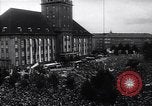
Berlin Crisis: The Western Powers respond to threats from the Soviet Union
Opening scene shows the Rathaus Schöneberg (John-F.-Kennedy-Platz, 10825 Berlin, Germany) where Mayor of Berlin Willy Brandt addresses a large crowd of West Berlin citizens, concerned about the building of the Berlin Wall by the Soviet Union. Many carry placards and signs, including some in English, reading: "We trust Kennedy, Pay any price, Bear any burden, for survival of Liberty" and "Millions behind the Iron Curtain ask for help." Scene shifts to a limousine driving into the center of a crowd. United States Vice President Lyndon B. Johnson steps from the car, accompanied by General Lucius D. Clay, who is seen next, with arm raised, acknowledging the crowd, while standing with Johnson and Brandt, at a podium cluttered with microphones. (Narrator refers to him as "Father of the Airlift.") The next day, British and American soldiers are seen driving in jeeps and trucks and M59 Armored Personnel Carriers, through cheering crowds, as they arrive to reinforce their Berlin garrisons. Closeup of cheering Berliners, waving handkerchiefs. Change of scene shows animated map of Europe illustrating the Westward expansion and growth of Soviet Communist occupation through World War II and the postwar era, concluding with East Berlin, in 1962. The threat to other Nations and regions is also illustrated. Legislators are seen in session in the plenary chamber of the German Bundestag in Bonn. Chancellor Konrad Adenauer is addressing the assembly. He states that Germany does not stand alone in the world. In France, Prime Minister Georges Pompidou addresses the National Assembly, regarding the Berlin Wall. In London, Prime Minister Harold Macmillan addresses Parliament. In the United States, on September 25, 1961, President John F. Kennedy, is addressing the UN General Assembly, in New York, about the dangerous crisis in Berlin. Scenes of the Berlin wall and Checkpoint Charlie. Memorials to persons killed attempting to escape East Berlin, are seen along the wall.
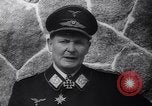
Hermann Goering, Chief of the German Air Force, gives a speech in tribute to the Luftwaffe (Air force)
Chief of the German Air Force (Luftwaffe), Hermann Goering, extols the capabilities and contributions of the Luftwaffe to German conquests, mentioning Poland, and France. As he speaks, a German Henschel Hs 126 observation plane is shown, followed by shots of a Messerschmitt Me-109 and formations of them flying amongst clouds, A German antiaircraft emplacement on a parapet high above a river. A lone German sentry patroling a beach and a flight of Me-109s flying low over his head. View from nose of a German bomber flying low over water. German Dornier Do-17 bombers penetrating a coastline. Pilots and gunner in bombers. Formation of Heinkel He-111 bombers in flight. Animation shows British mainland from perspective of a dive bomber heading toward the ground. Sequence finishes with explosion. Throughout the last half of the clip, a male chorus is heard singing the Luftwaffe's unofficial anthem, "Bomben auf Engelland," (Bombs on England) by Norbert Schultze (Norbert Arnold Wilhelm Richard Schultze).
CRITICALPAST.COM: About Us | Contact Us | FAQs - How to Order | License Agreement | My Account | My Lightboxes | Shopping Cart | Advanced Search | Featured Collections | Website Terms & Conditions | Privacy Policy ©2026 CriticalPast LLC.
License Agreement |
Terms & Conditions |
Privacy Policy
©2026 CriticalPast LLC.