


 Francais
 Deutsch
 Italiano
Refine Your Search
Colombey-les-Belles France 1918 stock footage and images
- Showing 4687 to 4692 of 6521 results more
more Hide
Hide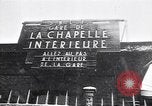
Workers sign petitions outside French Railway. Sir Bernard Law Montgomery visits a monumental cannon in Moscow, Soviet Union
Workers stand outside the French National Railway Company in France.It is snowing. They sign petitions. French policeman stands guard . In the Soviet Union, Sir Bernard Montgomery is accompanied by Russian officers while stopping to view a monumental cannon in Moscow.
American military trucks and tanks pass through an English city
United States B-17 bombers fly in formations in England. American military trucks and tanks pass through an English city with soldiers atop it. British civilians including a woman and young boy watch the procession of tanks headed for mobilization harbors in England, for the D-Day invasion of France in World War II.
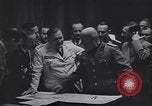
German troops planning and launching May 1940 attacks across Luxembourg, Belgium, and Holland; Rotterdam blitz scenes (WW2)
Hermann Goering, Benito Mussolini, Adolf Hitler and others as Italy joins Germany in declaring war against Britain and France June 10, 1940 (World War II). Animated map illustrates possible Axis war plans. Aerial view of Maginot line. Fire burning from German bombing in Scandinavia. Windmill turning in Holland. Map outlines Allied strategy for defense. Views of the Ardennes Forest. French Generals examining map. British Field Marshal John Vereker (Viscount Gort) studying map with two Generals. Narrator states they dismissed German attack through the Ardennes. May 9, 1940 - News headline reports German troops on move. Netherlands and French recruit troops mobilizing. French army soldiers standing at train station platform and loading into passenger railroad trains. Exterior of the Basilique du Sacre-Coeur (Basilica of the Sacred Heart) at Montmartre, Paris. People lighting candles. Statue of Madonna and Child. Views of several churches. A Catholic Bishop blessing people. People kneeling in prayer. Hitler and other Nazi leaders, including Heinrich Himmler, Goebbels, Bormann, Hess, and Rohm, haranguing crowds. Hermann Goering leading crowd in salutes. Ludwig Muller, Reichsbischof, Hitler supporter. Many views of Germans shouting Sieg Heil. German troops moving out on May 10, 1940. Hermann Goering, chief of Luftwaffe, in uniform. German pilots run to airplanes. Ju-87 Stukas take off. D0-17 bombers take off. German tanks, motorcycle troops, armor and infantry cross borders of Luxembourg, Belgium, and Holland. Map depicts action. German forces destroy obstacles at border crossings and move past windmill in Holland.He-111 bombers in flight. German paratroops jump from Ju-52 transport over Rotterdam. They capture key facilities. Troops riding on tanks. Dutch General Henri Gerard Winkelman walks with German officer over Maas-bridges in Rotterdam. He and delegation enter building at Rijsoord to sign surrender on May 15, 1940. German bombers destroy Rotterdam. View of German bomber bomb bay doors open and bombs away toward targets. The city in flames, with sound. Remains of the city. Numerous dead civilians.
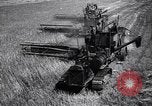
Farmers in Ukraine save crops from invading German forces in World War II Civilians prepare fortifications and defenses
Three Soviet harvesting machines in formation cut wheat in Ukraine before arrival of invading German forces during Operation Barbarossa, in World War 2. Several varying closeups of the harvesting operations and the farmers as they work. Tractor pulls a harvesting machine. Closeup of farmer teaching his wife how to operate the machinery. View of her at the wheel. People (mostly women and children) gleaning grain from the fields after the machinery has finished. Soviet soldiers carrying long handled scythes walk past the wing of an aircraft parked in a field, to join those in the harvesting. A windmill is seen in the far background. Civilians and soldiers work together with hand held tools to cut wheat. Closeup of woman twisting stalks to form a rope to bind the wheat sheaves. Views of soldiers carrying sheaves of wheat. People gathered around and atop a threshing machine. Workers,using pitch forks, toss wheat sheaves up to the threshers, who push them into the threshing machine. A tractor pulls a many wagons filled with flour, from a mill. Complete change of scene shows civilians hard at work building fortifications. Several ensuing scenes show civilians sandbagging and strengthening fortifications in other Allied countries, such as France, Czechoslovakia, Poland, Norway, Holland, Belgium, Spain, and China. Soviet men with shovels digging deep antitank defenses. Many hundreds of Soviet women at work with shovels building defenses along a hillside. A cadre of Soviet women, in uniform, march under command of a military officer, at a square in Moscow. Some appear to be carrying rolled up stretchers or litters over their shoulders, reflecting their role as nurses or medics. Red Cross nurses train for an emergency. One practices bandaging the arm of another. Several Red Cross nurses line up in a formation to march
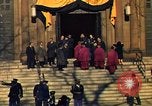
Funeral cortege of President John F. Kennedy on its way to Saint Matthew's Cathedral.
Four Bishops in scarlet-robes walk up steps and enter Saint Matthew’s Cathedral (1725 Rhode Island Ave NW, Washington, DC 20036, United States) before the funeral requiem mass for President John F. Kennedy. They are followed by military and civilian dignitaries. Funeral procession led by the Marine Band marching. Caisson arrives and stops in front of the church. View of riderless horse. Combined Honor Guard line up the steps. Crowds in background. Widow and former First Lady Jacqueline Kennedy and members of the family arrive at the church. The Kennedy family is followed by foreign dignitaries led by President Charles de Gaulle of France and Emperor Haile Selassie of Ethiopia. Jacqueline Kennedy walking up church steps with children Caroline and John Jr. is embraced by Cardinal Richard Cushing. Dignitaries entering the church. Joint Chiefs of Staff and military aides standing at bottom of church steps saluting as pallbearers remove casket from caisson. Priest blesses casket which is then carried into church. Crowd waiting outside church.
Early helicopter by American Leinweber brothers, and one made by Frenchman M. Douheret
Slate refers to Leinweber brothers helicopter in Chicago. View of their helicopter being moved out of a hangar in 1922. Closeup of helicopter controls being demonstrated. Next, a helicopter of M. Douheret, of France, is shown in 1919. Men stand nearby and watch its rotors turn in the breeze. Engine cylinders are clearly visible. Pilot sits in the machine and adjusts controls. Next he stands and starts engine. Suddenly, the running helicopter tips over and he runs for safety but returns to shut the engine down. In a second attempt, the pilot is again seen standing next to the machine, with its engine running. And, again, he must run to safety, as it tips over. This time it stops running by itself, and other men help him tip it back upright.
CRITICALPAST.COM: About Us | Contact Us | FAQs - How to Order | License Agreement | My Account | My Lightboxes | Shopping Cart | Advanced Search | Featured Collections | Website Terms & Conditions | Privacy Policy ©2026 CriticalPast LLC.
License Agreement |
Terms & Conditions |
Privacy Policy
©2026 CriticalPast LLC.