


 Francais
 Deutsch
 Italiano
Refine Your Search
Colombey-les-Belles France 1918 stock footage and images
- Showing 487 to 492 of 6520 results more
more Hide
Hide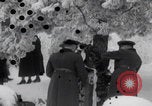
Tsar Boris III and King Alexander I pay their respects in front of a war memorial and meet in Belgrade
State visit of Bulgarian Tsar Boris III in Belgrade, Yugoslavia. King Alexander I (Aleksandar I) of Yugoslavia meets Tsar Boris III of Bulgaria. Tsar Boris III and King Alexander I and other officials walk in the snow together. The two monarchs salute in front of a monument and lay a wreath at the base of the memorial. (Based on text descriptions, this is possibly the original, smaller memorial to the Unknown Serbian Soldier, which was later replaced by the Monument to the Unknown Hero that was built atop the demolished Žrnov and completed in 1934. The original memorial, near Žrnov at the Avala mountain, was completed in June 1922. It reportedly had a plaque that read, "To the fallen heroes in the wars for liberation and unification 1912-1918, this monument is erected by the thankful people of the Vračar District. Consecrated on 1 June 1922." Another inscription read: "Unknown Serbian soldier confirmed by the commission on 29 November 1921". The text descriptions of the form and size of the 1922 memorial appear to match the memorial seen in this footage.) Honor guard of Yugoslavian soldiers depart the snow covered memorial area carrying a flag bearing the greater coast of arms of Yugoslavia. In next scene, Tsaritsa Giovanna of Italy, wife of Tsar Boris III, and Queen Maria of Yugoslavia leaving the royal residence in Belgrade. Final scenes show a car arriving in front of the royal residence and officers emerge. Another car arrives and women emerge to enter the residence. A brief frame or two of the film around timecode 02:29 shows four young children posing for the camera. The one on the far left, in the wide brim hat, is possibly Peter II Karađorđević, later King Peter II of Yugoslavia. Final scenes show the officials royalty emerging from the residence again and posing on the front steps.
Mules plow a field, cotton picking and shipping activities in the Mississippi river of the United States
The activities around the Mississippi River in the United States. Mules with slip shovels used to construct the levee embankment. Mules plow a field. Men work on the farm field. View of the plow. Men picking cotton from field. Smoke comes out of the smoke stack of a steamboat. A steamboat named "Assiniboine" in the river. Men load the steamboat with sacks. View of a bell. Men roll the sacks of cotton into the steamboat. View of Steamboat "Tennessee Belle" being loaded also. Steamboats in the Mississippi river. People aboard the steamboats, including the Chris Greene, the Tennessee Belle, and the Ouachita, which later became the Greene Lines's barge Stogie White.

Soviet film illustrating readiness to cope with possible air attack in rural village during World War II
A man pulls on a rope to ring a bell alerting a rural Soviet village of impending air attack during World War 2. Villagers begin running to shelters. Two biplanes, with fixed gear and inline engines, fly at tree top altitude over the area. A villager pulling on a rope at another bell alerting the populace. More views of villagers running to shelters. Several aircraft seen overhead. At least one appears to be equipped with skis. Another man sounding a bell alarm. Some men mount horses and ride them out of the village. Farmers in a field round up livestock and drive them away from pastures into nearby woods. Parachutists are seen descending from overhead. Village men on horseback are issued rifles as they pass by a wagon where a man is handing them out. They ride into woods nearby and then take up defensive positions with their weapons. As the parachutists land and spill their chutes, the armed villagers move closer to them. Next, men on horseback ride victoriously into their village and another group of men and women also parade into the village.
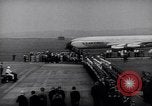
United States President Dwight Eisenhower's visit to Germany
In September, 1959, United States President Dwight Eisenhower arrives in Berlin, aboard a Boeing VC-137B aircraft (Air Force One). He is greeted by German President Konrad Adenauer. An honor guard of German soldiers salute him. President Eisenhower speaks at the airport and then stands in an open car with motorcade through streets of Berlin. Germans hold up a banner reading: "70 000 000 Germans rely on you." A replica of the American Liberty Bell rings, in the Town Hall of Schöneberg, Germany, as two children watch from below, and one holds her ears. A woman is interviewed, by an American soldier, for the Forces radio Network, about the meaning of the freedom bell to her. Huge crowd gathered in a stadium to celebrate "Berlin Bleibt Frei" (Berlin remains free). Elements of the U.S. Seventh Army on parade. A young German boy stops on a cobblestone street to look and listen to the Freedom Bell ringing from the Town Hall in Schöneberg. He runs and catches up with his mother.
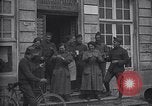
Salvation Army members make and distribute donuts, soft drinks and candies in France during World War I.
Salvation Army prepares and distributes food to soldiers in France, during World War 1.. Men and women stand at stairs of Salvation Army Hall. Women make donuts in the kitchen at Vacquerie-le-Boucq in France. One woman rolls the dough, other cuts shapes with a cutter and another one stands besides them with a dish in her hand. A backed dishes and donuts displayed on table while a soldier sits on table and eats donuts stuck into his fingers. Women distribute donuts to American soldiers and allied soldiers from a window of Salvation Army center. Soldiers stand in queue. Soldiers distribute soft drinks and candy to troops at Nouart and Varennes in France. (World War I; World War 1; WWI; WW1)
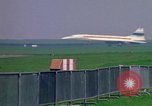
Aerospatiale-BAC Concorde takes off at 1971 Paris Air show, Le Bourget Airport, Paris, France
Paris Air Show. Supersonic Aerospatiale-BAC (British Aircraft Corporation) Concorde takes off. Buildings in the background.
CRITICALPAST.COM: About Us | Contact Us | FAQs - How to Order | License Agreement | My Account | My Lightboxes | Shopping Cart | Advanced Search | Featured Collections | Website Terms & Conditions | Privacy Policy ©2026 CriticalPast LLC.
License Agreement |
Terms & Conditions |
Privacy Policy
©2026 CriticalPast LLC.